


EDITORIAL CARTOON
China’s supreme objective in a war across the Taiwan Strait is to incorporate Taiwan as a province of the People’s Republic. It follows, therefore, that international recognition of Taiwan’s de jure independence is a consummation that China’s leaders devoutly wish to avoid. By the same token, an American strategy to deny China that objective would complicate Beijing’s calculus and deter large-scale hostilities. For decades, China has cautioned “independence means war.” The opposite is also true: “war means independence.” A comprehensive strategy of denial would guarantee an outcome of de jure independence for Taiwan in the event of Chinese invasion or
A recent Taipei Times editorial (“A targeted bilingual policy,” March 12, page 8) questioned how the Ministry of Education can justify spending NT$151 million (US$4.74 million) when the spotlighted achievements are English speech competitions and campus tours. It is a fair question, but it focuses on the wrong issue. The problem is not last year’s outcomes failing to meet the bilingual education vision; the issue is that the ministry has abandoned the program that originally justified such a large expenditure. In the early years of Bilingual 2030, the ministry’s K-12 Administration promoted the Bilingual Instruction in Select Domains Program (部分領域課程雙語教學實施計畫).
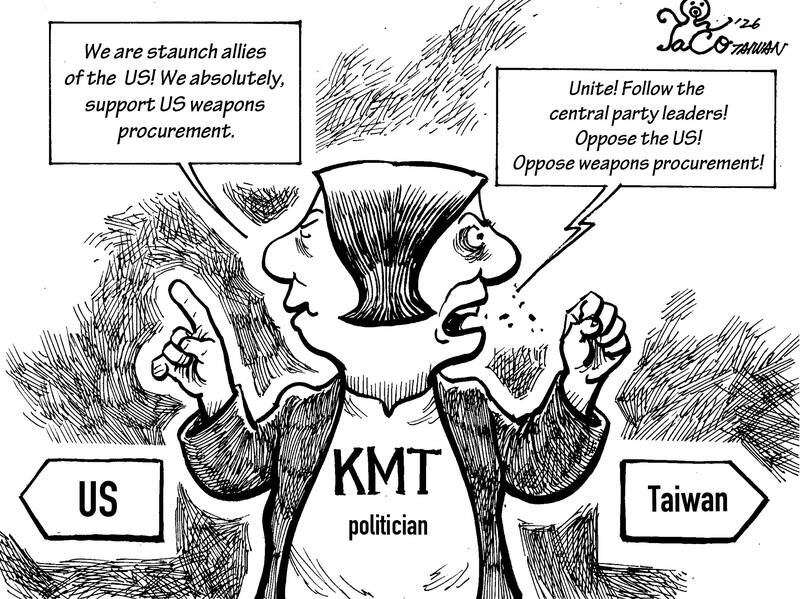
Chinese Nationalist Party (KMT) Chairwoman Cheng Li-wun (鄭麗文) earlier this month said it is necessary for her to meet with Chinese President Xi Jinping (習近平) and it would be a “huge boost” to the party’s local election results in November, but many KMT members have expressed different opinions, indicating a struggle between different groups in the party. Since Cheng was elected as party chairwoman in October last year, she has repeatedly expressed support for increased exchanges with China, saying that it would bring peace and prosperity to Taiwan, and that a meeting with Xi in Beijing takes priority over meeting
Philippine Department of Foreign Affairs spokesman for maritime affairs Rogelio Villanueva on Monday said that Manila’s claims in the South China Sea are backed by international law. Villanueva was responding to a social media post by the Chinese embassy alleging that a former Philippine ambassador in 1990 had written a letter to a German radio operator stating that the Scarborough Shoal (Huangyan Island, 黃岩島) did not fall within Manila’s territory. “Sovereignty is not merely claimed, it is exercised,” Villanueva said. The Philippines won a landmark case at the Permanent Court of Arbitration in 2016 that found China’s sweeping claim of sovereignty in


 RSS
RSS