


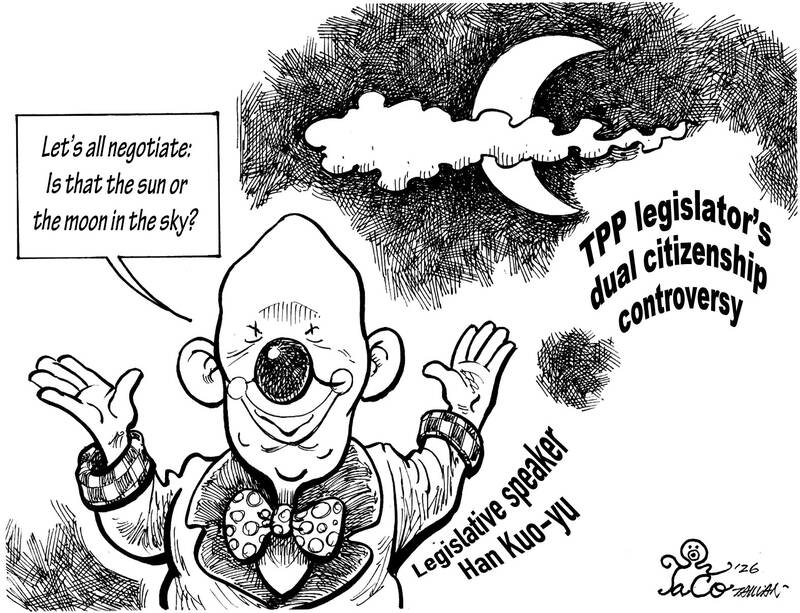
EDITORIAL CARTOON
Taiwanese pragmatism has long been praised when it comes to addressing Chinese attempts to erase Taiwan from the international stage. “Taipei” and the even more inaccurate and degrading “Chinese Taipei,” imposed titles required to participate in international events, are loathed by Taiwanese. That is why there was huge applause in Taiwan when Japanese public broadcaster NHK referred to the Taiwanese Olympic team as “Taiwan,” instead of “Chinese Taipei” during the opening ceremony of the Tokyo Olympics. What is standard protocol for most nations — calling a national team by the name their country is commonly known by — is impossible for
China’s supreme objective in a war across the Taiwan Strait is to incorporate Taiwan as a province of the People’s Republic. It follows, therefore, that international recognition of Taiwan’s de jure independence is a consummation that China’s leaders devoutly wish to avoid. By the same token, an American strategy to deny China that objective would complicate Beijing’s calculus and deter large-scale hostilities. For decades, China has cautioned “independence means war.” The opposite is also true: “war means independence.” A comprehensive strategy of denial would guarantee an outcome of de jure independence for Taiwan in the event of Chinese invasion or
A recent Taipei Times editorial (“A targeted bilingual policy,” March 12, page 8) questioned how the Ministry of Education can justify spending NT$151 million (US$4.74 million) when the spotlighted achievements are English speech competitions and campus tours. It is a fair question, but it focuses on the wrong issue. The problem is not last year’s outcomes failing to meet the bilingual education vision; the issue is that the ministry has abandoned the program that originally justified such a large expenditure. In the early years of Bilingual 2030, the ministry’s K-12 Administration promoted the Bilingual Instruction in Select Domains Program (部分領域課程雙語教學實施計畫).
Former Fijian prime minister Mahendra Chaudhry spoke at the Yushan Forum in Taipei on Monday, saying that while global conflicts were causing economic strife in the world, Taiwan’s New Southbound Policy (NSP) serves as a stabilizing force in the Indo-Pacific region and offers strategic opportunities for small island nations such as Fiji, as well as support in the fields of public health, education, renewable energy and agricultural technology. Taiwan does not have official diplomatic relations with Fiji, but it is one of the small island nations covered by the NSP. Chaudhry said that Fiji, as a sovereign nation, should support


 RSS
RSS