


If ever you needed a nudge to give your brain a workout, new research underscoring the benefits of “brain training” should offer fresh motivation.
The two long-term studies add to a growing body of evidence that people can boost their brain health by doing mentally stimulating activities, such as learning a language, visiting a museum or playing chess. They also show that consciously working to build cognitive resiliency can delay the onset of dementia for years.
That is an important message as the US grapples with the growing challenge of Alzheimer’s disease, which affects about 7 million Americans and counting.
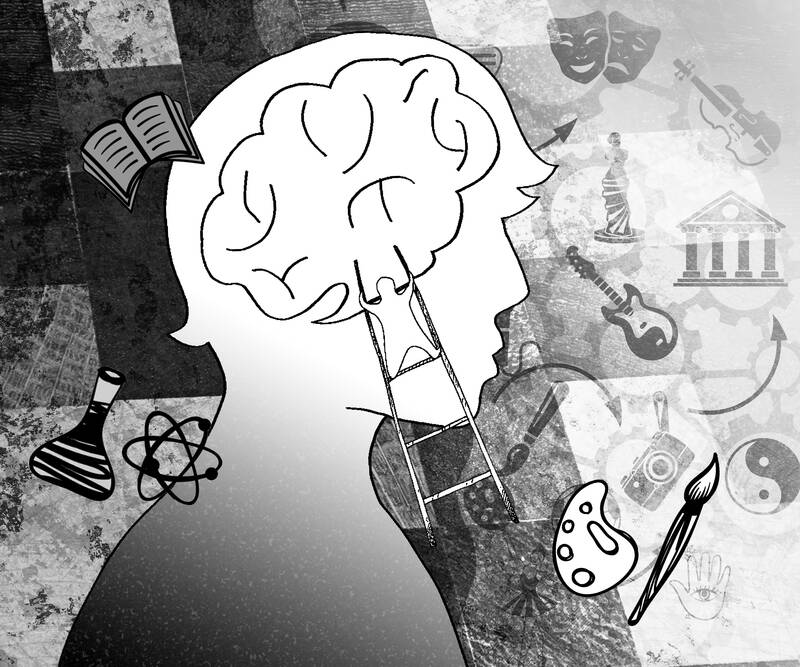
Illustration: Tania Chou
Both studies were part of a wave of trials started in the US in the late 1990s with the goal of better understanding how lifestyle, genetics, the environment and other factors affect people’s chances of developing dementia. Decades later, they are yielding real insights.
For the first study, researchers mined decades of Medicare data from roughly 2,000 people who had been recruited in the late 1990s to participate in the Advanced Cognitive Training for Independent and Vital Elderly (ACTIVE) trial. The study had tested whether certain types of brain games might boost brain health. People were sorted into groups, each assigned one of three computer games that tested either speed, memory or reasoning.
Participants spent an hour playing the game twice a week for six weeks, and then did the same thing again after one and three years. That made it more than a fun little challenge, like your daily crossword or sudoku. It was hard work. The payoff, though, was substantial. Twenty years later, about 25 percent fewer people in the speed training group developed dementia compared with the people who were not offered the intervention.
Interestingly, the memory and reasoning games did not have the same effect. Researchers suspect the difference is related to the type of exercise the speed game required of the brain. It tested people’s ability to juggle several tasks at once — and unlike with the memory and reasoning tests, players were not told how to improve their results. And the better they performed on the test, the more difficult it got.
Study coauthor Marilyn Albert, who directs the Johns Hopkins Alzheimer’s Disease Research Center, hypothesizes that implicit forms of learning improve brain connectivity, or the ability of the different parts of the brain to work together.
The booster sessions years on strengthened those links, she says.
Ideally, future research would explain the underlying biology of how such a game reduces dementia risk. That does not require running another multi-decade trial. When the ACTIVE study began, scientists had yet to invent the brain imaging techniques that allow researchers to observe changes and signs of disease in real time.
Now, though, it would be possible to conduct short-term studies that pair the games with imaging and perhaps blood markers, offering deeper insight into what is happening in people’s brains when they play these games, Albert says. New research could also potentially lead to even more effective brain games.
Meanwhile, a separate study showed that building a resilient brain is a lifelong endeavor — and that pursuing mentally stimulating activities early in life can make a difference decades down the road.
Rush University Medical Center’s Memory and Aging Project followed nearly 2,000 people to understand how their genetics and environment affect their chances of getting Alzheimer’s.
Participants were asked detailed questions about the types of experiences they had across all stages of life — things like whether they were read to as a child, visited a library or played chess. Researchers found that the people who were most engaged in enriching activities throughout their lives had much lower odds of developing Alzheimer’s. And among those who did develop the disease, people who spent a lot of time on intellectually enriching activities were healthier for five more years, on average, than those who did not spend as much time at the mental gym.
About half of the participants in the Rush study donated their brains to science, which offered another fascinating insight. Researchers found that even people whose brains were coated with the telltale plaques associated with Alzheimer’s benefited from a lifetime of mental workouts.
In other words, two people might have the same pathology in their brain, but one “could handle more wear and tear before symptoms appear,” explains Andrea Zammit, a study coauthor and neuropsychologist at the Rush Alzheimer’s Disease Center in Chicago.
One of the more encouraging findings out of the Rush study is that although the benefits were greater when someone seeks out intellectual stimulation throughout their life, people still were helped by enrichment in old age.
As Zammit puts it: “It’s never too late to start.”
Of course, getting started can be challenging. The Rush study suggests the US should be doing more to ensure everyone has access to enriching environments, whether that is libraries and museums, or through programs targeting early childhood or older adults.
Meanwhile, as studies like Albert’s point to short-term interventions that can stave off dementia, doctors and policymakers should be considering how to integrate those into a healthcare system often more focused on treatment than prevention. After all, if these efforts ultimately allow more older adults to live independently for longer, they could chip away at the nearly US$800 billion the US spends on dementia care each year, while improving countless lives.
The public is hopefully getting the message that we do have some control over our brain health. Proactive individuals might decide to pursue more structured activities — older adults wanting a workout for their brain can try a version of the speed game that participants played in the ACTIVE trial — while others might simply be more intentional about regularly opening up a book or challenging a friend to a game of Scrabble.
In our digital age, the growing research on brain health is also a good reminder that while scrolling and posting might offer a quick dopamine hit, real engagement — that is, focused, purposeful activities — offers a much bigger reward.
Lisa Jarvis is a Bloomberg Opinion columnist covering biotech, healthcare and the pharmaceutical industry. Previously, she was executive editor of Chemical & Engineering News. This column reflects the personal views of the author and does not necessarily reflect the opinion of the editorial board or Bloomberg LP and its owners.

The Chinese Communist Party (CCP) has long been expansionist and contemptuous of international law. Under Chinese President Xi Jinping (習近平), the CCP regime has become more despotic, coercive and punitive. As part of its strategy to annex Taiwan, Beijing has sought to erase the island democracy’s international identity by bribing countries to sever diplomatic ties with Taipei. One by one, China has peeled away Taiwan’s remaining diplomatic partners, leaving just 12 countries (mostly small developing states) and the Vatican recognizing Taiwan as a sovereign nation. Taiwan’s formal international space has shrunk dramatically. Yet even as Beijing has scored diplomatic successes, its overreach
For Taiwan, the ongoing US and Israeli strikes on Iranian targets are a warning signal: When a major power stretches the boundaries of self-defense, smaller states feel the tremors first. Taiwan’s security rests on two pillars: US deterrence and the credibility of international law. The first deters coercion from China. The second legitimizes Taiwan’s place in the international community. One is material. The other is moral. Both are indispensable. Under the UN Charter, force is lawful only in response to an armed attack or with UN Security Council authorization. Even pre-emptive self-defense — long debated — requires a demonstrably imminent
Since being re-elected, US President Donald Trump has consistently taken concrete action to counter China and to safeguard the interests of the US and other democratic nations. The attacks on Iran, the earlier capture of deposed of Venezuelan president Nicolas Maduro and efforts to remove Chinese influence from the Panama Canal all demonstrate that, as tensions with Beijing intensify, Washington has adopted a hardline stance aimed at weakening its power. Iran and Venezuela are important allies and major oil suppliers of China, and the US has effectively decapitated both. The US has continuously strengthened its military presence in the Philippines. Japanese Prime
After “Operation Absolute Resolve” to capture former Venezuelan president Nicolas Maduro, the US joined Israel on Saturday last week in launching “Operation Epic Fury” to remove Iranian supreme leader Ayatollah Ali Khamenei and his theocratic regime leadership team. The two blitzes are widely believed to be a prelude to US President Donald Trump changing the geopolitical landscape in the Indo-Pacific region, targeting China’s rise. In the National Security Strategic report released in December last year, the Trump administration made it clear that the US would focus on “restoring American pre-eminence in the Western hemisphere,” and “competing with China economically and militarily


 RSS
RSS