


The Chinese Communist Party (CCP) has long been expansionist and contemptuous of international law. Under Chinese President Xi Jinping (習近平), the CCP regime has become more despotic, coercive and punitive.
As part of its strategy to annex Taiwan, Beijing has sought to erase the island democracy’s international identity by bribing countries to sever diplomatic ties with Taipei. One by one, China has peeled away Taiwan’s remaining diplomatic partners, leaving just 12 countries (mostly small developing states) and the Vatican recognizing Taiwan as a sovereign nation. Taiwan’s formal international space has shrunk dramatically.
Yet even as Beijing has scored diplomatic successes, its overreach is turning it into its own worst enemy. Nowhere is this clearer than in its relationship with Japan, which it has pushed from wary partner to strategic counterweight over the past two decades.
More recently, China’s full-spectrum pressure campaign against Japan — intended to weaken Japanese Prime Minister Sanae Takaichi — has instead helped deliver her a landslide victory in the Feb. 8 election. Japanese voters appear to have grown weary of Beijing’s coercion. The resulting supermajority in the Diet gives Takaichi not only political authority, but also strategic latitude to harden Japan’s statecraft against China.
Japan’s election has thus delivered something Taiwan has not heard in a long time: genuinely good news.
For Taipei, Takaichi’s victory is not just another electoral outcome in a neighboring democracy. It marks a strategic inflection point for Taiwan’s security environment. For the first time in decades, Japan is moving decisively from strategic ambiguity toward strategic clarity — and that shift matters enormously for Taiwan’s future.
The first and most consequential change is political. Takaichi has been more explicit than any previous Japanese leader in stating that a Chinese attack on Taiwan would constitute a “survival-threatening situation” for Japan itself. Under Japan’s 2015 security legislation, that language is not rhetorical; it provides the legal basis for the Self-Defense Forces to exercise collective self-defense if an ally is attacked in circumstances that endanger Japan’s survival.
In practical terms, this signals that Japan is politically and legally prepared to stand alongside the US if Taiwan is attacked.
For Taiwan, this reduces the most dangerous form of uncertainty — not whether China might act, but whether others would respond.
It may also explain Beijing’s sharp reaction. At the recent Munich Security Conference, Chinese Foreign Minister Wang Yi (王毅) denounced Takaichi’s Taiwan position as a “challenge to China’s sovereignty.”
The second shift is military. Japan’s southwestern island chain, stretching from Kyushu to Yonaguni just 110 kilometers from Taiwan, is rapidly becoming a fortified defensive arc. Japanese missile batteries, air defense systems, electronic warfare units and surveillance networks are being deployed along this chain, transforming it from a symbolic “tripwire” into a credible counterstrike barrier. This significantly complicates any Chinese attempt to blockade Taiwan or project force across the Taiwan Strait.
Geography has always made Japan central to Taiwan’s security. Taiwan, in turn, underpins Japan’s own security as a geographic extension of the Japanese archipelago. Under Takaichi, that geographic reality is finally being translated into operational strategy.
Third, Takaichi’s supermajority opens the door to constitutional reform. For decades, Article 9 has constrained Japan’s ability to act as a normal security provider.
With a two-thirds majority in the Lower House, Takaichi now has the leverage to formalize the status of the Self-Defense Forces and expand their operational latitude, even as she accelerates defense spending toward 2 percent of GDP.
A stronger Japan means a more secure Taiwan. Indeed, a Japan that is legally unshackled becomes a far more credible deterrent against Chinese expansionism — one that Beijing must factor into any calculus over Taiwan.
Japan now appears poised to move from reacting to Chinese military pressure to imposing tangible costs. Nowhere is this clearer than along the southwestern island chain, where Tokyo is building the capacity to deny access, complicate Chinese planning, and ensure that no coercive maritime gambit or fait accompli seizure of territory goes unanswered.
Fourth, and just as important, Tokyo has demonstrated that it will not be intimidated by China’s economic coercion, despite the costs.
Beijing attempted to influence Japan’s election by restricting seafood imports and Chinese tourism, tightening export controls on critical materials, and intensifying military pressure around Japan’s southwestern islands. The effort backfired. Japanese voters interpreted the pressure as bullying and responded by strengthening Takaichi’s mandate.
That outcome carries a powerful message for Taiwan: China’s economic leverage is not irresistible, and democratic societies can push back when they choose to do so.
Taken together, these developments amount to something Taiwan has long needed but rarely enjoyed: strategic clarity from its most important neighbor.
The benefits for Taipei are concrete. A Taiwan contingency is now explicitly linked to Japan’s own security. Intelligence-sharing is likely to deepen as Tokyo centralizes its intelligence apparatus. Economic ties may expand through a potential Taiwan-Japan Economic Partnership Agreement, embedding Taiwan more firmly in trusted supply chains. And Japan’s easing of defense-export restrictions opens the door to quiet but meaningful industrial cooperation.
None of this means Taiwan’s challenges are over. Beijing will continue to apply pressure — diplomatic, economic and military. Japan’s constitutional reforms will likely face hurdles in the Upper House and in a national referendum. Ultimately, Taiwan’s own resilience remains the decisive factor in its future.
But geopolitics is rarely about perfect security; it is about relative advantage. Compared with a year ago, Taiwan’s strategic position is stronger. It now has a Japan that is more willing, more capable and more politically authorized to contribute to its defense. And the US has approved a record US$11.1 billion arms package to strengthen Taiwan’s deterrence against Chinese coercion.
In a region where bad news has become routine, that alone marks a meaningful shift.
For Taiwan, Japan’s election result is a reminder that the balance of power in Asia is not static and that democratic solidarity, when backed by political will, can still reshape the strategic landscape.
Brahma Chellaney, professor of strategic studies at the independent Center for Policy Research in New Delhi, is the author of nine books, including the award-winning Water: Asia’s New Battleground (Georgetown University Press).
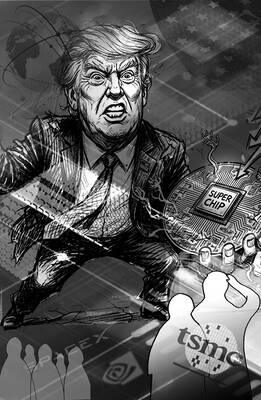
The White House’s decision to take a 9.9 percent stake in Intel Corp is looking like very shrewd business indeed. Since the government bought in at US$20.47 a share last August, the US chipmaker’s surging stock price has delivered the US a US$43 billion return. One of the reasons the investment has so far proved so sound is that the White House has made sure of it. According to The Wall Street Journal, Howard personally pushed deals on Intel’s behalf with some of the most lucrative clients imaginable. They include Nvidia Corp, the company at the heart of the AI
In a Taiwanese university classroom, a lecturer asks in English: “Can anyone give me an example from Taiwan?” Students look down. No one answers. After class, one student writes on the course platform in Mandarin: “I understood the concept, but I didn’t know how to answer in English.” That moment highlights a key issue in Taiwan’s English-medium instruction (EMI) reform: It is not just about more English-taught courses, but whether students can learn, participate and belong. EMI expansion is part of the Bilingual 2030 policy and the Ministry of Education’s BEST Program, aiming to improve English ability, support EMI teaching
A single photograph can cut through a lot of noise, but it can also be used to misrepresent the truth. At the very least, it can concentrate the mind on something that requires further investigation. On Monday last week, Ma Ying-jeou Foundation CEO Tai Hsia-ling (戴遐齡) and former National Security Council secretary-general King Pu-tsung (金溥聰) held a news conference in which they showed a photograph of former foundation CEO Hsiao Hsu-tsen (蕭旭岑), now Chinese Nationalist Party (KMT) deputy chairman. In the image Hsiao is seated next to Xiamen Taiwan Businessmen Association chairman Han Ying-huan (韓螢煥). The two men were holding
The Ministry of the Interior, working with the navy and coast guard, is organizing Taiwan’s first joint exercise simulating escort tankers carrying liquefied natural gas (LNG) and oil through a Chinese blockade. The drills simulate fuel transport along three maritime corridors leading toward Japan, the Philippines and the US. Deputy Minister of the Interior Sawyer Mars (馬士元) said that a blockade of the Taiwan Strait would amount to “almost a 100 percent blockade of the regional energy supply.” Minister of National Defense Wellington Koo said planning to counter a blockade is standard practice in Taipei. While the exercise is limited in


 RSS
RSS