


In March last year, a Turkish court jailed Istanbul Mayor Ekrem Imamoglu pending a trial on corruption charges. While Turkish President Recep Tayyip Erdogan’s regime has denied any political motivation, arguing that the judiciary is independent, many have recognized it as a classic example of democratic backsliding: detain the popular opposition leader and dress it up as law enforcement. The move triggered nationwide protests on a scale not seen in more than a decade.
Using legal institutions and procedures to shape who can run, who can speak and who can organize has become the preferred method for limiting political competition while still retaining the veneer of democracy. The prosecution of Imamoglu, who defeated the Istanbul mayoral candidate from the ruling Justice and Development Party (AKP) in the 2019 election (and its court-mandated rerun) and the 2024 election, was only the beginning in Turkey. Since then, other mayors from the Republican People’s Party (CHP) have been detained as part of a campaign to weaken and dismantle the opposition.
Sowing uncertainty by applying judicial and administrative pressure depends not only on prosecution. Right before Imamoglu’s arrest, Istanbul University annulled his degree based on alleged irregularities, disqualifying him from running for president. This came days before the CHP was set to pick Imamoglu as its presidential candidate for the 2028 election. The impact is clear: narrow the electoral field by incapacitating the only viable challenger. The Council of Europe rightly condemned the move as an “assault on democracy.”
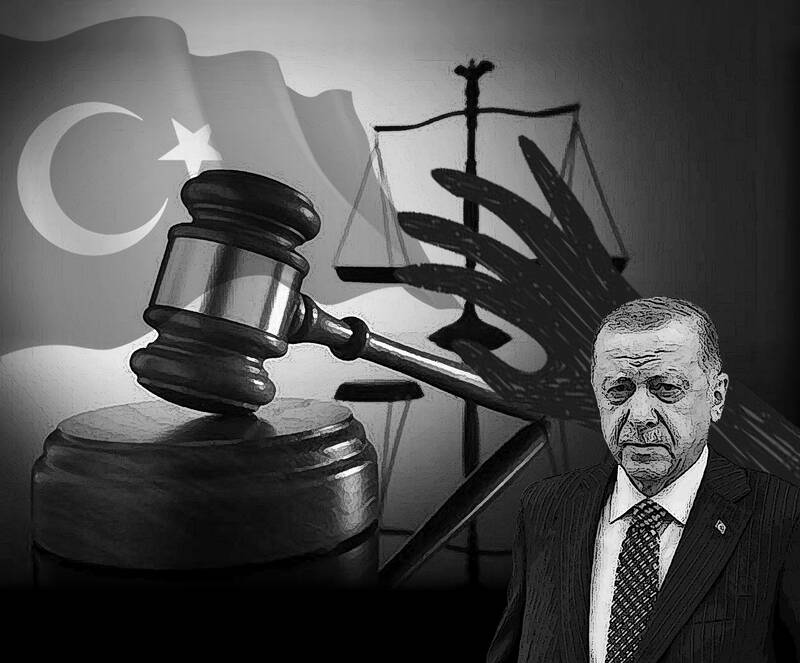
Illustration: Constance Chou
Pretrial detention adds another layer of uncertainty. In principle, detention is meant to protect judicial proceedings; in practice, it is a way to sideline a political opponent indefinitely, especially as investigations and trials are increasingly extended over years. The prosecutor overseeing the graft case later demanded a prison sentence of more than 2,000 years for Imamoglu, a show of force that aims to present his exit from politics as inevitable. Whether or not a court accepts these claims, the process itself would likely drain the opposition’s attention, money and leadership capacity, while also deterring other challengers.
Imamoglu has been targeted because he is a non-polarizing, service-oriented centrist who won without resorting to the identity politics that Erdogan relies on to maintain the support of his base. Serving as Istanbul’s mayor has burnished that image. Municipal office often gives opposition leaders visibility, administrative experience and a track record showing that there is another way to govern. That is why cities tend to be the front line in the fight for maintaining democracy.
This pattern extends far beyond Istanbul. In late 2024, the Turkish Interior Ministry removed elected mayors in Kurdish-majority provinces like Mardin and Batman, replacing them with state-appointed trustees. The message to voters is clear: You may vote, but the state reserves the right to correct your choice.
In Turkey, the silencing of politicians was accompanied by internet censorship. During the protests following Imamoglu’s detention, the Turkish authorities clamped down on social-media platforms, throttling messaging apps and ordering content blocks to prevent the opposition from organizing. When the digital public square is shuttered at the government’s whim, any hope of fair competition vanishes.
Venezuela offers a sobering parallel. In January 2024, Venezuela’s Supreme Justice Tribunal upheld a ban preventing the opposition leader — and now Nobel Peace Prize laureate — Maria Corina Machado from holding office. This disqualification was an act of democratic nullification routed through the courts, removing voters from the equation.
The political logic is the same in both countries: preserve enough formal legality to claim rule-based governance, while using institutions to preclude a genuine alternation in power. Around 811 political prisoners remain locked up in Venezuela after US President Donald Trump removed Nicolas Maduro from power and decided to preserve the Chavista regime. The road to deeper authoritarianism is paved with selective prosecution, administrative exclusion and pretrial detention — techniques that determine political outcomes before a single ballot is cast.
Western countries often tolerate democratic backsliding in their strategically important partners for the sake of stability. Turkey is a NATO ally with an important role in regional security, while Venezuela is an energy power. In both cases, the prospect of securing short-term gains encourages foreign leaders to downplay the erosion of democratic freedoms.
However, when incumbents can neutralize their rivals through lawfare, public institutions lose credibility, and politics hinges on the survival strategies of those in power. That is personalization, not stability. Policy commitments are less predictable because they are anchored in regime security rather than accountable bodies. A country where the rule of law has collapsed cannot be a bulwark of NATO’s eastern flank. It is a constant source of friction and could become a source of fragility.
The imprisonment of Imamoglu is not only about one politician. It serves as a warning. A democratic country can retain its outward form even as its leaders use the courts to engineer political outcomes. While voters in such countries fight to choose their candidates without interference from the state’s legal machinery, foreign leaders must pressure these regimes to allow for elections that are both free and fair.
Bilal Bilici is a member of the Turkish parliament. Eric A. Baldwin is a postdoctoral research fellow at Stanford University.
Copyright: Project Syndicate
After more than a year of review, the National Security Bureau on Monday said it has completed a sweeping declassification of political archives from the Martial Law period, transferring the full collection to the National Archives Administration under the National Development Council. The move marks another significant step in Taiwan’s long journey toward transitional justice. The newly opened files span the architecture of authoritarian control: internal security and loyalty investigations, intelligence and counterintelligence operations, exit and entry controls, overseas surveillance of Taiwan independence activists, and case materials related to sedition and rebellion charges. For academics of Taiwan’s White Terror era —
On Feb. 7, the New York Times ran a column by Nicholas Kristof (“What if the valedictorians were America’s cool kids?”) that blindly and lavishly praised education in Taiwan and in Asia more broadly. We are used to this kind of Orientalist admiration for what is, at the end of the day, paradoxically very Anglo-centered. They could have praised Europeans for valuing education, too, but one rarely sees an American praising Europe, right? It immediately made me think of something I have observed. If Taiwanese education looks so wonderful through the eyes of the archetypal expat, gazing from an ivory tower, how
China has apparently emerged as one of the clearest and most predictable beneficiaries of US President Donald Trump’s “America First” and “Make America Great Again” approach. Many countries are scrambling to defend their interests and reputation regarding an increasingly unpredictable and self-seeking US. There is a growing consensus among foreign policy pundits that the world has already entered the beginning of the end of Pax Americana, the US-led international order. Consequently, a number of countries are reversing their foreign policy preferences. The result has been an accelerating turn toward China as an alternative economic partner, with Beijing hosting Western leaders, albeit
After 37 US lawmakers wrote to express concern over legislators’ stalling of critical budgets, Legislative Speaker Han Kuo-yu (韓國瑜) pledged to make the Executive Yuan’s proposed NT$1.25 trillion (US$39.7 billion) special defense budget a top priority for legislative review. On Tuesday, it was finally listed on the legislator’s plenary agenda for Friday next week. The special defense budget was proposed by President William Lai’s (賴清德) administration in November last year to enhance the nation’s defense capabilities against external threats from China. However, the legislature, dominated by the opposition Chinese Nationalist Party (KMT) and Taiwan People’s Party (TPP), repeatedly blocked its review. The


 RSS
RSS