


Three months into her tenure as Japan’s first female prime minister, Sanae Takaichi is connecting with younger voters in a way her predecessors failed.
She plays KPop Demon Hunters’ Golden on the drums with South Korean President Lee Jae-myung and takes selfies with Italian Prime Minister Giorgia Meloni. In the evenings, she prefers to sharpen her policy knowledge at home, rather than wining and dining Japan’s old-guard business elite behind closed doors. From her handbags to her pink pens, orders are surging for items that have unexpectedly captured the zeitgeist.
So far her PR strategy of presenting herself as different seems to have struck a chord with Japan’s youth, likely clawing back some of the votes lost to opposition parties with savvier social media reach in the upper house election last year. The question for Takaichi is how much that support would carry through in tomorrow’s closely watched lower house election.
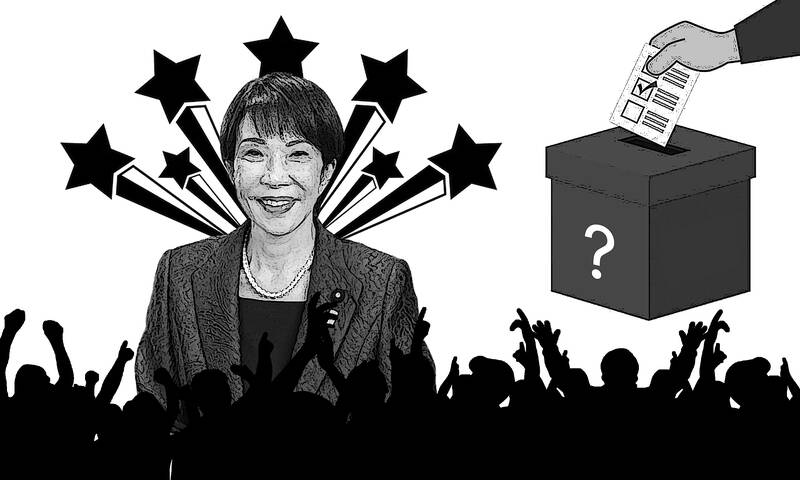
Illustration: Constance Chou
“It feels like Japan’s changed,” 21-year-old university student Genki Takahashi said at a campaign rally for Takaichi on Tuesday, noting that all past prime ministers were men. “We’ve gone from tradition to innovation.”
In some recent polls, support for Takaichi among those aged 18 to 29 is nearly 90 percent. A survey by public broadcaster NHK taken right after Takaichi took office put her approval rating at 77 percent among 18-to-39-year-olds, compared with 38 percent and 51 percent respectively for her immediate predecessors, Shigeru Ishiba and Fumio Kishida, when they began their terms.
“I think she’s really good at marketing herself,” said Kenshiro Kawasaki, a 24-year-old Takaichi supporter.
TIRED OF THE OLD
Younger people are particularly sensitive to politicians’ image strategy, and voters more broadly were getting tired of the last few prime ministers, he added.
Some supporters have even coined a new term for their fandom: Sanakatsu, derived from oshikatsu, a Japanese word usually reserved for cheering on pop idols.
Homemaker Hitomi Sasaki was also listening to Takaichi speak on Tuesday as she waved a sign saying “Thank you Sanae.”
“She has conviction, her policies are clear and she has a strong will to protect Japan,” Sasaki said. “I’m fully behind her.”
Takaichi’s smarter use of social media may be contributing to her popularity. An analysis conducted by political data Web site Senkyo.com in November showed that from July to November, views for YouTube videos related to Takaichi far exceeded those for individual political parties, particularly surging when she became prime minister.
When she took office in October, YouTube interest in Takaichi was triple the scale seen for Sanseito during its popularity surge in the summer’s upper house election. That suggests her clearer message on fiscal spending and national security, and her sharper social media use might be stealing back support from far-right Sanseito and the “raise take-home pay” messaging of the Democratic Party for the People — parties that had been jumping ahead in recent elections at the expense of Takaichi’s ruling Liberal Democratic Party (LDP).
“Younger voters respond more to a simple, direct pitch and a leader who can push policies forward,” Osaka University of Economics associate professor Masaki Hata said. “Older generations tend to prefer consensus-driven messaging.”
Other Cabinet members have taken the hint. Japanese Minister of Defense Shinjiro Koizumi has posted photos of working out with US Secretary of Defense Pete Hegseth on Instagram, while Japanese Minister of Economy, Trade and Industry Ryosei Akazawa took his trade negotiation partner, US Secretary of Commerce Howard Lutnick, on a whistle-stop tour around the historic Tokyo district of Asakusa.
Her personal narrative is also a big part of her appeal. The daughter of an office worker and a police officer from the western prefecture of Nara, Takaichi built her career without the benefit of a wealthy background or connections to politics. For a generation that feels far removed from Japan’s boom years, her story of reaching the nation’s highest office through diligence and grit, rather than inherited privilege, has particular appeal.
“The fact that Takaichi managed to become prime minister through hard work provides a role model for young people who want to believe that it actually pays off,” said Waka Ikeda, a researcher at the Youth Research Institute in Budapest, where she is studying cross-cultural patterns in youth and family policies.
Japan’s political class is unusually dynastic. About 30 percent of Japanese lawmakers are hereditary politicians, far higher than in the US and Germany, where the share is below 10 percent, according to a book by Daniel Smith, an associate professor at the University of Pennsylvania.
WORK OVER PRIVILEGE
However, Takaichi is not one of them, and has leaned into a work-first image. Her pledge to “work, work, work, work and work” during her post-victory speech and a recent 3am meeting she called to study up on policies have been criticized, but have also projected an image of meritocracy over schmoozing with the old guard.
Her message of work over privilege is also blended with a bid for a stronger Japan, echoing former Japanese prime minister Shinzo Abe, who also enjoyed support from younger voters.
Her push for aggressive spending and large-scale investment also tracks the Abenomics playbook: monetary easing, flexible fiscal policy and a growth strategy.
“Some young voters see Takaichi as Abe’s successor and back her for that reason,” Hata said.
Still, it is unclear whether her popularity among young voters would directly translate into votes for her ruling coalition. Even among younger voters, support for the LDP remains at about 30 percent, underscoring the gap between approval for Takaichi herself and backing for her party.
“I’m looking closely at how younger people are supporting the Takaichi administration lately,” said 21-year-old Masato Iwanaka, who said he has not decided who he would vote for yet. “I want parties to learn from each other’s good parts and do things in a hybrid way.”
Turnout is another hurdle, with youth participation typically far lower than among older generations. Tomorrow’s vote, held in cold weather and overlapping with exam season and spring break, could further bring down voter turnout.
Still, Hata said youth interest in politics is rising, suggesting that those views might be overblown. In the upper house election in July last year, turnout among people in their late 20s climbed to 52 percent, up about 14 percentage points from national races in 2022 and 2024.
“I’ve been supporting her since the last party leadership election,” said 28-year-old Miku Tobe, who was listening to Takaichi give a campaign speech. “I really feel like she’s thinking seriously about Japan.”
“The LDP was not particularly good at using social media,” at least compared with the DPP and Sanseito, Ikeda said.
“Many young people in Japan are tired of being called out for their views, or being canceled,” she added, explaining that many see liberals as being overly politically correct, making them more receptive to messaging from Japan’s rising right wing.
“I wasn’t interested in politics before,” said 21-year-old university student Itto Mitsuo, who was also at Tuesday’s rally. “But Takaichi is different, and I have a good image of her interacting with other countries.”
Still, support fueled by social media can be fragile, raising the risk that Takaichi’s popularity might prove short-lived. As social media use spreads, public attention and opinion can become more volatile, with larger swings unfolding more quickly than before, according to a project by the Oxford Internet Institute.
“Young people are quick to jump on, but just as quick to move on,” Ikeda said.
Additional reporting by Mari Kiyohara, Maho Nambu and Eddy Duan

KMT Chairwoman Cheng Li-wun’s (鄭麗文) recent visit to Beijing and her upcoming visit to Washington will serve as a high-level test of her diplomatic mettle. In Beijing, Cheng was received with symbolic gestures, a warm reception, and high-level access. In Washington, she will receive far less pomp and far sharper questions about the KMT’s vision for the future of Taiwan. Her challenge will be to persuade Washington that the KMT’s engagement with China can coexist with strong deterrence. Cheng’s April 7-12 visit to mainland China coincided with an intense period of conflict in Iran. Despite the strategic significance of Cheng’s trip,

The closure of the Strait of Hormuz has sent the vast Asian chemicals industry into a tailspin. Deprived of the likes of Qatari natural gas and Saudi Arabian oil, the region’s fertilizer and plastics plants are slowing production or even shutting down. Everywhere except China, that is. In petrochemicals, China is unique. As well as a traditional industry that uses oil and gas as feedstock, it has parallel output that relies on its abundant domestic coal. Unsurprisingly, India and other regional powers want to copy and paste the Chinese method. This would not be easy — or climate friendly. The
US President Donald Trump recently repeated his claim that “Taiwan stole America’s chip industry,” reigniting public debate on the issue. As a former Taiwanese minister of economic affairs and an entrepreneur deeply involved in semiconductor supply chain development, I feel a responsibility to clarify this misunderstanding. From the perspective of global industrial evolution and the economic principle of comparative advantage, such a statement appears overly simplistic and risks obscuring the essence of the issue. The rise of Taiwan’s semiconductor industry was not built on “replacing America,” but rather emerged as a result of countries pursuing different development paths within the
Indonesian President Prabowo Subianto says he knows how to fix the problems facing Indonesia. Yet his economic mismanagement and authoritarian tendencies are steering the nation toward a familiar mix of currency instability and political chaos. The world’s fourth-most populous nation risks reversing the hard-won democratic and business reforms that came after the Asian Financial Crisis in 1997. At that time, the rupiah collapsed and the political upheaval that followed forced former president Haji Mohamed Suharto from power. Prabowo’s administration is ignoring similar warning signs. That disconnect was apparent in a national address on Wednesday, when Prabowo projected the swagger that has


 RSS
RSS