


Forty-seven years on from the Iranian revolution, Tehran is confronting a strategic reality it has never faced before — a simultaneous crisis of domestic legitimacy and a credible threat of external attack so severe that regime survival can no longer be taken for granted. Until now, Iran has survived wars, sanctions, assassinations, mass protests and international isolation through a strategy of projecting strength abroad, repressing dissent at home and generating a permanent crisis to justify poor leadership and political failure.
Today, US President Donald Trump has mobilized an “armada” to the Middle East that includes the USS Abraham Lincoln carrier strike group, guided-missile destroyers, an expanded air presence and missile defense systems. This force projection suggests the US is no longer focused on containing Iran, but rather compelling a final resolution of a long-running conflict. The choice at hand is either the acceptance of a US-imposed settlement or the destruction of the Islamic republic as it exists today.
Trump’s actions during his first term as president included abandoning the 2015 nuclear deal, reimposing sweeping sanctions and the assassination of Quds Force commander Qassem Suleimani in 2020, and foreshadowed a new approach toward a longstanding adversary. Now back in office, he seems intent on completing that project by forcing Tehran to either accept a deal on US terms or confront military strikes aimed at dismantling the regime itself.
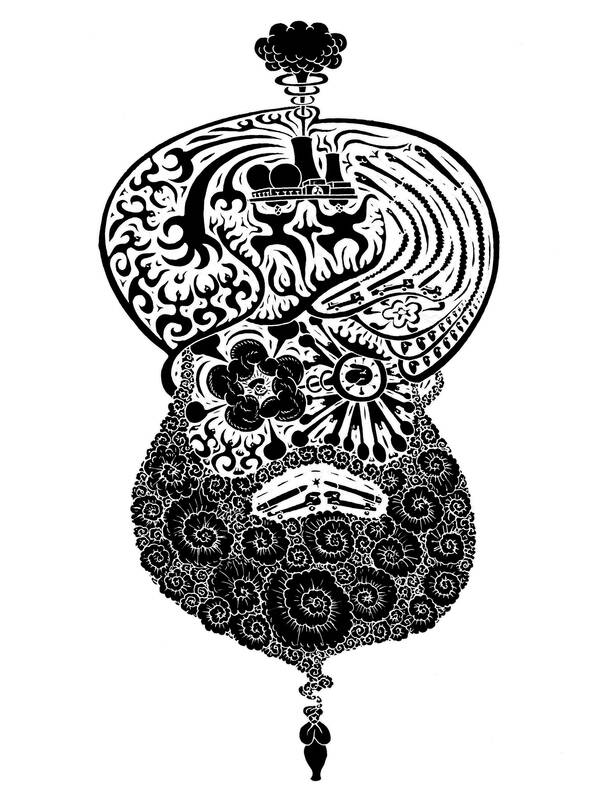
Illustration: Mountain People
For Iran, this is an unprecedented moment. Not since 1979 has the regime faced serious threats to its legitimacy at home and its ability to deter enemies abroad at the same time. Inside the country, the system is exhausted. Years of economic decline, corruption, currency collapse and mass emigration have hollowed out the social contract. The protests since 2017, including the “Woman, Life, Freedom” uprising in 2022 and the mass demonstrations of the past month showcase a society that no longer fears the state. Protesters have grown bolder and angrier, even as the cost of dissent has risen sharply. Last month’s crackdown was the most violent in the regime’s history, with more than 6,000 people confirmed dead and a further 17,000 recorded deaths still under investigation.
Externally, Iran has lost its footing, and its regional projection of power has crumbled. Since Oct. 7 last year, Israel’s systematic campaign against Iran’s so-called axis of resistance has steadily eroded Tehran’s sense of security. Through open airstrikes across the region and in Iran itself, high-level targeted assassinations and cyberoperations culminating in last summer’s 12-day war, Israel has moved its shadow war into the open and, in doing so, has actively pushed Iran toward a direct confrontation with the US.
At the same time, Iran has created the conditions of its own vulnerability. Its effort to build influence through militias across Iraq, Syria, Lebanon and Yemen was meant to deter attack by raising the cost of war. Instead, it has created multiple points of exposure. Its nuclear brinkmanship, once a source of leverage, has become the main justification for international pressure. In addition, its revolutionary ideology, once a tool for mobilization, now leaves it increasingly isolated in a region that has grown tired of ideological conflict.
The question looming for the days ahead is not whether confrontation would occur, but what form it would take.
The first scenario is forced compromise. Under intense pressure, Iran accepts a deal that limits its nuclear program, allows intrusive inspections, places constraints on its missile capabilities and reduces its regional role, in return for sanctions relief and perhaps eventual US investment in the country. This might prevent immediate war, but it would come at a heavy political cost. Such an agreement would be seen inside Iran as a bargain for the sake of the regime’s survival.
The second scenario is controlled war. The US would coordinate strikes against the Iranian leadership, missile forces, air defenses and remaining nuclear infrastructure, seeking to cripple the regime. This would probably trigger Iranian regional escalation ranging from attacks on US bases, shipping lanes and Israeli cities, and maybe even some proxy mobilization across the Gulf. The goal in this scenario would be regime transformation, but the outcome would certainly unleash prolonged instability, elite fragmentation and a violent struggle over future leadership.
The third scenario is uncontrolled collapse. Under combined external pressure and internal unrest, the regime fractures, producing not liberal transition, but a power vacuum. Competing security factions, economic breakdown and regional intervention could turn Iran into a long-term source of instability conjuring up images of Libya and Syria that would produce an outcome more perilous than the regime it replaces.
In all three scenarios, the outcome is dangerous for Iranians. Whether through forced compromise, limited war or regime collapse, none of the likely paths ahead point toward immediate stability or democratic transition. Moreover, all sides — Israel, the US and Iran — are locked into a logic of escalation over restraint.
This is what makes the current moment so dangerous. There are no real diplomatic brakes left. The systems and mechanisms that previously kept conflict contained no longer function. Europe has no role left to play in mediating with Iran. Russia is distracted by its war in Ukraine and reluctant to invest in any off-ramps. China is cautious and unwilling to lead. Regional states are trying to intercede and manage last-ditch diplomacy, but they are also bracing for the impact.
For Iran — and for the Middle East more broadly — the question is no longer whether the crisis can be defused, but how much damage would be done before it finally runs its course.
Sanam Vakil is director of Chatham House’s Middle East and North Africa program.
The Chinese Communist Party (CCP) has long been expansionist and contemptuous of international law. Under Chinese President Xi Jinping (習近平), the CCP regime has become more despotic, coercive and punitive. As part of its strategy to annex Taiwan, Beijing has sought to erase the island democracy’s international identity by bribing countries to sever diplomatic ties with Taipei. One by one, China has peeled away Taiwan’s remaining diplomatic partners, leaving just 12 countries (mostly small developing states) and the Vatican recognizing Taiwan as a sovereign nation. Taiwan’s formal international space has shrunk dramatically. Yet even as Beijing has scored diplomatic successes, its overreach
For Taiwan, the ongoing US and Israeli strikes on Iranian targets are a warning signal: When a major power stretches the boundaries of self-defense, smaller states feel the tremors first. Taiwan’s security rests on two pillars: US deterrence and the credibility of international law. The first deters coercion from China. The second legitimizes Taiwan’s place in the international community. One is material. The other is moral. Both are indispensable. Under the UN Charter, force is lawful only in response to an armed attack or with UN Security Council authorization. Even pre-emptive self-defense — long debated — requires a demonstrably imminent
Since being re-elected, US President Donald Trump has consistently taken concrete action to counter China and to safeguard the interests of the US and other democratic nations. The attacks on Iran, the earlier capture of deposed of Venezuelan president Nicolas Maduro and efforts to remove Chinese influence from the Panama Canal all demonstrate that, as tensions with Beijing intensify, Washington has adopted a hardline stance aimed at weakening its power. Iran and Venezuela are important allies and major oil suppliers of China, and the US has effectively decapitated both. The US has continuously strengthened its military presence in the Philippines. Japanese Prime
After “Operation Absolute Resolve” to capture former Venezuelan president Nicolas Maduro, the US joined Israel on Saturday last week in launching “Operation Epic Fury” to remove Iranian supreme leader Ayatollah Ali Khamenei and his theocratic regime leadership team. The two blitzes are widely believed to be a prelude to US President Donald Trump changing the geopolitical landscape in the Indo-Pacific region, targeting China’s rise. In the National Security Strategic report released in December last year, the Trump administration made it clear that the US would focus on “restoring American pre-eminence in the Western hemisphere,” and “competing with China economically and militarily


 RSS
RSS