


How do you persuade a population to have more babies after generations of limiting families to just one?
A decade after ending China’s longtime one-child policy, authorities are pushing a range of ideas and policies to try to encourage more births — tactics that range from cash subsidies and taxing condoms to eliminating a tax on matchmakers and day care centers.
The efforts have not paid off yet. At least, that is what population figures released on Monday show for what is now the world’s second-most populous nation. China’s population of 1.4 billion continued to shrink, marking the fourth straight year of decrease, new government statistics show. The total population last year stood at 1.404 billion, which was 3 million less than in 2024.
Measured another way, the birthrate last year — 5.63 per 1,000 people — is the lowest on record since 1949, the year that Mao Zedong’s (毛澤東) communists overthrew the nationalists and began running China. Figures before that, under the previous nationalist government, were not available.
China was long the world’s most populous nation until 2023, when it was surpassed by regional neighbor and sometime rival India. Monday’s statistics illustrate the stark demographic pressures faced by the country as it tries to pivot from a problem it is working hard to overcome: status as a nation with a growing, but transitional economy that, as is often said, is “getting old before it gets rich.”
The number of new babies born was just 7.92 million last year, a decline of 1.62 million, or 17 percent, from 2024. The latest birth numbers show that the slight tick upward in 2024 was not a lasting trend. Births declined for seven years in a row through 2023.
Most families cite the costs and pressure of raising a child in a highly competitive society as significant hurdles that now loom larger in the face of an economic downturn that has impacted households struggling to meet their living costs.
Another potential factor in the numbers: Last year in China was the year of the snake, considered one of the least favored years for having a child under the Chinese zodiac.
Like many other countries in Asia, China has faced a declining fertility rate, or the average number of babies a woman is expected to have in her lifetime. While the government does not regularly publish a fertility rate, last saying it was 1.3 in 2020, experts have estimated it is now about 1. Both figures are far below the 2.1 rate that would maintain the size of China’s population.
For decades, the Chinese government barred people from having more than one baby and often sanctioned those who did — a policy that produced more than two generations of only children. In 2015, the government raised the permitted amount of offspring to two and then, facing demographic pressure, further revised the limit to three in 2021.
The push for more births is about the economy. China now has 323 million people older than 60, or 23 percent of the entire population. That number has continued to rise, while the working-age population is shrinking, meaning there are fewer workers to support the older population.
This demographic shift is happening while China is in the process of trying to transition away from labor-intensive industries like farming and manufacturing into a consumer-driven economy built with high-tech manufacturing.
While China’s rapid development in manufacturing with high-tech and robotics can reduce the impact of a shrinking labor force, “the bigger concern is whether economic growth can stay afloat with a shrinking population,” said Gary Ng, senior economist for Asia Pacific at French investment bank Natixis.
China reported 5 percent annual economic growth for last year on Monday, based on official data, but some analysts expect growth to slow in the next few years.
To cope with these massive changes, China could eventually need to reform its pension system, Ng said, as well as broaden the tax base to cope with the higher government expenditure.
Officials have had limited success with policy changes to incentivize families to have more children. In July, the government announced cash subsidies of 3,600 yuan (US$517) per child to families.
Coupling incentives with other attempts to mold behavior, the government also has started taxing condoms. China removed contraceptives, including condoms, from a value-added tax exemption list last year, meaning condoms are now being hit with a 13 percent tax that kicked into effect on Jan. 1.
In an attempt to further promote child-rearing, kindergartens and day-care centers have been added to the tax-exemption list, along with matchmaking services.
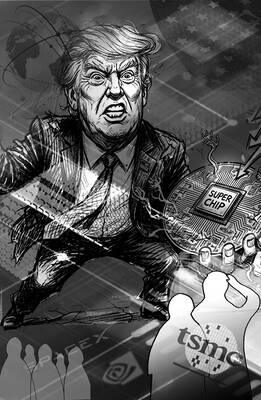
The White House’s decision to take a 9.9 percent stake in Intel Corp is looking like very shrewd business indeed. Since the government bought in at US$20.47 a share last August, the US chipmaker’s surging stock price has delivered the US a US$43 billion return. One of the reasons the investment has so far proved so sound is that the White House has made sure of it. According to The Wall Street Journal, Howard personally pushed deals on Intel’s behalf with some of the most lucrative clients imaginable. They include Nvidia Corp, the company at the heart of the AI
In a Taiwanese university classroom, a lecturer asks in English: “Can anyone give me an example from Taiwan?” Students look down. No one answers. After class, one student writes on the course platform in Mandarin: “I understood the concept, but I didn’t know how to answer in English.” That moment highlights a key issue in Taiwan’s English-medium instruction (EMI) reform: It is not just about more English-taught courses, but whether students can learn, participate and belong. EMI expansion is part of the Bilingual 2030 policy and the Ministry of Education’s BEST Program, aiming to improve English ability, support EMI teaching
A single photograph can cut through a lot of noise, but it can also be used to misrepresent the truth. At the very least, it can concentrate the mind on something that requires further investigation. On Monday last week, Ma Ying-jeou Foundation CEO Tai Hsia-ling (戴遐齡) and former National Security Council secretary-general King Pu-tsung (金溥聰) held a news conference in which they showed a photograph of former foundation CEO Hsiao Hsu-tsen (蕭旭岑), now Chinese Nationalist Party (KMT) deputy chairman. In the image Hsiao is seated next to Xiamen Taiwan Businessmen Association chairman Han Ying-huan (韓螢煥). The two men were holding
The Ministry of the Interior, working with the navy and coast guard, is organizing Taiwan’s first joint exercise simulating escort tankers carrying liquefied natural gas (LNG) and oil through a Chinese blockade. The drills simulate fuel transport along three maritime corridors leading toward Japan, the Philippines and the US. Deputy Minister of the Interior Sawyer Mars (馬士元) said that a blockade of the Taiwan Strait would amount to “almost a 100 percent blockade of the regional energy supply.” Minister of National Defense Wellington Koo said planning to counter a blockade is standard practice in Taipei. While the exercise is limited in


 RSS
RSS