


US President Donald Trump’s decision to approve banned exports of Nvidia Corp’s powerful H200 artificial intelligence (AI) chips to China could turbocharge the People’s Liberation Army’s (PLA) technological ambitions, narrowing the US’ edge in military supremacy. Over time, this risks shifting the balance of power in the Indo-Pacific, the primary region in which Washington competes with Beijing for influence.
It’s still unclear how far the deal is going to go. Chinese regulators are reportedly keen to limit access to the chips to keep domestic developers on the path to self-sufficiency in semiconductor production. Trump says that President Xi Jinping (習近平) has responded favorably to the move. The plan would be for shipments to go to as-yet unspecified “approved customers.”
The shift away from tighter controls, if China approves this deal, could give the country crucial access to Nvidia’s second-most powerful AI processor, which is roughly six times more capable than the H20 chips available to it. It is an important tool for any country trying to push the frontier of AI, especially in military applications.
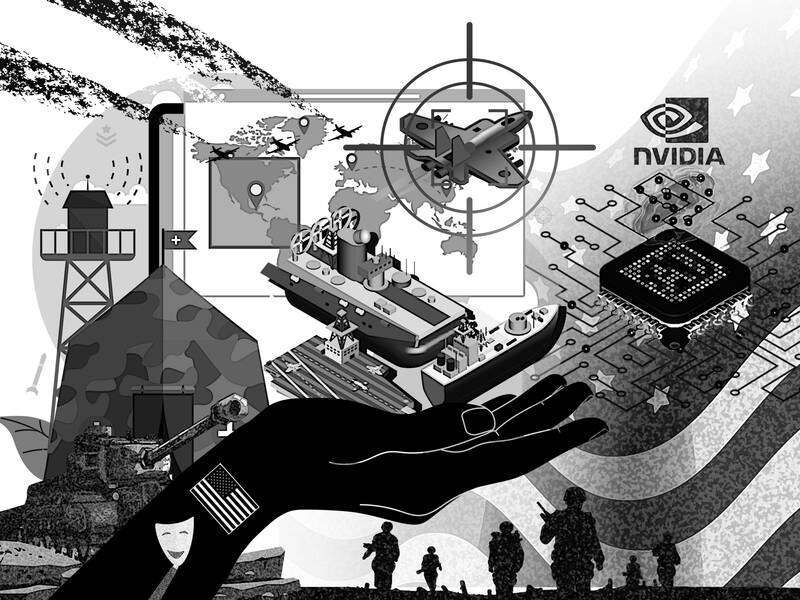
Illustration: Louise Ting
The stakes are clear for the PLA. Chinese military documents said that future warfare hinges on using AI to determine precision and lethality of military operations. Beijing believes that winning future wars depends not only on the largest fleets or longest-range missiles, but on the ability to sense, decide and strike faster than the enemy. This requires enormous computing capacity.
The country’s domestic semiconductor sector has made undeniable progress, but remains far behind the cutting edge. The PLA and its affiliated research institutes have repeatedly sought access to US chips through commercial procurement channels. A review of records by researchers at Georgetown University’s Center for Security and Emerging Technology (CSET) shows the Chinese military purchasing Nvidia GPUs to develop AI-enabled systems.
There is a growing number of cases of restricted US chips being diverted illegally. Earlier this month, two Chinese nationals were detained for allegedly violating export control laws by attempting to smuggle at least US$160 million worth of Nvidia chips to China, the US Department of Justice said. A third, the owner of a Houston company, has already pleaded guilty. Prosecutors allege the network obscured the chips’ origin by stripping Nvidia labels and rebranding them under a fabricated name, including advanced H200 models.
Under China’s civil-military fusion strategy, which blurs the lines between civilian tech and defense, the PLA aims to integrate commercially available AI hardware into military systems, although there are likely obstacles to implementation, said Cole McFaul, senior research analyst at the Center for Security and Emerging Technology.
“It’s early days,” McFaul said, “But if the Chinese military is willing to work through the potential cybersecurity risks, we could see a world where the PLA is able to deploy highly capable AI systems for military-use cases. That would be very worrying for American power.”
Policy experts are sounding similar warnings. Allowing China access to chips such as the H200 risks accelerating Beijing’s military AI capabilities at a pivotal moment, said the Atlantic Council. Whatever the PLA can do today with constrained hardware, it could do far more — and far faster — with next-generation US technology. The Council on Foreign Relations said that exporting such chips could meaningfully erode the US lead in AI. Computing power is the key input in developing and deploying the most advanced systems.
Beijing is unlikely to want to appear dependent on US hardware as it pursues a multi-year push for semiconductor self-sufficiency. Officials might try to manage access carefully so that neither Nvidia nor any other form of US tech leads to strategic military dependency.
Still, Nvidia CEO Jensen Huang (黃仁勳) has said that restricting exports to China would only accelerate Beijing’s domestic semiconductor push. He said that the PLA would not use US chips because of national security risks associated with US tech.
US policymakers face an uncomfortable reality: Denying China access to advanced chips raises costs and slows progress for a competing superpower, but does not halt it. Conversely, allowing access might speed its military modernization at a critical moment in the Beijing-Washington rivalry.
Putting in place stronger audits and traceability to ensure US-made or designed chips does not reach military-linked entities through intermediaries could be one way to circumvent the PLA’s civil-military fusion strategy. Working together to create coordinated rules on access with like-minded partners — in particular Japan, South Korea and Taiwan, who control almost the entire advanced semiconductor supply chain — could close loopholes that China exploits.
Whether Beijing wants an AI-empowered military force is a moot question. It does, and it is building toward one. The real question is how much Washington is inadvertently helping it along the way.
Karishma Vaswani is a Bloomberg Opinion columnist covering Asia politics with a special focus on China. Previously, she was the BBC’s lead Asia presenter and worked for the BBC across Asia and South Asia for two decades. This column reflects the personal views of the author and does not necessarily reflect the opinion of the editorial board or Bloomberg LP and its owners.
What began on Feb. 28 as a military campaign against Iran quickly became the largest energy-supply disruption in modern times. Unlike the oil crises of the 1970s, which stemmed from producer-led embargoes, US President Donald Trump is the first leader in modern history to trigger a cascading global energy crisis through direct military action. In the process, Trump has also laid bare Taiwan’s strategic and economic fragilities, offering Beijing a real-time tutorial in how to exploit them. Repairing the damage to Persian Gulf oil and gas infrastructure could take years, suggesting that elevated energy prices are likely to persist. But the most
In late January, Taiwan’s first indigenous submarine, the Hai Kun (海鯤, or Narwhal), completed its first submerged dive, reaching a depth of roughly 50m during trials in the waters off Kaohsiung. By March, it had managed a fifth dive, still well short of the deep-water and endurance tests required before the navy could accept the vessel. The original delivery deadline of November last year passed months ago. CSBC Corp, Taiwan, the lead contractor, now targets June and the Ministry of National Defense is levying daily penalties for every day the submarine remains unfinished. The Hai Kun was supposed to be
The Legislative Yuan on Friday held another cross-party caucus negotiation on a special act for bolstering national defense that the Executive Yuan had proposed last year. The party caucuses failed to reach a consensus on several key provisions, so the next session is scheduled for today, where many believe substantial progress would finally be made. The plan for an eight-year NT$1.25 trillion (US$39.59 billion) special defense budget was first proposed by the Cabinet in November last year, but the opposition Chinese Nationalist Party (KMT) and Taiwan People’s Party (TPP) lawmakers have continuously blocked it from being listed on the agenda for
On Tuesday last week, the Presidential Office announced, less than 24 hours before he was scheduled to depart, that President William Lai’s (賴清德) planned official trip to Eswatini, Taiwan’s sole diplomatic ally in Africa, had been delayed. It said that the three island nations of Seychelles, Mauritius and Madagascar had, without prior notice, revoked the charter plane’s overflight permits following “intense pressure” from China. Lai, in his capacity as the Republic of China’s (ROC) president, was to attend the 40th anniversary of King Mswati III’s accession. King Mswati visited Taiwan to attend Lai’s inauguration in 2024. This is the first


 RSS
RSS