


As the sun sank on the first day of Hanukkah on Sunday, people gathered at a playground facing Sydney’s iconic Bondi Beach for an event melding characteristically Jewish and Australian traditions: Free donuts, ice cream, kosher food, a petting zoo, face painting — and the main event, a menorah lighting.
What happened instead was unthinkable violence. Two gunmen stalked the beachside park raining gunfire into the crowd for more than 10 minutes, leaving 15 dead and 42 in hospital. Among those killed were a 10-year-old girl and Rabbi Eli Schlanger, head of Bondi’s Chabad mission.
The alleged shooters were a father and son. Sajid Akram, aged 50, was shot by police at the scene. Naveed Akram, 24, was taken to hospital in a critical condition. Naveed had been investigated six years ago over links to a Sydney-based self-proclaimed Islamic State terror cell, Australian Broadcasting Corp reported on Monday without saying where it got the information.
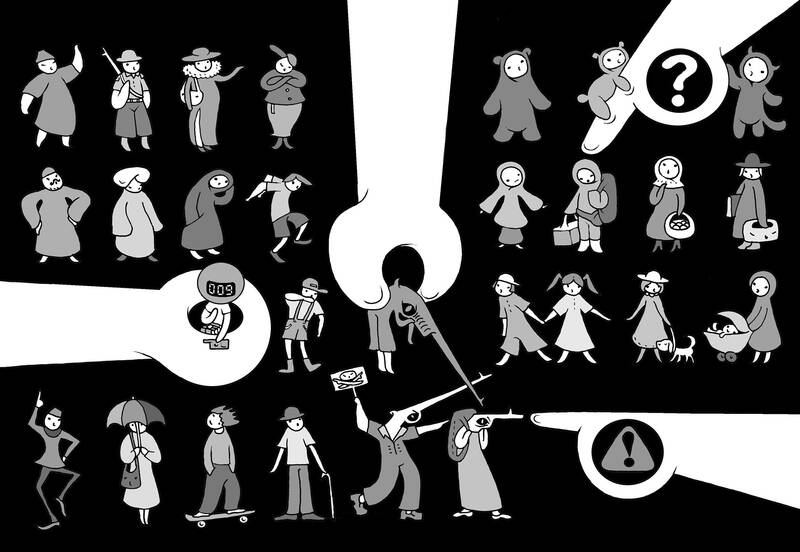
Illustration: Mountain People
Bondi — a suburb of low-rise apartments, multimillion-dollar family homes, and surfers strung between cliffs and sand on the azure waters of the Pacific — has been a center of Jewish life in Australia for more than a century.
As early as 1921, about one-third of Sydney’s Jewish community lived there and in neighboring suburbs in the city’s east, then a solidly working-class area. Thousands of migrants fleeing rising European anti-Semitism in the 1930s and 1940s joined them, building synagogues, social clubs and businesses.
In the years after World War II, billionaire property developers Frank Lowy and Harry Triguboff rose from, respectively, a Hungarian ghetto and Tianjin’s Russo-Jewish community to become two of Australia’s five richest people. Each has long-standing connections to the area and built up much of the neighboring suburb of Bondi Junction. One of the country’s most famous swimwear brands, Seafolly, was started in Bondi in 1975 by a Hungarian-born Holocaust survivor.
Bondi Beach has broader meaning to Australia, too. In an overwhelmingly secular nation, beaches represent something close to a sacred space. On the sand, there are no divisions of race, class or creed, and people from every corner of the planet can come together to barbecue, swim, sunbathe and socialize.
Sunday’s shootings feel like a conscious attack on both sides of that escapism: Australia as a physical refuge from political violence, and as a mental retreat from a world where polarization and hatred seem to be relentlessly rising.
The flip side was always a certain complacency. Jews fleeing the rise of Nazism in Europe were not always welcomed in a society whose official migration policy favored white northern Europeans until the 1970s.
The country has become increasingly polarized since the Hamas attack on a music festival in Israel on Oct. 7, 2023, killing 1,200 people and taking 251 hostages, and Israel’s subsequent war in Gaza that has so far killed more than 70,000 Palestinians.
A report released earlier this month by the Executive Council for Australian Jewry found there had been more anti-Jewish incidents in the past two years than in the previous 10 put together, including the torching of vehicles, graffiti sprayed on synagogues and homes, windows smashed, and myriad incidents of verbal and physical abuse. In the past 12 months alone there have been 1,654 such incidents.
Just last month, police authorized a neo-Nazi rally on the steps of the New South Wales parliament building in which black-shirted thugs hoisted a flag reading: “Abolish the Jewish Lobby.”
Such hatred is spreading on every side. Australian Prime Minister Anthony Albanese presides over a comfortable center-left hegemony that seems a world away from the far-right politics on the rise in Chile, France, Germany, the UK and the US. And yet the One Nation party, whose founder, Pauline Hanson, has vilified Asian, indigenous and Muslim people since the 1990s, would be the third-biggest faction in Australia’s House of Representatives if an election were held tomorrow, according to one recent poll.
There were 309 Islamophobic incidents in roughly two years through November last year, about double the rate of previous years.
Even Australia’s vaunted gun laws — passed in the wake of the 1996 Port Arthur shootings, in which a lone gunman killed 35 people — are looking increasingly threadbare. There are now more guns in the country than there were back then. The older of Sunday’s Bondi attackers had six firearms licensed to him.
The government has worked hard to halt the rising tide of anti-Semitic attacks, despite what some of its critics have alleged. It expelled Iran’s ambassador and three other diplomats in August after concluding that the country’s Revolutionary Guard directed at least two attacks, including the firebombing of a Jewish restaurant a few minute’s walk from Bondi Beach. Clearly, though, it has not been enough.
More can be done to investigate and prevent that, without violating Australia’s guarantees on free speech and civil liberties. A country that has just implemented a ban on most social media usage by under-16s also needs to take a hard look at how online platforms are being used to spread prejudice.
Let us not throw out the promise of safety and optimism that led people to gather at Sunday’s Hanukkah festival in the first place, though. If that tradition represents the triumph of light over darkness — the rededication of a sacred space despoiled by violence — then upholding that spirit now seems a fitting rebuke to this vile attack.
David Fickling is a Bloomberg Opinion columnist covering climate change and energy. Previously, he worked for Bloomberg News, the Wall Street Journal and the Financial Times. This column reflects the personal views of the author and does not necessarily reflect the opinion of the editorial board or Bloomberg LP and its owners.
This should be the year in which the democracies, especially those in East Asia, lose their fear of the Chinese Communist Party’s (CCP) “one China principle” plus its nuclear “Cognitive Warfare” coercion strategies, all designed to achieve hegemony without fighting. For 2025, stoking regional and global fear was a major goal for the CCP and its People’s Liberation Army (PLA), following on Mao Zedong’s (毛澤東) Little Red Book admonition, “We must be ruthless to our enemies; we must overpower and annihilate them.” But on Dec. 17, 2025, the Trump Administration demonstrated direct defiance of CCP terror with its record US$11.1 billion arms
We are used to hearing that whenever something happens, it means Taiwan is about to fall to China. Chinese President Xi Jinping (習近平) cannot change the color of his socks without China experts claiming it means an invasion is imminent. So, it is no surprise that what happened in Venezuela over the weekend triggered the knee-jerk reaction of saying that Taiwan is next. That is not an opinion on whether US President Donald Trump was right to remove Venezuelan President Nicolas Maduro the way he did or if it is good for Venezuela and the world. There are other, more qualified
China’s recent aggressive military posture around Taiwan simply reflects the truth that China is a millennium behind, as Kobe City Councilor Norihiro Uehata has commented. While democratic countries work for peace, prosperity and progress, authoritarian countries such as Russia and China only care about territorial expansion, superpower status and world dominance, while their people suffer. Two millennia ago, the ancient Chinese philosopher Mencius (孟子) would have advised Chinese President Xi Jinping (習近平) that “people are the most important, state is lesser, and the ruler is the least important.” In fact, the reverse order is causing the great depression in China right now,
As technological change sweeps across the world, the focus of education has undergone an inevitable shift toward artificial intelligence (AI) and digital learning. However, the HundrED Global Collection 2026 report has a message that Taiwanese society and education policymakers would do well to reflect on. In the age of AI, the scarcest resource in education is not advanced computing power, but people; and the most urgent global educational crisis is not technological backwardness, but teacher well-being and retention. Covering 52 countries, the report from HundrED, a Finnish nonprofit that reviews and compiles innovative solutions in education from around the world, highlights a


 RSS
RSS