


As the year comes to an end, economists at the IMF, the World Bank and several major research institutions have unveiled their assessments for this year and expectations for next year.
The global economy has experienced a limited recovery so far this year, given lukewarm macroeconomic conditions, they said, forecasting that the world economy would expand by between 2.8 percent and 3.2 percent this year.
Next year, global economic growth is set to slow from this year’s pace due to prolonged geopolitical uncertainty, more trade protectionism and a tighter labor supply, the economists said. Still they predict next year’s global economy to increase by 2.7 percent to 3.1 percent, benefiting mainly from artificial intelligence (AI) investments by governments and businesses around the world.
The US, Europe and major Asian countries are expected to accelerate their construction of AI infrastructure, with capital investments in semiconductors, data centers, fiber optics, cloud equipment and energy systems, economists said, adding that global technology giants, especially major cloud service providers, are likely to further raise their capital expenditures, with AI outlays as the core equipment investment.
Most economists also believe that expansionary fiscal policies worldwide would lend support to the global economy next year. For example, fiscal spending in the US is expected to further expand under the One Big Beautiful Bill Act, while many European countries would likely continue to increase their defense and energy budgets to support their economic activities and fend off Russia.
In Asia, the Chinese government is rolling out a 500 billion yuan (US$70.9 billion) initiative to promote tech-driven projects and urban renewal programs, while Japanese Prime Minister Sanae Takaichi has pledged to adopt a relatively proactive fiscal policy to protect people’s livelihoods and build a robust economy. Emerging markets such as Indonesia, India and Malaysia have also proposed tax cuts, infrastructure programs and government spending plans to boost domestic demand and employment, thereby driving regional economic growth.
Furthermore, the US Federal Reserve’s accommodative monetary policy is projected to help the world economy maintain its uptrend, despite market volatility, economists said. The rationale is that US interest rate changes are more than just a domestic issue — they also influence global trade in many aspects, from the strength of the US dollar to global capital flows, and from the financing costs of international trade to shifts in economic strategies worldwide, they added.
As widely expected, the US central bank concluded its final monetary policy committee meeting of the year on Wednesday last week by delivering a third 25-basis-point reduction to its key policy rate. The market consensus is that the appointment of the next Fed chair, who would take over in May next year, is likely to lower borrowing costs further and at a quicker pace amid public pressure from the White House, regardless of whether US National Economic Council Director Kevin Hassett or former Fed governor Kevin Warsh gets the position.
Against this backdrop, Taiwan’s economy has so far delivered a strong performance despite headwinds from tariff uncertainties and foreign exchange volatility from US President Donald Trump’s trade policy, thanks to the global AI boom, as well as local businesses pushing for digitalization and low-carbon transformation.
The Directorate-General of Budget, Accounting and Statistics last month raised its GDP growth forecast for this year to 7.37 percent, the highest in 15 years. However, the nation’s economy is expected to slow slightly next year compared with this year due to a high base effect.
The agency also predicted a 3.58 percent growth on the back of solid momentum in exports and domestic investments. While a robust stock market and a stable labor market would help boost consumer spending, the increasing gap between tech and non-tech sectors warrants closer attention. Firms in some non-tech manufacturing, construction and service industries might face pressure from unpaid leaves or layoffs due to US tariffs and China’s sluggish economy, which the government must respond to in a timely and effective manner.
A gap appears to be emerging between Washington’s foreign policy elites and the broader American public on how the United States should respond to China’s rise. From my vantage working at a think tank in Washington, DC, and through regular travel around the United States, I increasingly experience two distinct discussions. This divergence — between America’s elite hawkishness and public caution — may become one of the least appreciated and most consequential external factors influencing Taiwan’s security environment in the years ahead. Within the American policy community, the dominant view of China has grown unmistakably tough. Many members of Congress, as
The Hong Kong government on Monday gazetted sweeping amendments to the implementation rules of Article 43 of its National Security Law. There was no legislative debate, no public consultation and no transition period. By the time the ink dried on the gazette, the new powers were already in force. This move effectively bypassed Hong Kong’s Legislative Council. The rules were enacted by the Hong Kong chief executive, in conjunction with the Committee for Safeguarding National Security — a body shielded from judicial review and accountable only to Beijing. What is presented as “procedural refinement” is, in substance, a shift away from
The shifting geopolitical tectonic plates of this year have placed Beijing in a profound strategic dilemma. As Chinese President Xi Jinping (習近平) prepares for a high-stakes summit with US President Donald Trump, the traditional power dynamics of the China-Japan-US triangle have been destabilized by the diplomatic success of Japanese Prime Minister Sanae Takaichi in Washington. For the Chinese leadership, the anxiety is two-fold: There is a visceral fear of being encircled by a hardened security alliance, and a secondary risk of being left in a vulnerable position by a transactional deal between Washington and Tokyo that might inadvertently empower Japan
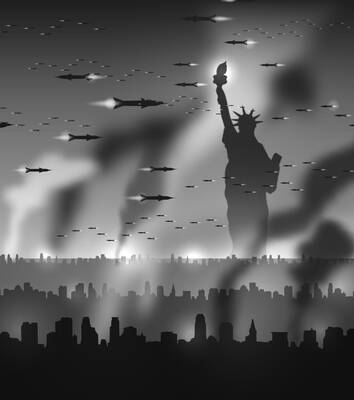
After declaring Iran’s military “gone,” US President Donald Trump appealed to the UK, France, Japan and South Korea — as well as China, Iran’s strategic partner — to send minesweepers and naval forces to reopen the Strait of Hormuz. When allies balked, the request turned into a warning: NATO would face “a very bad” future if it refused. The prevailing wisdom is that Trump faces a credibility problem: having spent years insulting allies, he finds they would not rally when he needs them. That is true, but superficial, as though a structural collapse could be caused by wounded feelings. Something


 RSS
RSS