


The next stage of the global artificial intelligence (AI) race would be decided not by algorithms or chips, but by electricity — and that puts China at a distinct advantage. While Western tech giants are emphasizing closed, capital-intensive models that demand enormous computing power, China is embracing open-source AI and massively expanding its renewable and nuclear-energy capacity, thereby positioning itself to deploy powerful AI technologies at scale without breaking the bank.
These differences reflect a more fundamental split. Whereas the US and its allies have treated AI as a proprietary technology, China has approached it as public infrastructure, building an open AI ecosystem that reflects the same philosophy it applied to manufacturing: broad adoption, fast iteration and relentless cost reduction.
Chinese open-source models like DeepSeek, Qwen and Kimi are not just scientific achievements; they are strategic instruments designed for participation and are transforming the economics of AI.
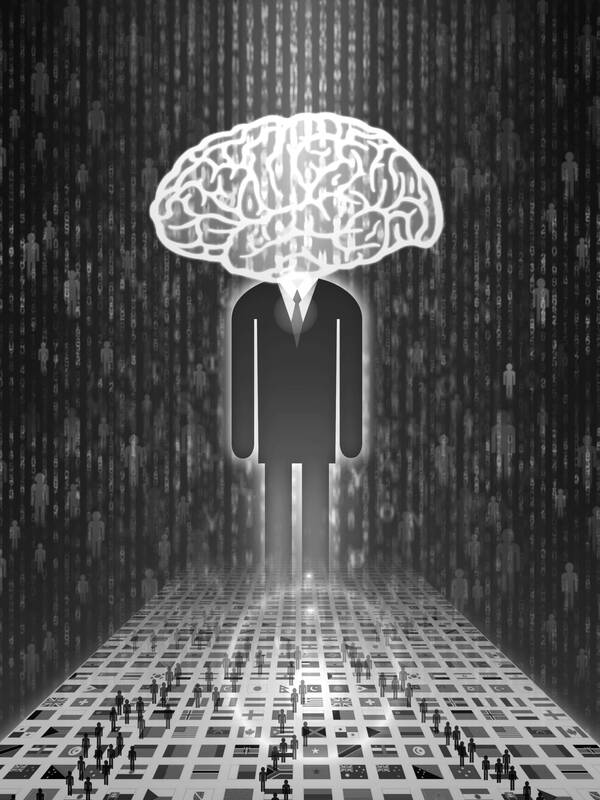
Illustration: Yusha
DeepSeek’s latest version reportedly matches the capabilities of frontier systems, such as those being developed by US companies, at a fraction of their compute cost. Qwen and Kimi’s annual program interface prices — that is, the fees developers pay to access the models through an online interface and integrate them into their own software — have fallen by orders of magnitude. In purely economic terms, the marginal cost of “thought” is collapsing. The inference costs of some Chinese models are one-tenth or less of those incurred by OpenAI’s GPT-4.
However, the cheaper AI becomes, the more of it the world consumes, with each token saved inviting a thousand more to be generated. The same dynamic that once powered the coal age now drives the digital one. In China, this is by design: low inference costs, together with the open weights of Chinese models, are intended to invite experimentation across universities, start-ups and local governments.
However, all that activity requires energy: the International Energy Agency expects global electricity consumption from data centers to double by 2030 (from last year’s levels), driven largely by AI workloads. Training GPT-4 alone likely consumed millions of kilowatt-hours — enough to power San Francisco for three days.
What once was a contest of algorithms is fast becoming a contest of kilowatts, and China is setting itself up to win. Last year, the country added 356 gigawatts of renewable-energy capacity — more than the US, the EU and India combined — with 91 percent of all new generation coming from solar, wind and hydro. Battery storage tripled from 2021 levels, and an ultra-high-voltage grid now carries clean power thousands of miles, from deserts to data hubs.
China is also investing heavily in nuclear energy. Its nuclear research and development spending is about five times higher than that of the US, data compiled by the Information Technology and Innovation Foundation showed. As its fourth-generation reactors and small modular designs advance from pilot to deployment, nuclear energy is quietly providing the baseload power that intermittent renewables cannot.
This combination of open AI models, cheap renewables and a stable supply of nuclear power forms what might be called an energy-compute flywheel: more clean power enables more compute, which in turn optimizes the grid. Already, machine-learning systems are predicting solar output, managing energy storage and balancing load across China’s vast power network in real time. The result is a reorganization of industry, as the traditional boundaries between energy, semiconductors and software vanish. Data centers are the new power plants; graphics processing units are the new turbines. China is not merely electrifying its industry; it is electrifying its intelligence.
Beyond strengthening its own clean-energy grid, China is exporting the building blocks of the world’s new energy system. Its clean-tech exports — including solar panels, grid batteries and electric vehicles — hit a record US$20 billion in August, overtaking its consumer-electronics shipments from a decade earlier. Even if the West exports chips and software, it is China that is producing the electrons that make them useful.
Meanwhile, the West’s energy constraints — aging grids, slow permitting processes and high prices — are creating digital bottlenecks. In the US and elsewhere, data-center expansion is increasingly limited by access to a reliable supply of electricity. Some jurisdictions — such as Virginia and Dublin, Ireland — face moratoria on new data centers.
Industrial revolutions have always favored the societies that could convert energy into productivity most efficiently. In the 19th century, coal was the key to empire. In the 20th century, oil was king, and in the 21st century, it would be clean power paired with compute. Whoever commands the cheapest electrons would command the cheapest intelligence — and reap the benefits of growing abundance on both fronts.
China is positioning itself to occupy this coveted position, thanks to a systemic alignment of investment and incentives that democracies would find difficult to replicate quickly, but it is not the only country that stands to gain from its success. For emerging economies that have long been priced out of high-performance computing, open-weight models and falling energy costs could make AI accessible and even essential, much like electricity or broadband.
However, abundance does not guarantee stability. Without sufficient investment in clean-energy generation and storage, surging energy demand for AI could strain grids and undermine progress on decarbonization. Like in the industrial age, efficiency could lead to excess, and progress could be accompanied by growing imbalances. Managing the tension between abundance and restraint would determine whether AI becomes a tool of empowerment or a new driver of inequality.
Two centuries ago, the steam engine converted heat into motion — and remade the global economy. Today, AI is transforming electricity into cognition, and whoever masters both would again rewrite the rules of progress.
Jeffrey Wu is director at MindWorks Capital.
Copyright: Project Syndicate
A recent report concerning a student who is suing his teacher posed the question in its headline: Does failing a student in two subjects constitute bullying? The college student in Chiayi County apparently sought NT$2 million (US$63,603) in state compensation, but a court dismissed the case. The first reaction of many might have been to ask: What has happened to students nowadays? Some say that teachers have lost their authority, while others say students are overindulged. Some even start reminiscing over the days when “whatever the teacher says goes.” However, the real issue might be overlooked if emotional reactions like that are the
When I visited Taiwan last summer, I called on the nation to use its status as a technology superpower to build superweapons. It is obvious to me as I return a year later that Taiwan is now answering that call. By 2030, Taiwan envisions a domestic drone hub, capable of producing large quantities of drones per year. The nation continues to tighten cooperation across the private sector, scientific researchers and the elected government, on creating new and innovative production avenues for defense, while efforts to become central to the “democratic supply chain” are only increasing. Anduril is seeing all of these positive
Singaporean former Prime Minister and current senior minister Lee Hsien- Loong(李顯龍) last month stood on Chinese soil and told Beijing that Singapore cooperates because of “shared interests”, not because of common “ethnic descent,” a significant statement that has upended China’s cognitive warfare tactics of “ethnic nationalism.” Along with using its military buildup and economic growth to expand its international dominance, China has long deployed ethnic politics to promote the idea that all ethnic Chinese around the world, regardless of citizenship, share a tight bond with the Chinese motherland, by which it means the regime of the People’s Republic of China (PRC)
President William Lai Ching-te’s (賴清德) May 20 second-anniversary address was not just a routine policy review; it was damage control. US President Donald Trump’s remarks — that he did not want to see anyone move toward independence and that the delivery of a major Taiwan arms package could depend on the progress of US-China relations — unsettled Taiwan’s public and created an opening for opposition parties to question whether Taiwan was being treated as a bargaining chip in Washington’s dealings with Beijing. Lai’s speech was designed to close that opening. The address covered the expected ground: sovereignty, cross-strait relations, defense spending,


 RSS
RSS