


The world has become less predictable, less rules-based, and more shaped by the impulses of strongmen and short-term dealmaking.
Nowhere is this more consequential than in East Asia, where the fate of democratic Taiwan hinges on how global powers manage — or mismanage — tensions with an increasingly assertive China.
The return of Donald Trump to the White House has deepened the global uncertainty, with his erratic, highly personalized foreign-policy approach unsettling allies and adversaries alike. Trump appears to treat foreign policy like a reality show.
Yet, paradoxically, the global unpredictability may offer Taiwan unexpected deterrence. For China, the risk of provoking the United States may now outweigh the temptation of taking Taiwan by force.
Trump’s foreign policy is less about strategy than instinct. Unlike past American presidents who embedded US commitments in alliances and treaties, Trump approaches diplomacy as a real estate mogul might: transactional, impulsive, and often devoid of historical context. For Taiwan, this raises uncomfortable questions. Can it continue to rely on a US security umbrella under a president who has questioned the value of NATO, threatened to pull US troops from South Korea, and hinted in the past at making deals with China at Taiwan’s expense?
Under a president whose loyalty to democratic norms is ambiguous and whose geopolitical thinking centers on short-term leverage, Taiwan could easily become a pawn in a larger bargain — or worse, left to fend for itself. Trump has previously oscillated between fiery rhetoric on China and overtures of camaraderie with Chinese President Xi Jinping (習近平). His unpredictability breeds confusion in Taipei, and, perhaps more dangerously, could encourage miscalculation in Beijing.
However, unpredictability is not always a strategic liability. In the context of Taiwan’s security, it can act as a form of deterrence — especially when facing an increasingly authoritarian and repressive regime like China’s that prizes control and risk management.
Trump’s military strike on Iran last month, executed with little consultation or warning, sent a jolt through global capitals. For Beijing, it was a sharp reminder that a Trump-led America could respond to Chinese aggression not with diplomatic caution, but with military intervention.
This lesson is not lost on China’s leadership, especially at a time when intra-party power struggles in Beijing are raising questions about Xi’s one-man dictatorship.
Despite its military build-up and increasingly bellicose rhetoric on Taiwan, China remains fundamentally cautious about entering a war it cannot control. The US military still possesses unmatched power projection capabilities in the Indo-Pacific. And now, with Trump in office again, the risks of a US military response to a Taiwan invasion — while not guaranteed — appear less abstract than they might under a more cautious administration in Washington.
Indeed, the combination of Trump’s volatility and America’s military reach could force China to recalibrate its timetable on Taiwan.
Xi may still view “reunification” as a historic mission, but he must weigh that ambition against a backdrop of rising internal vulnerabilities — including economic stagnation, demographic decline, eroding international goodwill and sharpening power rivalries within the Chinese Communist Party. Trump’s return to power, with its promise of intensified economic confrontation and strategic pressure, only accentuates those challenges.
At the same time, the broader geopolitical environment is shifting in ways that offer Taiwan both risks and opportunities. On one hand, Trump’s disdain for traditional alliances weakens the cohesion of the democratic front that has helped shield Taiwan diplomatically and militarily. On the other hand, growing concerns about Chinese assertiveness — from Japan and South Korea to the Philippines and India — have created a more favorable regional climate for closer defense cooperation with Taiwan, even if done quietly and informally.
Europe, too, is awakening to the Taiwan question. While Trump’s disdain for the EU may hinder transatlantic coordination, the European Parliament and several key EU member states have become more vocal in opposing any change to the status quo across the Taiwan Strait. These diplomatic gains, while modest, offer Taiwan a broader base of international sympathy in the event of a crisis.
Ultimately, Taiwan is navigating a world in flux — one where neither deterrence nor diplomacy can be taken for granted. Trump’s second term has added a layer of strategic fog to an already unstable international order.
But this fog is not entirely to Taiwan’s disadvantage. The fear that Trump might launch a military response to a Chinese invasion — not out of alliance loyalty, but out of rage or opportunism — may be precisely the uncertainty that keeps Beijing at bay.
Still, deterrence rooted in unpredictability is fragile and cannot substitute for a coherent long-term strategy.
Taiwan must be vigilant as it continues to strengthen its asymmetric defense capabilities, deepen its informal security partnerships and build public resilience. It must also avoid putting all its eggs in Washington’s basket, especially when that basket is being carried by a man who has repeatedly broken with tradition, institutions, and norms.
In an age where geopolitics is shaped as much by personality as by policy, Taiwan’s fate will hinge not just on its own resolve, but on its ability to read and adapt to a rapidly shifting international landscape.
In this precarious balancing act, Taiwan remains both a frontline of democracy and a test case for how smaller powers can survive — and even thrive — amid great-power struggles and global uncertainty.
Brahma Chellaney, professor of strategic studies at the independent Center for Policy Research in New Delhi, is the author of nine books, including the award-winning Water: Asia’s New Battleground (Georgetown University Press).
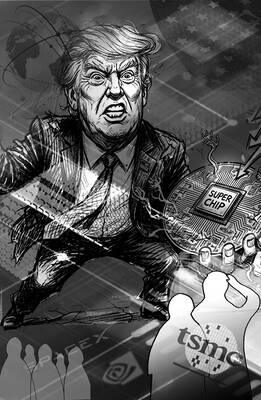
The White House’s decision to take a 9.9 percent stake in Intel Corp is looking like very shrewd business indeed. Since the government bought in at US$20.47 a share last August, the US chipmaker’s surging stock price has delivered the US a US$43 billion return. One of the reasons the investment has so far proved so sound is that the White House has made sure of it. According to The Wall Street Journal, Howard personally pushed deals on Intel’s behalf with some of the most lucrative clients imaginable. They include Nvidia Corp, the company at the heart of the AI
In a Taiwanese university classroom, a lecturer asks in English: “Can anyone give me an example from Taiwan?” Students look down. No one answers. After class, one student writes on the course platform in Mandarin: “I understood the concept, but I didn’t know how to answer in English.” That moment highlights a key issue in Taiwan’s English-medium instruction (EMI) reform: It is not just about more English-taught courses, but whether students can learn, participate and belong. EMI expansion is part of the Bilingual 2030 policy and the Ministry of Education’s BEST Program, aiming to improve English ability, support EMI teaching
A single photograph can cut through a lot of noise, but it can also be used to misrepresent the truth. At the very least, it can concentrate the mind on something that requires further investigation. On Monday last week, Ma Ying-jeou Foundation CEO Tai Hsia-ling (戴遐齡) and former National Security Council secretary-general King Pu-tsung (金溥聰) held a news conference in which they showed a photograph of former foundation CEO Hsiao Hsu-tsen (蕭旭岑), now Chinese Nationalist Party (KMT) deputy chairman. In the image Hsiao is seated next to Xiamen Taiwan Businessmen Association chairman Han Ying-huan (韓螢煥). The two men were holding
The Ministry of the Interior, working with the navy and coast guard, is organizing Taiwan’s first joint exercise simulating escort tankers carrying liquefied natural gas (LNG) and oil through a Chinese blockade. The drills simulate fuel transport along three maritime corridors leading toward Japan, the Philippines and the US. Deputy Minister of the Interior Sawyer Mars (馬士元) said that a blockade of the Taiwan Strait would amount to “almost a 100 percent blockade of the regional energy supply.” Minister of National Defense Wellington Koo said planning to counter a blockade is standard practice in Taipei. While the exercise is limited in


 RSS
RSS