


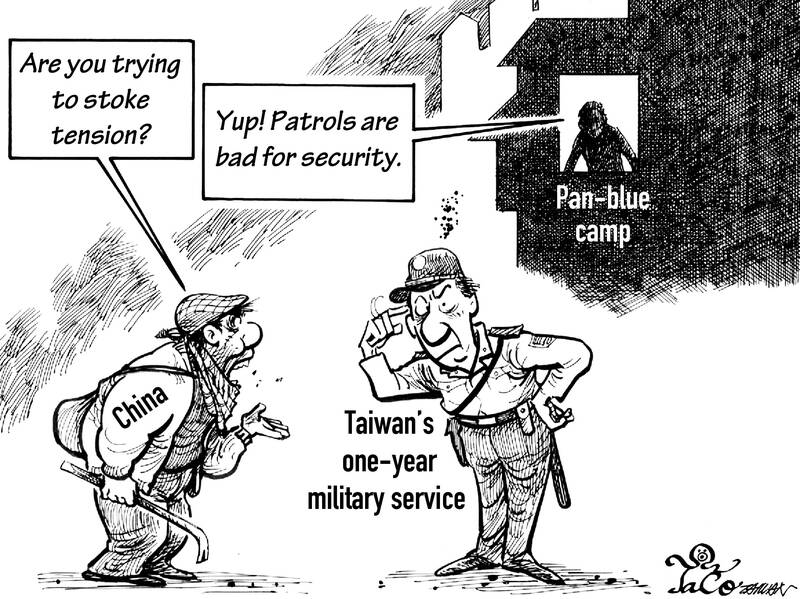
EDITORIAL CARTOON
We are used to hearing that whenever something happens, it means Taiwan is about to fall to China. Chinese President Xi Jinping (習近平) cannot change the color of his socks without China experts claiming it means an invasion is imminent. So, it is no surprise that what happened in Venezuela over the weekend triggered the knee-jerk reaction of saying that Taiwan is next. That is not an opinion on whether US President Donald Trump was right to remove Venezuelan President Nicolas Maduro the way he did or if it is good for Venezuela and the world. There are other, more qualified
This should be the year in which the democracies, especially those in East Asia, lose their fear of the Chinese Communist Party’s (CCP) “one China principle” plus its nuclear “Cognitive Warfare” coercion strategies, all designed to achieve hegemony without fighting. For 2025, stoking regional and global fear was a major goal for the CCP and its People’s Liberation Army (PLA), following on Mao Zedong’s (毛澤東) Little Red Book admonition, “We must be ruthless to our enemies; we must overpower and annihilate them.” But on Dec. 17, 2025, the Trump Administration demonstrated direct defiance of CCP terror with its record US$11.1 billion arms
China’s recent aggressive military posture around Taiwan simply reflects the truth that China is a millennium behind, as Kobe City Councilor Norihiro Uehata has commented. While democratic countries work for peace, prosperity and progress, authoritarian countries such as Russia and China only care about territorial expansion, superpower status and world dominance, while their people suffer. Two millennia ago, the ancient Chinese philosopher Mencius (孟子) would have advised Chinese President Xi Jinping (習近平) that “people are the most important, state is lesser, and the ruler is the least important.” In fact, the reverse order is causing the great depression in China right now,
As technological change sweeps across the world, the focus of education has undergone an inevitable shift toward artificial intelligence (AI) and digital learning. However, the HundrED Global Collection 2026 report has a message that Taiwanese society and education policymakers would do well to reflect on. In the age of AI, the scarcest resource in education is not advanced computing power, but people; and the most urgent global educational crisis is not technological backwardness, but teacher well-being and retention. Covering 52 countries, the report from HundrED, a Finnish nonprofit that reviews and compiles innovative solutions in education from around the world, highlights a


 RSS
RSS