


The Chinese communist Party’s cruel and abusive Zero-COVID lockdown policy has been a disaster. At home, it has brought incalculable suffering to the Chinese people, while abroad it has made the country a laughingstock to the rest of the world. Since the outbreak of the pandemic, the Chinese people have been compelled to adhere to this draconian policy, conceived and orchestrated by Xi Jinping (習近平). Xi showed no signs of brooking compromises or changing course, despite the calamity he brought to the nation.
However, over the last couple of weeks, we have seen Xi’s resolve shaken by mass protests throughout China. Faced with nationwide outrage, Xi had no alternative but to implement a set of humiliating compromises in the interest of maintaining the stability of the Chinese Communist Party’s (CCP) authoritarian regime. Inexplicably, the Zero-COVID policy that had been in place for the length of the pandemic came tumbling down overnight, with restrictions and regulations suddenly relaxed throughout China.
This is what dictatorships are like: they govern with an iron fist, but with it they also tend to go where the wind blows. They can be ferocious and draconian one day and flip 180 degrees the next if they sense a challenge to their monopoly of power. They care little for consistency and severe consequence of drastic and swift policy swings without adequate preparation, so long as their dictatorship prolongs and prospers.
There is nothing surprising about the failure of Zero-COVID policy. In fact, it mirrors similar CCP policy disasters. It is comparable to two other policy abominations: the Great Leap Forward and the Cultural Revolution. They might differ in the scale and magnitude of the suffering that they wrought on the people, but their inherent logic, their modus operandi, and their development are remarkably identical.
What the Great Leap Forward, the Cultural Revolution, and Zero-COVID have in common, is their stupefying hubris. They assume the Party and its supreme leader are so powerful and capable, that with an order they can eradicate all the vermin, pests, sparrows, “revisionists,” and viruses they choose not to like.
The Great Leap Forward was motivated by Mao’s desire to see China surpass Britain and catch up with the US within a short period of time. The Cultural Revolution was to continue the communist revolution by opposing revisionism abroad and preventing it at home. Zero-COVID, for its part, is to reduce infections to zero nationwide. All three lunacies are meant to showcase the Chinese communists’ all-encompassing greatness.
From the outset of the COVID outbreak in Wuhan, Xi has stuck to his plan, which he perceives to be superior to those adopted by advanced industrial democracies. As a result, he has ignored common sense and science, causing immense human suffering. Supremely confident in his approach, Xi sought to position himself and the CCP’s model for pandemic response as a beacon of salvation for the rest of the world. The CCP would lead us all out of the deadly pandemic, garnering praise for Beijing and the Supreme Leader, guiding us ever closer to fulfilling the common destiny of mankind under the CCP’s brilliant leadership.
These dramatic aims appear quite silly as the virus proves to be smarter than the severely under-educated Xi. But the supreme leader however could not admit the failure of his policy, and thus, he made support for Zero-COVID a test of every party member’s loyalty to him, the Party, and ultimately the communist cause. To oppose the Zero-COVID policy is to oppose Xi; to oppose Xi is to oppose the Party; and to oppose the Party is to oppose communism itself.
It is little wonder, then, that senior CCP officials, well aware of Xi’s capacity for ruthless purges, would prostrate themselves before him and keep silent about the absurdity and inhumanity of Zero-COVID. No senior CCP leader has openly uttered any meaningful objection to Xi’s lunacy. The only real opposition has come from outside the Communist Party, from the angry, loud and brave protesters in the streets, in all the major cities and metropolises across the country.
The nationwide protests, unprecedented since 1989, threatened the stability of the CCP’s power. But there is another situation that compelled Xi to make the inevitable compromise: his Zero-COVID lockdowns have ruined the Chinese economy, the world’s second largest.
Like Mao’s Great Leap Forward and the Cultural Revolution, Xi’s Zero-COVID policy had brought the Chinese economy to the brink of collapse. Under Zero-COVID, millions of ordinary people lost their jobs and millions of businesses were forced to shut down. Production in China, the world’s factory, came to a shuddering halt. Virtually all the foreign companies operating in Guangdong’s Dongguan City, the world’s largest manufacturing base, including Sanyo, Panasonic, Sony, Nokia, Canon, Epson and Cisco, have fled.
The Zero-COVID lockdowns led to a mass exodus of employees and a shutdown of production at the Foxconn factory in Zhengzhou, which produces 80 percent of the world’s Apple phones, and Apple has been forced to look outside of China for other production bases to expedite its flight from China. With Christmas just around the corner, orders from around the world to the hobbled Chinese factories are down by nearly 40 percent. Within China, November 11th, the biggest consumer day in the country, known as Singles Day in China, saw sales drop by 42 percent.
Investor confidence in Chinese companies has plummeted, causing the stocks of almost all the leading Chinese companies like Alibaba and Tencent to fall at an unprecedented rate. The central, provincial, and local governments have wasted enormous resources building huge concentration camp-style mobile cabin hospitals, Orwellian rapid-testing stations, and all manner of control mechanisms to keep the costly Zero-COVID policy running. Zero-COVID has run the finances of every province in China into the red.
In short, Zero-COVID has shattered the myth of the CCP’s economic miracle. Just like Mao during the Great Leap Forward and the Cultural Revolution, Xi has managed to once again bring China’s economy to near collapse.
Like Mao’s Great Leap Forward and the Cultural Revolution, Xi’s Zero-COVID policy has fostered deep suspicion and distrust of the CCP and of the prudence and competence of China’s leaders, not just in the eyes of the Chinese people, but throughout the world.
Xi had intended to display to the world the glory and superiority of the CCP and China’s socialist system, but this backfired miserably. All Zero-COVID proved in the end was the arrogance, incompetence, stupidity, and cruelty of the communist system, and the protests demonstrated the disappointment, desperation, and anger of the people toward their rulers. When repression deepens, the Chinese people want to flee, en masse.
On Dec. 6, the day after the sudden relaxation of the Zero-COVID policy, the most searched phrase on WeChat by Chinese people was “emigration” (移民), with over 116 million entries. The philosophy of the CCP is the philosophy of “struggle,” while the philosophy of the Chinese people under CCP rule is either the philosophy of “lying flat” (躺平),a pervasive form of passive resistance and disengagement with the CCP, or the philosophy of “RUN” (潤), a phonetic adaptation of the English word “run,” to mean the study of how to flee from China.
Given how flagrantly incompetent and callous the CCP has proven itself, what right does it have to think it can achieve “the great rejuvenation of the Chinese nation”?
Miles Yu served as the senior China policy and planning advisor to Secretary of State Mike Pompeo during the Trump Administration.
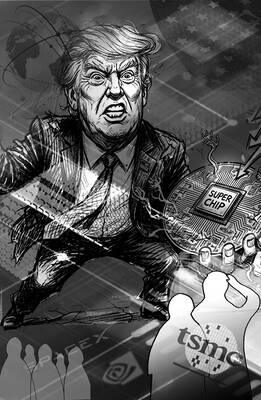
The White House’s decision to take a 9.9 percent stake in Intel Corp is looking like very shrewd business indeed. Since the government bought in at US$20.47 a share last August, the US chipmaker’s surging stock price has delivered the US a US$43 billion return. One of the reasons the investment has so far proved so sound is that the White House has made sure of it. According to The Wall Street Journal, Howard personally pushed deals on Intel’s behalf with some of the most lucrative clients imaginable. They include Nvidia Corp, the company at the heart of the AI
In a Taiwanese university classroom, a lecturer asks in English: “Can anyone give me an example from Taiwan?” Students look down. No one answers. After class, one student writes on the course platform in Mandarin: “I understood the concept, but I didn’t know how to answer in English.” That moment highlights a key issue in Taiwan’s English-medium instruction (EMI) reform: It is not just about more English-taught courses, but whether students can learn, participate and belong. EMI expansion is part of the Bilingual 2030 policy and the Ministry of Education’s BEST Program, aiming to improve English ability, support EMI teaching
The Ministry of the Interior, working with the navy and coast guard, is organizing Taiwan’s first joint exercise simulating escort tankers carrying liquefied natural gas (LNG) and oil through a Chinese blockade. The drills simulate fuel transport along three maritime corridors leading toward Japan, the Philippines and the US. Deputy Minister of the Interior Sawyer Mars (馬士元) said that a blockade of the Taiwan Strait would amount to “almost a 100 percent blockade of the regional energy supply.” Minister of National Defense Wellington Koo said planning to counter a blockade is standard practice in Taipei. While the exercise is limited in
A single photograph can cut through a lot of noise, but it can also be used to misrepresent the truth. At the very least, it can concentrate the mind on something that requires further investigation. On Monday last week, Ma Ying-jeou Foundation CEO Tai Hsia-ling (戴遐齡) and former National Security Council secretary-general King Pu-tsung (金溥聰) held a news conference in which they showed a photograph of former foundation CEO Hsiao Hsu-tsen (蕭旭岑), now Chinese Nationalist Party (KMT) deputy chairman. In the image Hsiao is seated next to Xiamen Taiwan Businessmen Association chairman Han Ying-huan (韓螢煥). The two men were holding


 RSS
RSS