


Later this month, the Indian Navy is to dispatch a task force of four ships to the South China Sea. During the deployment, the ships are to join the other nations of the Quadrilateral Security Dialogue, also known as the “Quad” — Japan, Australia and the US — for joint military exercises off the coast of Guam.
The deployment is much more significant than just a freedom of navigation operation in the contested region. During the past 18 months or so, India has been devastated by the COVID-19 pandemic, posting huge economic losses while increasing its military expenditure.
The deployment — which also includes bilateral exercises with the navies of claimant nations in the South China Sea, including Singapore, Vietnam, Indonesia and the Philippines — marks New Delhi’s return to South China Sea affairs in the post-pandemic world.
COVID-19 has wreaked havoc in India, perhaps more than in any other country, with religious and political gatherings quickening the spread of the disease. About two-thirds of Indians are estimated to have antibodies against the virus so that the country is nearing herd immunity. Unlike China, India is not obsessed about the country’s image during the pandemic: Many Indians continue to walk barefoot in an almost deliberate display of fearlessness in the face of death.
For India’s many poor, if they do not perish from COVID-19, they might fall victim to hunger. When there is already so much suffering, why fear a virus?
Meanwhile, the Indian Army has been forced to station 200,000 soldiers in the Himalayas to defend its northern border against Chinese troops in temperatures as low as minus-30oC.
Who will pick up the tab for the massive surge of troops? Since Beijing will not compensate India, New Delhi has been left with no choice but to find compensation in the South China Sea.
Having claimed nearly the entirety of the sea as its sovereign waters, China has been scheming like there is no tomorrow.
Beijing has proposed a framework to discuss the joint development and exploitation of the sea’s resources among claimant nations.
However, all discussions were either kicked into the long grass, delayed or their terms were altered, and all eventually fizzled out.
At the same time, Beijing has been actively exploiting its possessions, engaging in land reclamation and construction of artificial islands on reefs and other features.
Unwilling to allow Beijing to get away with this, the US government intervened, using its formidable navy to carry out regular freedom of navigation operations and slice through China’s ring-fenced portions of the sea.
This had the additional effect of suppressing the momentum of Beijing’s Belt and Road Initiative.
Neither Washington nor Tokyo are predisposed to becoming isolated within China’s global trade empire and have formed an alliance.
Of the other Western nations that have sent naval assets to the South China Sea, nearly all are big players in the petroleum industry and have a close eye on the potential profits buried underneath the sea bed, anticipating potential cooperation with the region’s nations rivaling China’s claims.
Now that India has joined the party, Taiwan should use this opportunity to pursue strategic oil exploitation with New Delhi.
Even after oil extraction begins, Taiwan would continue to import oil from the US, as it does today, but it would be able to sell any oil that it does not need back to India, or alternatively sell it in the international oil market.
A growing India will require a large amount of oil to fuel its economy.
Petroleum refining is one of Taiwan’s strengths, while India is extremely proficient in the information technology sector. Although Taiwan’s tech industry is a force to be reckoned with, in terms of capitalization and technology, its firms will find it hard to compete with Indian companies as the country seeks to achieve dominance in the industry.
If Taiwanese companies’ strategy to gain a foothold in the Indian market is based on their position in Apple Inc’s supply chain, they must recognize that Apple is first and foremost a US company and therefore enjoys Washington’s backing.
Taiwanese contract manufacturers such as Wistron, which had a riot at one of its Indian plants in December last year, do not.
If Taipei wants to increase Taiwan’s value in the eyes of New Delhi, offering a strategic partnership with regard to oil extraction would be a valuable card to play, and might herald the beginning of a new Taiwanese economic miracle for the 21st century.
Lin Hsiao-chen holds a doctorate in international relations from Jawaharlal Nehru University in India.
Translated by Edward Jones
A gap appears to be emerging between Washington’s foreign policy elites and the broader American public on how the United States should respond to China’s rise. From my vantage working at a think tank in Washington, DC, and through regular travel around the United States, I increasingly experience two distinct discussions. This divergence — between America’s elite hawkishness and public caution — may become one of the least appreciated and most consequential external factors influencing Taiwan’s security environment in the years ahead. Within the American policy community, the dominant view of China has grown unmistakably tough. Many members of Congress, as
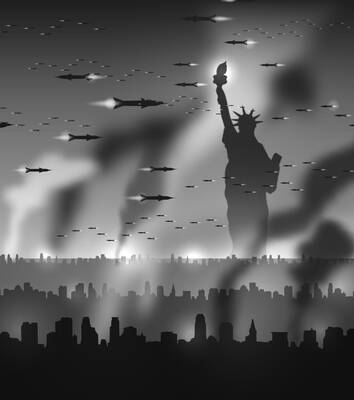
After declaring Iran’s military “gone,” US President Donald Trump appealed to the UK, France, Japan and South Korea — as well as China, Iran’s strategic partner — to send minesweepers and naval forces to reopen the Strait of Hormuz. When allies balked, the request turned into a warning: NATO would face “a very bad” future if it refused. The prevailing wisdom is that Trump faces a credibility problem: having spent years insulting allies, he finds they would not rally when he needs them. That is true, but superficial, as though a structural collapse could be caused by wounded feelings. Something
Former Taipei mayor and Taiwan People’s Party (TPP) founding chairman Ko Wen-je (柯文哲) was sentenced to 17 years in prison on Thursday, making headlines across major media. However, another case linked to the TPP — the indictment of Chinese immigrant Xu Chunying (徐春鶯) for alleged violations of the Anti-Infiltration Act (反滲透法) on Tuesday — has also stirred up heated discussions. Born in Shanghai, Xu became a resident of Taiwan through marriage in 1993. Currently the director of the Taiwan New Immigrant Development Association, she was elected to serve as legislator-at-large for the TPP in 2023, but was later charged with involvement
Out of 64 participating universities in this year’s Stars Program — through which schools directly recommend their top students to universities for admission — only 19 filled their admissions quotas. There were 922 vacancies, down more than 200 from last year; top universities had 37 unfilled places, 40 fewer than last year. The original purpose of the Stars Program was to expand admissions to a wider range of students. However, certain departments at elite universities that failed to meet their admissions quotas are not improving. Vacancies at top universities are linked to students’ program preferences on their applications, but inappropriate admission


 RSS
RSS