


Taiwan’s first drag queen to compete on the internationally acclaimed RuPaul’s Drag Race, Nymphia Wind (妮妃雅), was on Friday crowned the “Next Drag Superstar.”
Dressed in a sparkling banana dress, Nymphia Wind swept onto the stage for the final, and stole the show.
“Taiwan this is for you,” she said right after show host RuPaul announced her as the winner.

Photo: Screen grab from Nymphia Wind’s Instagram
“To those who feel like they don’t belong, just remember to live fearlessly and to live their truth,” she said on stage.
One of the frontrunners for the past 15 episodes, the 28-year-old breezed through to the final after weeks of showcasing her unique style, which often tapped into her Asian background.
All three of the contestants facing off in the final looked at times as if they could clinch the top spot with excellent performances and lip-synching.
Only seven Asians have ever made it to the top four since the show premiered in 2009.
Throughout her run on the show, Nymphia gained strong support from home and abroad, which only grew as more episodes aired.
On top of mastering Taiwanese style with her traditional opera makeup, Nymphia also perfected Japanese butoh, European Rococo style and even went as far as dressing as a flower in a pot.
Nymphia often uses yellow in her costumes, which she says is a mix of camp and pop art, and is also a nod to a well-known sexual innuendo — the banana.
Despite making it big in the US, Nymphia still considers her home bar to be Cafe Dalida in the “Red House” area of Taipei — the birthplace of a number of the city’s drag queens.
The bar’s owner, Alvin Chang (張原韶), who hosts weekly screenings of RuPaul’s Drag Race, said he is proud of Nymphia and what she has achieved.
“She’s not the kind of person who waits for people to give her opportunities. She creates them herself,” Chang said.
In an interview in December last year, when the show first revealed its list of competitors, Nymphia said she was excited, but also stressed because she “didn’t want to let Taiwanese people down.”
Reflecting on the show, she wrote on social media that “drag lets me reconnect with my culture; it teaches me to be a proud Asian.”
“The talent show was definitely an opportunity for me to showcase something I didn’t think I would be able to in a competition setting — traditional Asian sleeve dance,” she said. “So, of course, I had to take this chance to really show what us Asians are made of.”
President Tsai Ing-wen (蔡英文) yesterday congratulated Nymphia Wind, the first person from East Asia to win the crown.
“Congratulations to you, Nymphia Wind, for being so accomplished in the difficult art form of drag, and for being the first Taiwanese to take the stage and win on RuPaul’s Drag Race,” Tsai wrote in English on Instagram.
“Right after being crowned queen, you said: ‘Taiwan, this is for you.’ Taiwan thanks you for living fearlessly,” she wrote.
Additional reporting by Reuters
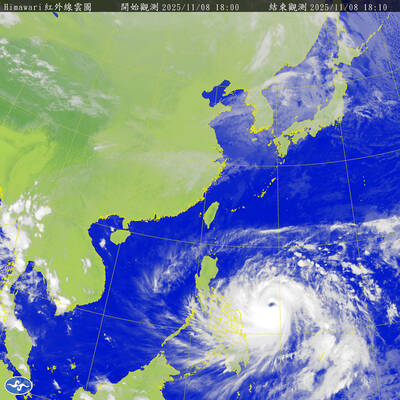
The Central Weather Administration (CWA) yesterday said it expected to issue a sea warning for Typhoon Fung-Wong tomorrow, which it said would possibly make landfall near central Taiwan. As of 2am yesterday, Fung-Wong was about 1,760km southeast of Oluanpi (鵝鑾鼻), Taiwan’s southernmost point, moving west-northwest at 26kph. It is forecast to reach Luzon in the northern Philippines by tomorrow, the CWA said. After entering the South China Sea, Typhoon Fung-Wong is likely to turn northward toward Taiwan, CWA forecaster Chang Chun-yao (張峻堯) said, adding that it would likely make landfall near central Taiwan. The CWA expects to issue a land
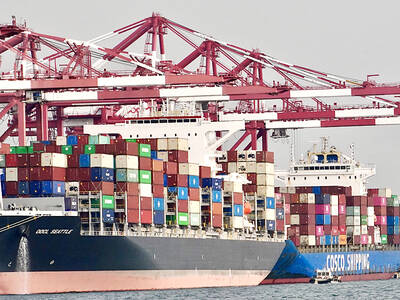
Taiwan’s exports soared to an all-time high of US$61.8 billion last month, surging 49.7 percent from a year earlier, as the global frenzy for artificial intelligence (AI) applications and new consumer electronics powered shipments of high-tech goods, the Ministry of Finance said yesterday. It was the first time exports had exceeded the US$60 billion mark, fueled by the global boom in AI development that has significantly boosted Taiwanese companies across the international supply chain, Department of Statistics Director-General Beatrice Tsai (蔡美娜) told a media briefing. “There is a consensus among major AI players that the upcycle is still in its early stage,”
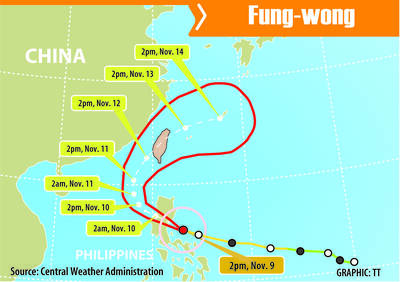
The Central Weather Administration (CWA) yesterday said it is expected to issue a sea warning for Typhoon Fung-wong this afternoon and a land warning tomorrow. As of 1pm, the storm was about 1,070km southeast of Oluanpi (鵝鑾鼻), Taiwan’s southernmost point, and was moving west-northwest at 28 to 32kph, according to CWA data. The storm had a radius of 250km, with maximum sustained winds of 173kph and gusts reaching 209kph, the CWA added. The storm is forecast to pass near Luzon in the Philippines before entering the South China Sea and potentially turning northward toward Taiwan, the CWA said. CWA forecaster Chang Chun-yao (張峻堯) said

PREPARATION: Ferry lines and flights were canceled ahead of only the second storm to hit the nation in November, while many areas canceled classes and work Authorities yesterday evacuated more than 3,000 people ahead of approaching Tropical Storm Fung-wong, which is expected to make landfall between Kaohsiung and Pingtung County this evening. Fung-wong was yesterday morning downgraded from a typhoon to a tropical storm as it approached the nation’s southwest coast, the Central Weather Administration (CWA) said, as it issued a land alert for the storm. The alert applies to residents in Tainan, Kaohsiung, Pingtung and Taitung counties, and the Hengchun Peninsula (恆春). As of press time last night, Taichung, Tainan, Kaohsiung, and Yilan, Miaoli, Changhua, Yunlin, Pingtung and Penghu counties, as well as Chiayi city and county had


 RSS
RSS