


Taipei was named the city with the “highest staying power” in the world by US-based design and architecture firm Gensler.
The Taiwanese capital earned the top spot among 65 cities across six continents with 64 percent of Taipei respondents in a survey of 33,000 people saying they wanted to stay in the city.
Rounding out the top five were Vietnam’s Ho Chi Minh City (61 percent), Singapore (59 percent), Sydney (58 percent) and Berlin (51 percent). Sixth to 10th place went to Monterrey, Mexico; Munich, Germany; Sao Paulo, Brazil; Vancouver; and Seoul.
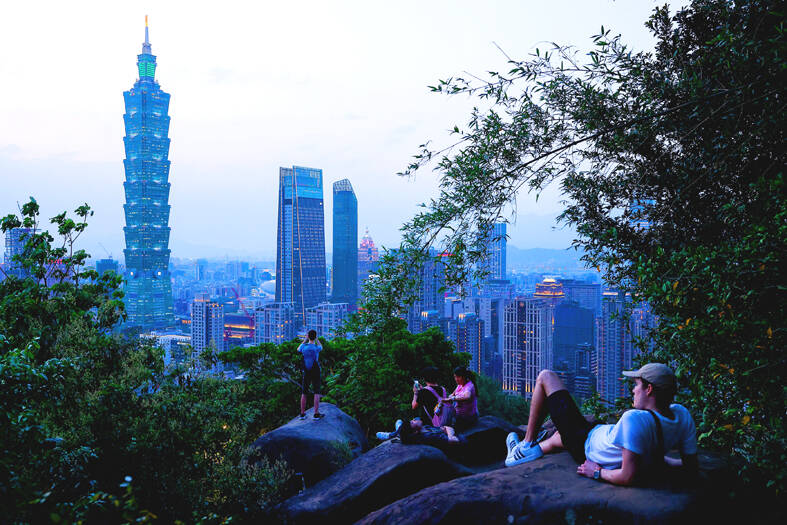
Photo: Ann Wang, Reuters
Cities in the US were ranked separately, with Minneapolis first at 53 percent, followed by San Antonio, Texas, (53 percent) and San Diego, California, (50 percent).
“While the decision to move to a new city is often driven by practical needs — like affordability, safety and healthcare — choosing to stay is shaped by much more intangible factors,” Gensler said in a report released on June 17.
“It’s not enough to build economic infrastructure,” it said. “A city becomes home when it inspires pride, offers moments of joy and fosters a true sense of belonging.”
Josh Edbrooke, a British music fan who has lived in Taiwan for a decade, on Friday said that he enjoys Taipei’s music scene, as it is easy to see independent bands and keep up with music news.
“I have been to Beijing, Tokyo and Seoul and I found the pace of life there faster, while it is slower and more flexible in Taipei,” said Tim Smith, an American.
Taipei scored above the global average in all eight key indicators in the survey: economic strength (73 percent), peace and stability (78 percent), vibrancy (76 percent), climate preparedness (69 percent), improving quality of life (71 percent), investing in neighborhoods (70 percent), addressing homelessness (60 percent) and reducing crime (71 percent).
The staying power of cities reflected respondents’ likelihood of leaving their homes. Taipei and Ho Chi Minh City were nearly tied for the lowest average likelihood of leaving, followed by Shanghai, Singapore and Riyadh.
Gensler’s analysis found that respondents in the Asia-Pacific region were the least likely to leave their city, at 29 percent.
However, Taipei did not lead in resident satisfaction, ranking 14th, with 80 percent of respondents saying they were “satisfied” or “very satisfied.”
Shanghai topped the category at 94 percent, followed by Abu Dhabi and Mumbai, India (both 92 percent); Dubai, United Arab Emirates (91 percent); and Delhi and Bangalore, India (both 90 percent).
Athens had the lowest satisfaction rate, with 44 percent of respondents saying they were satisfied.
The survey was first conducted in the spring of 2020 with only four cities. It was conducted twice a year until 2022, before switching to an annual format in 2023.
This year was the first time Taipei was included.

NATIONAL SECURITY: Authorities are working to confirm the identities of the military personnel involved and investigating possible illegal conduct and regulatory violations Authorities are probing possible national security implications after Kinmen police and immigration officers on Sunday found a Chinese woman allegedly posing as a tourist while engaging in prostitution involving more than 10 military personnel. The woman, surnamed Chen (陳), has since been deported, authorities said, adding that investigators are still working to confirm the identities of those implicated, as the records only listed code names and aliases. The case stemmed from a report received by the Kinmen District Prosecutors’ Office on Friday last week from the Jinhu Precinct of the Kinmen County Police Bureau. On Sunday, police, along with the National Immigration

GLOBALGIVING: ‘ Caving to external pressure is not acceptable for an organization that has cultivated justice reform and human rights for 30 years,’ one NGO said A slew of non-government organizations (NGOs) have withdrawn from the GlobalGiving fundraising platform after it announced it would use “Chinese Taipei” instead of “Taiwan” from next month. The Taiwan Good Rice Association wrote on Facebook on Friday that it was informed on April 28 via a teleconference call of the change, which was made because the platform wanted to operate in China. Taiwan Good Rice is to terminate all cooperative relationships with GlobalGiving in response to the platform’s “unilateral and non-negotiable” decision to remove references to Taiwan, the NGO said. “Taiwan is in the official name of Taiwan Good Rice Association and the

HEAVY WEATHER: Typhoon Jangmi is due to crash straight into the Ryukyus as airlines look to shift flights to larger aircraft or cancel flights to Okinawa entirely Taiwan’s international air carriers announced flight adjustments over the weekend as Typhoon Jangmi is forecast to hit the Ryukyu Islands today and tomorrow. The Central Weather Administration (CWA) upgraded Jangmi from a tropical storm to a typhoon at 8am yesterday, with the eye located 580km south of Naha city. It was moving north at 19kph. Today, China Airlines’ CI-120, CI-121, CI-122 and CI-123 flights between Taoyuan and Naha, Okinawa, have been canceled as well as CI-132 and CI-133 between Kaohsiung and Naha. EVA Air’s BR-112, BR-113, BR-186 and BR-185 flights between Taoyuan and Naha are also canceled. Low-cost carrier Tigerair Taiwan canceled IT-230,

Chinese Nationalist Party (KMT) Chairwoman Cheng Li-wun (鄭麗文) yesterday briefed her party’s Central Standing Committee regarding her scheduled visit to the US between Monday next week and June 16, saying that her purpose would be to persuade the US that the Republic of China (ROC) Constitution was a “one China” constitution that would foster stable and peaceful cross-strait relations. The ROC Constitution is the most important defense for all Taiwanese citizens, as it upholds our democracy and has contributed to our robust economy, which aligns with international and US interests, she said. “We would not be troublemakers and drag the US under,”


 RSS
RSS