


At the conclusion of the G7 Leaders’ Summit on June 13, Indian Prime Minister Narendra Modi, who participated virtually, called for the reform of multilateral institutions as the best signal of commitment to the cause of open societies. His comments are significant in light of China’s ongoing and successful efforts to control international organizations, and, in particular, to keep Taiwan out of critical health agencies amid the COVID-19 pandemic.
China’s influence over the WHO is well known. It has used this control to deny Taiwan a place at the World Health Assembly (WHA), the decisionmaking body of the WHO. Taiwan’s absence from the WHA has possibly cost the world a speedier recovery from the pandemic. Early in the pandemic, when Taipei’s investigations pointed out the role of human-to-human transmission in spreading COVID-19, the WHO endorsed China’s position, downplaying evidence of such transmission. Taiwan was one of the few countries to successfully contain COVID-19, and despite a local outbreak, there is much to learn from its processes and protocols, especially as the world battles new and deadlier variants of the virus.
Taiwan has shared its knowledge globally and India has been a beneficiary. It was among the first nations to provide relief material to India during its deadly second wave — 150 oxygen concentrators, 500 oxygen cylinders and personal protective equipment. Other medical and public health collaborations commenced last year — from computational prediction models of disease spread to co-production of traditional Ayurvedic treatment of COVID-19.
India can change the “status quo” at the WHA, for other parts of the world to also benefit. It appointed then-member of parliament Meenakshi Lekhi, now the minister of state for external affairs, to virtually attend the inauguration ceremony of President Tsai Ing-wen (蔡英文), who was re-elected president in May last year. India will continue to need Taiwan’s public health knowledge, and can return the favor by rallying support for Taiwan’s inclusion in the WHA.
However, India lost an early opportunity to support Taiwan’s observer role at the 74th WHA when Harsh Vardhan, the former Indian minister of health and family welfare, served as the chairperson of the WHO’s Executive Board. At the height of COVID-19’s rampage, India’s intentional silence could be a political calculation to re-establish its relationship with China after a series of border conflicts. It could also be the inertial force and obsessive concerns over the “one China” policy — a policy that has haunted international diplomacy for decades, but which can also be reversed.
It is not difficult to reinstate Taiwan at the WHA. It was an observer from 2008 to 2016, but in 2017, under the instructions of Beijing, then-director-general of the WHO, Margaret Chan (陳馮富珍) — from Hong Kong — stopped sending invitations to Taiwan to attend the WHA. Taiwan has since been denied access to the most important gathering of global health policymakers. Pertinently, Chan’s successor and the current director-general, Tedros Adhanom Ghebreyesus, was elected in 2017 with the backing of China. Upon his election, he immediately reiterated the “one China” policy.
China’s 2017 volte-face on Taiwan reflects its usual tactics to satisfy domestic interests by politicizing international fora. The same domestic audience would have been better served and showered with international praise if Taiwan were allowed to re-enter the WHA under the name “Chinese Taipei” — the same model used at the Olympic Games. That way, Taiwan would have been recognized by all members of the WHA, and made valuable contributions to managing COVID-19. If international organizations are indeed a fair playground for everyone, then granting Taiwan WHA observer status needs to be determined through discussions and deliberations by all members.
Taiwan’s case reflects China’s broader global ambitions. According to a study by Gateway House, Beijing is expanding its influence across the UN system by installing its nationals or proxies in significant agencies, such as the International Telecommunications Union, the International Civil Aviation Organization and the International Maritime Organization.
Can India succeed in leading support for Taiwan? It can, as there is already support for Taiwan. In May, the G7 backed Taiwan’s inclusion in the WHA. Last month, Japan’s upper house of parliament adoped a resolution demanding Taiwan’s participation in the WHA.
Within the WHO system, India occupies three crucial positions: Minister of Health Mansukh Mandaviya is a member of the Executive Board; Soumya Swaminathan is chief scientist and comptroller; and Auditor General of India G.C. Murmu is the WHO’s external auditor.
India can voice its support in its parliament. Indian lawmakers and their counterparts in Taiwan founded the India-Taiwan Parliamentary Friendship Forum in 2016. Private member resolutions raised by individual lawmakers — stating clearly the benefits brought to world health with Taiwan’s active participation in the WHO — can ignite useful debates and draw the attention of more legislators. This can be echoed within civil groups to amplify the vox populi and seek a response from government agencies and key bureaucrats. Outside its boundaries, India can join like-minded nations and make submissions to the WHO Secretariat, calling for the re-entry of Taiwan into the WHA as an observer before the annual WHA, which is held every spring in Geneva, Switzerland.
The WHO has been questioned about its impartiality and ability to manage global health issues. It is in India’s interest to demand more transparency and accountability from the WHO, which also allocates vital resources to developing countries.
Backing Taiwan at the WHA is a touchstone for India and other powers to test how determined democratic and open societies can fend off China’s emboldened global offensive.
Roger Liu is an associate professor at FLAME University’s social sciences department. Sameer Patil is a fellow in the International Security Studies Program at Gateway House: Indian Council on Global Relations.
A gap appears to be emerging between Washington’s foreign policy elites and the broader American public on how the United States should respond to China’s rise. From my vantage working at a think tank in Washington, DC, and through regular travel around the United States, I increasingly experience two distinct discussions. This divergence — between America’s elite hawkishness and public caution — may become one of the least appreciated and most consequential external factors influencing Taiwan’s security environment in the years ahead. Within the American policy community, the dominant view of China has grown unmistakably tough. Many members of Congress, as
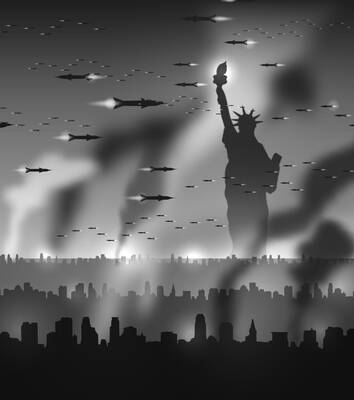
After declaring Iran’s military “gone,” US President Donald Trump appealed to the UK, France, Japan and South Korea — as well as China, Iran’s strategic partner — to send minesweepers and naval forces to reopen the Strait of Hormuz. When allies balked, the request turned into a warning: NATO would face “a very bad” future if it refused. The prevailing wisdom is that Trump faces a credibility problem: having spent years insulting allies, he finds they would not rally when he needs them. That is true, but superficial, as though a structural collapse could be caused by wounded feelings. Something
Former Taipei mayor and Taiwan People’s Party (TPP) founding chairman Ko Wen-je (柯文哲) was sentenced to 17 years in prison on Thursday, making headlines across major media. However, another case linked to the TPP — the indictment of Chinese immigrant Xu Chunying (徐春鶯) for alleged violations of the Anti-Infiltration Act (反滲透法) on Tuesday — has also stirred up heated discussions. Born in Shanghai, Xu became a resident of Taiwan through marriage in 1993. Currently the director of the Taiwan New Immigrant Development Association, she was elected to serve as legislator-at-large for the TPP in 2023, but was later charged with involvement
Out of 64 participating universities in this year’s Stars Program — through which schools directly recommend their top students to universities for admission — only 19 filled their admissions quotas. There were 922 vacancies, down more than 200 from last year; top universities had 37 unfilled places, 40 fewer than last year. The original purpose of the Stars Program was to expand admissions to a wider range of students. However, certain departments at elite universities that failed to meet their admissions quotas are not improving. Vacancies at top universities are linked to students’ program preferences on their applications, but inappropriate admission


 RSS
RSS