


They are not leaders for life — not technically, at least. In political reality, the powerful tenures of Chinese President Xi Jinping (習近平) and, as of this week, Russian President Vladimir Putin are looking as if they will extend much deeper into the 21st century — even as the two superpowers whose destinies they steer gather more clout with each passing year.
What is more, as they consolidate political control at home, sometimes with harsh measures, they are working together more substantively than ever in a growing challenge to the West and the world’s other superpower, the US, which elects its leader every four years.
This week, Putin signed a law allowing him to potentially hold on to power until 2036. The 68-year-old Russian president, who has been in power for more than two decades — longer than any other Kremlin leader since Joseph Stalin — pushed through a constitutional vote last year allowing him to run again in 2024, when his six-year term ends. He has overseen a systematic crackdown on dissent.
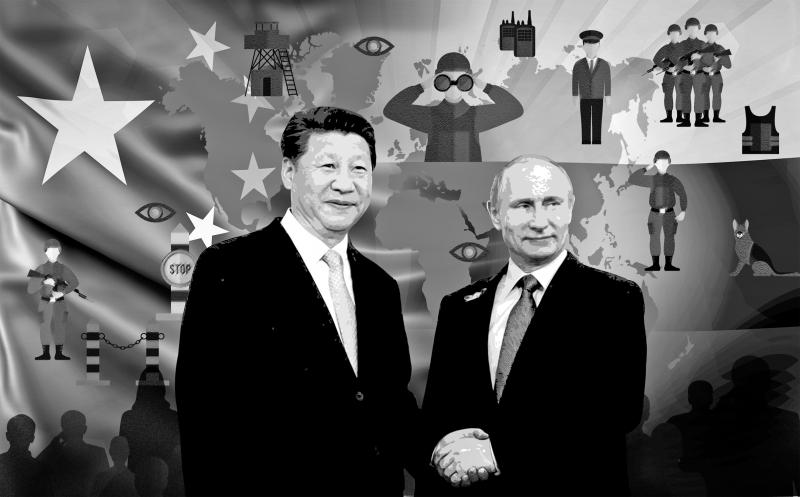
Illustration: Louise Ting
In China, Xi, who came to power in 2012, has imposed even tighter controls on the already repressive political scene, emerging as one of his nation’s most powerful leaders in the seven decades of Chinese Communist Party rule that began with Mao Zedong’s (毛澤東) often-brutal regime.
Under Xi, the government has rounded up, imprisoned or silenced intellectuals, legal activists and other voices, cracked down on Hong Kong’s opposition and used security forces to suppress calls for minority rights in Xinjiang, Tibet and Inner Mongolia.
CONSOLIDATING POWER
Xi has sidelined rivals, locked up critics and tightened the party’s control over information. An ongoing crackdown against corruption has won popular support while also keeping potential competitors in line.
His steady consolidation of power led to the removal of term limits on the Chinese presidency in 2018, demolishing a convention the party had established to prevent a repeat of the abuse produced by Mao’s one-person rule.
Xi further telegraphed his intention to remain in power by breaking from tradition and not indicating a preferred successor. One who appeared eager to take on the role, Sun Zhengcai (孫政才), was brought down in 2017 and sentenced to life in prison on corruption charges.
In Russia, Putin’s most outspoken critic, Alexei Navalny, was arrested in January upon his return from Germany, where he spent five months recovering from a nerve-agent poisoning that he blames on the Kremlin — an accusation Russian authorities have denied. In February, Navalny was sentenced to two-and-a-half years in prison.
In defying the West, Putin and Xi have both tapped nationalist feelings. Russia’s 2014 annexation of Ukraine’s Crimea propelled Putin’s approval ratings to nearly 90 percent before they slackened amid economic woes and unpopular pension reforms.
RIPPLE EFFECTS
The impact of Putin’s and Xi’s enduring retention of power hardly ends at their respective nations’ borders. It ripples outward into the geopolitical balance of power in countless ways.
As Moscow’s relations with the West sank to post-Cold War lows amid accusations of election meddling and hacking attacks, Putin has increasingly sought to bolster ties with China. While China so far has avoided a showdown with the West like Russia’s, it is coming under growing pressure from Washington and its allies over Beijing’s human rights record in Xinjiang, Hong Kong and the South China Sea.
US President Joe Biden has taken an increasingly tough line with both leaders, describing Putin as a “killer” and having his top national security aides excoriate China for a litany of issues. Such approaches suggest that Moscow and Beijing have incentives to build an even stronger alliance.
Like their nations, the two leaders themselves have fostered a closer relationship, too.
Putin and Xi have developed strong personal ties to bolster a “strategic partnership” between the two former communist rivals as they vie with the West for influence. Even though Moscow and Beijing in the past rejected the possibility of forging a military alliance, Putin last year said that such a prospect could not be ruled out entirely.
While Putin and Xi each appear to be firmly entrenched, numerous challenges persist. The COVID-19 pandemic posed a major challenge for the rulers, and they took a similarly cautious approach when it struck.
Putin responded by introducing a sweeping six-week lockdown that severely hurt the already weak Russian economy. His approval rating plummeted to a historic low of 59 percent. Later, the government eased restrictions and steered clear from new lockdowns, helping reduce economic damage and shore up Putin’s ratings.
CULT OF PERSONALITY
Xi remained out of the public eye in the first uncertain weeks, possibly fearing that any misstep could have given rivals a chance to topple him. In the end, China controlled the pandemic better than many other places, enhancing Xi’s position as leader.
Xi must also figure out how to satisfy ambitious young politicians who might see their careers being stymied by his lengthy tenure. He has to demonstrate that his extended rule will not lead to the excesses of the Mao years, especially the disastrous and deeply traumatic 1966 to 1976 Cultural Revolution.
“Xi has to manage an essential paradox. He venerates Mao and is building the same cult of personality and centrality of the party,” said Daniel Blumenthal, director of Asian studies at the American Enterprise Institute. “But he knows his people fear and loathe Maoism so he has to also pretend he is not Mao. For now, he is an unchallenged strong leader, dealing with cracks and fissures in the party and society through Maoist-style campaigns and purges.”
Putin faces even more daunting challenges. Russia’s economy is a fraction of China’s, and its overwhelming reliance on exports of oil and gas and other raw materials makes it vulnerable to market fluctuations.
Western economic and financial sanctions have cut Moscow’s access to Western technologies and capital markets, slowing down the economy and impeding modernization efforts. Stagnant living standards and falling incomes have fueled growing discontent.
Russia’s increasingly close ties with China are part of its strategy to offset Western sanctions. Chinese companies provided substitutes for missing Western technologies, helped with major infrastructure projects such as energy supplies to Crimea and channeled cash flows to ease the burden from sanctions on Kremlin-connected tycoons.
“Beijing helped Moscow, at least to some extent, to withstand US and EU pressure,” Alexander Gabuev, the top China expert with the Carnegie Moscow Center, wrote in an analysis. “This assistance also allowed Moscow to become more assertive elsewhere in the world, from being present in the Middle East and Africa to supporting the Venezuelan regime and interfering in US elections.”
POSSIBLE ALLIANCE
Military cooperation remains a high-stakes frontier. As US pressure grew, Russia has moved to expand military ties with China. Their armed forces have held a series of joint drills, and Putin has said that Russia has provided China with cutting-edge military technologies.
A full-on alliance — putting the joint military might of Xi’s and Putin’s grips on their nations seems less abstract when the increasingly tight relationship between the two long-term leaders is taken into consideration.
“We don’t need it,” Putin said in October last year. “But theoretically, it’s quite possible to imagine it.”
Recently, China launched another diplomatic offensive against Taiwan, improperly linking its “one China principle” with UN General Assembly Resolution 2758 to constrain Taiwan’s diplomatic space. After Taiwan’s presidential election on Jan. 13, China persuaded Nauru to sever diplomatic ties with Taiwan. Nauru cited Resolution 2758 in its declaration of the diplomatic break. Subsequently, during the WHO Executive Board meeting that month, Beijing rallied countries including Venezuela, Zimbabwe, Belarus, Egypt, Nicaragua, Sri Lanka, Laos, Russia, Syria and Pakistan to reiterate the “one China principle” in their statements, and assert that “Resolution 2758 has settled the status of Taiwan” to hinder Taiwan’s
Singaporean Prime Minister Lee Hsien Loong’s (李顯龍) decision to step down after 19 years and hand power to his deputy, Lawrence Wong (黃循財), on May 15 was expected — though, perhaps, not so soon. Most political analysts had been eyeing an end-of-year handover, to ensure more time for Wong to study and shadow the role, ahead of general elections that must be called by November next year. Wong — who is currently both deputy prime minister and minister of finance — would need a combination of fresh ideas, wisdom and experience as he writes the nation’s next chapter. The world that
Can US dialogue and cooperation with the communist dictatorship in Beijing help avert a Taiwan Strait crisis? Or is US President Joe Biden playing into Chinese President Xi Jinping’s (習近平) hands? With America preoccupied with the wars in Europe and the Middle East, Biden is seeking better relations with Xi’s regime. The goal is to responsibly manage US-China competition and prevent unintended conflict, thereby hoping to create greater space for the two countries to work together in areas where their interests align. The existing wars have already stretched US military resources thin, and the last thing Biden wants is yet another war.
Since the Russian invasion of Ukraine in February 2022, people have been asking if Taiwan is the next Ukraine. At a G7 meeting of national leaders in January, Japanese Prime Minister Fumio Kishida warned that Taiwan “could be the next Ukraine” if Chinese aggression is not checked. NATO Secretary-General Jens Stoltenberg has said that if Russia is not defeated, then “today, it’s Ukraine, tomorrow it can be Taiwan.” China does not like this rhetoric. Its diplomats ask people to stop saying “Ukraine today, Taiwan tomorrow.” However, the rhetoric and stated ambition of Chinese President Xi Jinping (習近平) on Taiwan shows strong parallels with


 RSS
RSS