


Chinese tech companies did a pretty good job of convincing global investors that they operated independently from the Chinese Communist Party (CCP), but Jack Ma (馬雲) has become a case study for the firms’ biggest skeptics.
Companies from Alibaba Group Holding to Tencent Holdings splashed out billions on overseas acquisitions, while developing apps and technologies that challenged Western rivals, with little or no state interference.
However, Beijing’s pursuit of Ma and his Ant Group after he criticized regulators arguably plays directly into the hands of China’s biggest critics in Washington, who have long asserted that no Chinese tech giant or entrepreneur is beyond the reach of Chinese President Xi Jinping (習近平).
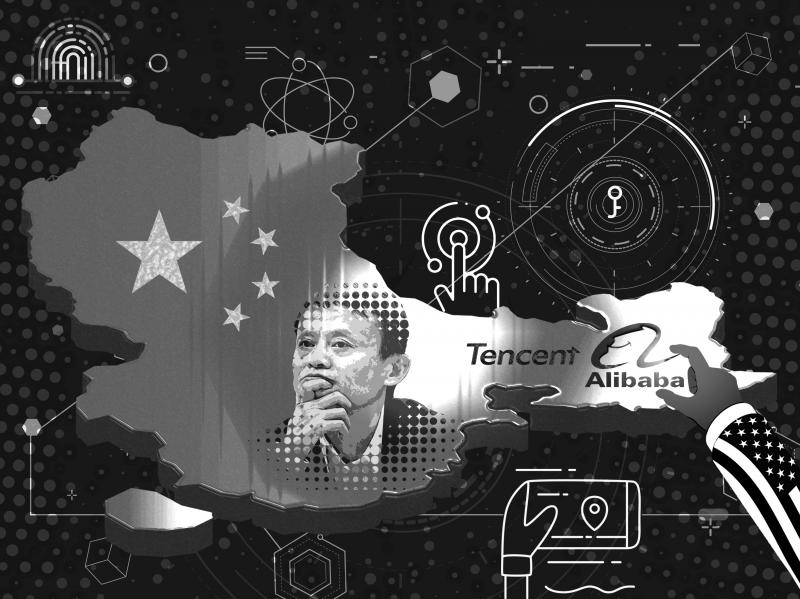
Illustration: Louise Ting
US authorities are debating whether to ban investments in Alibaba and Tencent, according to people familiar with the matter, in what would be a dramatic blow to two of the companies whose shares are most widely held by global investors.
Already on Tuesday last week, US President Donald Trump signed an executive order banning transactions with eight Chinese software applications, including Ant’s Alipay and Tencent’s WeChat Pay, citing concerns that Beijing would have access to the data collected by the platforms.
“I stand with President Trump’s commitment to protecting the privacy and security of Americans from threats posed by the Chinese Communist Party,” US Secretary of Commerce Wilbur Ross said in a statement on the order.
Beijing’s moves could raise pressure on the incoming administration of US president-elect Joe Biden to push through further action detrimental to China, although it is not clear how much of Trump’s aggressive policies Biden would continue.
The CCP’s sway over business has become even clearer over the past 12 months, as Xi pushes to consolidate power ahead of next year’s Chinese National People’s Congress, when he is expected to extend his rule for at least another five years.
The COVID-19 pandemic has only served to strengthen his grip, fueling a war-like campaign to steer the economy back on track and snuff out perceived threats to national security.
“You need to be very mindful of who ultimately controls regulations, who controls licensing — of who’s in charge,” Beijing-based Marbridge Consulting managing director Mark Natkin said. “And if you forget and you start to be overly critical, or take too much of a role that normally belongs to the party, then you’re going to get chopped down a notch or two.”
Beijing has moved to fundamentally overhaul Ma’s trillion-dollar Internet empire since demolishing Ant’s US$35 billion initial public offering (IPO) in November last year, a record-breaking debut that was to have been the entrepreneur’s crowning achievement.
Authorities then forced his online finance titan to cap loans and devise a plan to hive off its most lucrative businesses. The government also launched a probe into alleged anti-competitive practices at Alibaba.
Ma has not been seen in public since November last year and his absence from the recent taping of an African TV program that he created spurred speculation of his whereabouts.
“There is a lot of power in the Chinese government’s economic and financial management infrastructure, and if Ant was going to erode that power, important people would see it as a step too far,” said Graham Webster, editor of the DigiChina project at the Stanford Cyber Policy Center.
“The Chinese government also prizes these leading companies as drivers of technological independence. The party would have to perceive significant threats to tear them down,” Webster added.
The action against Ma sends the latest signal that Beijing feels emboldened to risk international fallout from measures meant to address domestic challenges.
Xi defied threats of US sanctions to impose national security legislation on Hong Kong. Crushing Ant’s IPO risked alienating a plethora of powerful global financiers from Singapore’s sovereign wealth fund to the Carlyle Group.
The US has also cited concerns about Chinese government influence over private industry to justify its efforts to force ByteDance to sell the US share of its TikTok social network, and the global campaign to convince allies to swear off equipment made by Huawei Technologies.
Supporters of the US measures often cite Chinese policies such as a 2017 law that requires companies to “support, assist and cooperate” with intelligence agencies.
Like Huawei, Ant has also asserted its independence from the Chinese government, saying in a 2017 application to the US securities regulator that it is “a private sector company and while a handful of Chinese state-owned or affiliated funds own non-controlling minority stakes, they do not participate in company management.”
The CCP has long reached into private firms, including foreign ones operating in China. One way it does that is through the presence of party committees in companies, among them tech enterprises, that are made up of employees.
In addition, it dispatches officials to companies to oversee certain activities. Many tech leaders are also party members, including Ma, Lenovo founder Liu Chuanzhi (柳傳志) and Huawei founder Ren Zhengfei (任正非). Tencent chairman Pony Ma (馬化騰) and Xiaomi founder Lei Jun (雷軍) are delegates to the National People’s Congress.
The CCP’s also stepped in on several occasions to punish executives for mismanagement, including former Anbang Insurance Group chairman Wu Xiaohui (吳小暉).
However, recent efforts to exert government influence over companies and intervene in the business landscape have reached new levels. That has provided fuel to the China hawks in Washington, who say that the CCP exerts too much influence over Chinese companies.
Xi needs business executives on his side to achieve strategic goals such as the “dual -circulation” economic plan focused on domestic consumption, developing secure supply chains and reducing reliance on foreign technology.
While the world’s second-largest economy was the first to rebound from COVID-19, its recovery is showing signs of peaking even as global growth remains sluggish and ties with the US stay fraught.
In a rare direct plea to the business sector in July last year, Xi called on executives, including those from the tech industry, to be more patriotic and help the post-pandemic economic recovery.
“Outstanding entrepreneurs must have a strong sense of mission and responsibility for the nation, and align their businesses’ development with the prosperity of the nation and the happiness of the people,” Xi said.
Weeks later, the CCP revealed plans to tighten control over the private sector by extending its “united front” networking operations further into the business community.
The policy would “strengthen ideological guidance” and “create a core group of private sector leaders who can be relied upon during critical times,” guidelines released at the time said.
“Under President Xi, the CCP has tightened its grip over tech companies and doubled down on its techno-nationalist initiatives,” researcher Alex Capri wrote in a recent report for the Hinrich Foundation. “In addition to placing party officials within prominent companies, it continues to neuter high-profile corporate executives where there is the perception that they were operating independently from party directive or becoming too influential.”
Reports about Elon Musk planning his own semiconductor fab have sparked anxiety, with some warning that Taiwan Semiconductor Manufacturing Co (TSMC) could lose key customers to vertical integration. A closer reading suggests a more measured conclusion: Musk is advancing a strategic vision of in-house chip manufacturing, but remains far from replacing the existing foundry ecosystem. For TSMC, the short-term impact is limited; the medium-term challenge lies in supply diversification and pricing pressure, only in the long term could it evolve into a structural threat. The clearest signal is Musk’s announcement that Tesla and SpaceX plan to develop a fab project dubbed “Terafab”
In late January, Taiwan’s first indigenous submarine, the Hai Kun (海鯤, or Narwhal), completed its first submerged dive, reaching a depth of roughly 50m during trials in the waters off Kaohsiung. By March, it had managed a fifth dive, still well short of the deep-water and endurance tests required before the navy could accept the vessel. The original delivery deadline of November last year passed months ago. CSBC Corp, Taiwan, the lead contractor, now targets June and the Ministry of National Defense is levying daily penalties for every day the submarine remains unfinished. The Hai Kun was supposed to be

Most schoolchildren learn that the circumference of the Earth is about 40,000km. They do not learn that the global economy depends on just 160 of those kilometers. Blocking two narrow waterways — the Strait of Hormuz and the Taiwan Strait — could send the economy back in time, if not to the Stone Age that US President Donald Trump has been threatening to bomb Iran back to, then at least to the mid-20th century, before the Rolling Stones first hit the airwaves. Over the past month and a half, Iran has turned the Strait of Hormuz, which is about 39km wide at
The ongoing Middle East crisis has reinforced an uncomfortable truth for Taiwan: In an increasingly interconnected and volatile world, distant wars rarely remain distant. What began as a regional confrontation between the US, Israel and Iran has evolved into a strategic shock wave reverberating far beyond the Persian Gulf. For Taiwan, the consequences are immediate, material and deeply unsettling. From Taipei’s perspective, the conflict has exposed two vulnerabilities — Taiwan’s dependence on imported energy and the risks created when Washington’s military attention is diverted. Together, they offer a preview of the pressures Taiwan might increasingly face in an era of overlapping geopolitical


 RSS
RSS