


Presuming he does not have to be dragged out of the White House as a trespasser at noon on Jan. 20, US President Donald Trump will make one last walk across the South Lawn, take his seat inside Marine One and leave.
From that moment, Trump’s rambunctious term as US president will be over. In one important aspect, the challenge presented by his presidency will have only just begun: The possibility that he will face prosecution for crimes committed before he took office or while in the Oval Office.
“You’ve never had a president before who has invited so much scrutiny,” said Bob Bauer, White House counsel under former US president Barack Obama. “This has been a very eventful presidency that raises hard questions about what happens when Trump leaves office.”
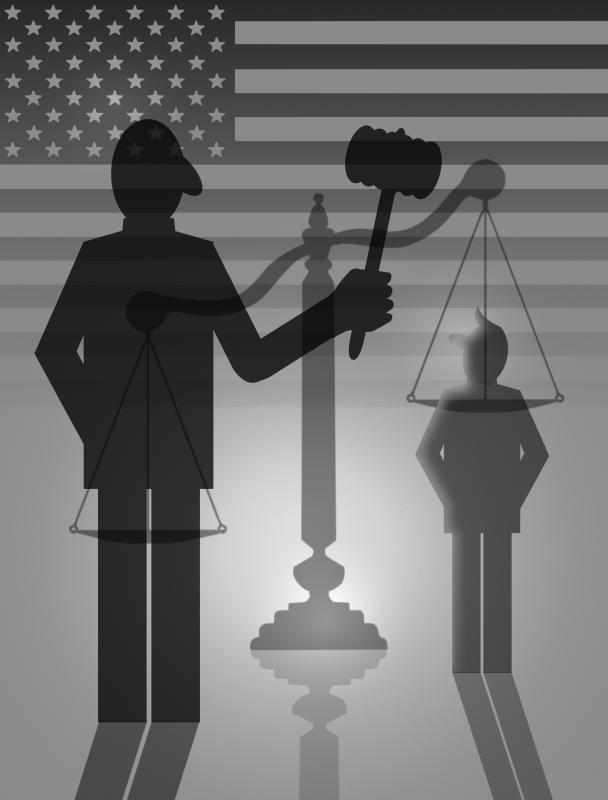
Illustration: Yusha
For the past four years, Trump has been shielded from legal jeopardy by a memo from the US Department of Justice that rules out criminal prosecution of a sitting president, but the second he boards that presidential helicopter and fades into the horizon, all bets are off.
Manhattan District Attorney Cyrus Vance is investigating Trump’s business dealings. The focus described in court documents is “extensive and protracted criminal conduct at the Trump Organization” including possible bank fraud.
A second major investigation by the fearsome federal prosecutors of the Southern District of New York has already led to the conviction of Trump’s former lawyer Michael Cohen.
He pleaded guilty to breaching campaign finance rules related to “hush money” paid to Stormy Daniels, the adult film actress who alleged an affair with Trump during the 2016 presidential campaign.
During the course of the prosecution, Cohen implicated a certain “Individual 1” — Trump — as the mastermind behind the felony. Although the investigation was technically closed last year, charges could be revisited once Trump’s effective immunity is lifted.
It all points to a momentous and fiendishly difficult legal challenge, fraught with political danger for the incoming administration of US president-elect Joe Biden.
Should Trump be investigated and possibly prosecuted for crimes committed before and during his presidency?
“It looks like the incoming administration will have to confront some form of these issues,” said Bauer, who is coauthor of After Trump: Reconstructing the Presidency. “The government is going to have decisions to make about how to respond, given the potential that it becomes a source of division.”
Any attempt to hold Trump criminally liable in a federal prosecution would be a first in US history. No exiting president has ever been pursued in such a way by his successor. Former US president Richard Nixon was spared the ordeal by Gerald Ford’s contentious presidential pardon.
Previous presidents have tended to take the view that it is better to look forward in the name of national healing than backward at the failings of their predecessor, and for good reasons: Any prosecution would probably be long and difficult, act as a huge distraction and expose the incoming president to accusations that they were acting like a tin-pot dictator hounding their political enemy.
That a possible Trump prosecution is being discussed at all is a sign of the exceptional nature of the past four years. Those who argue in favor of legal action accept that there are powerful objections to going after Trump, but urge people to think about the alternative — the dangers of inaction.
“If you do nothing you are saying that though the president of the United States is not above the law, in fact he is. And that would set a terrible precedent for the country and send a message to any future president that there is no effective check on their power,” said Andrew Weissmann, who was a lead prosecutor in US special counsel Robert Mueller’s investigation into coordination between Russia and Trump’s 2016 campaign.
As head of one of the three main teams answering to Mueller, Weissmann had a ringside seat on what he calls Trump’s “lawless White House.”
In his new book, Where Law Ends: Inside the Mueller Investigation, he argues that the prevailing view of the 45th president is that “following the rules is optional and that breaking them comes at minimal, if not zero, cost.”
Weissmann said that there would be a price to be paid if that attitude went unchallenged once Trump leaves office.
“One of the things we learnt from this presidency was that our system of checks and balances is not as strong as we thought, and that would be exacerbated by not holding him to account,” he said.
Bauer, who was an adviser to Biden during the presidential campaign, but has no role in the transition team, is also worried that a sort of double immunity would be established.
Presidents cannot be prosecuted while in office under justice department rules, but under such a double immunity nor could they be prosecuted once leaving the White House in the interests of “national healing,” he said.
“And so the president is immune coming and going, and I think that would be very difficult to square with the idea that he or she is not above the law,” he said.
Biden has made clear his lack of enthusiasm for prosecuting Trump, saying it would be “probably not very good for democracy.”
However, he has also made clear that he would leave the decision to his appointed attorney general, following the norm of justice department independence that Trump has repeatedly shattered.
Other prominent Democrats have taken a more bullish position, adding pressure on the incoming attorney general to be aggressive.
During the Democratic presidential primary debates, US Senator Elizabeth Warren called for the establishment of an independent task force to investigate any Trump corruption or other criminal acts in office.
US vice president-elect Kamala Harris also took a stance that might come to haunt the new administration.
Asked by NPR last year whether she would want to see charges brought by the US Department of Justice, she said: “I believe that they would have no choice and that they should, yes.”
There are several possible ways the justice department could be forced to confront the issue of whether or not to take on Trump. One would be through a revelation as yet unknown, following the emergence of new information.
Weissmann said that the Biden administration would have access to a wealth of documents that were previously withheld from the US Congress during the impeachment inquiry, including intelligence agency and US Department of State files.
Official communications sent by White House special adviser Jared Kushner and Ivanka Trump through their personal e-mails and messaging apps — an ironic move given the flak Hillary Rodham Clinton endured from the Trump family in 2016 for using her personal e-mail server — might also become available for scrutiny.
The two most likely avenues for the pursuit of any criminal investigation would relate to Trump’s use of his presidential pardon power and alleged obstruction of justice.
“Trump issued a series of pardons largely characterized by political self-interest,” Weissmann said.
Although the presidential pardon power is extensive, it is not, as Trump has claimed, absolute — including the “absolute right” to pardon himself. He is not immune from bribery charges if he were found to have offered somebody a pardon in exchange for their silence in a judicial case.
For Weissmann, the way Trump continually teased his associates — including Roger Stone and Paul Manafort — with the promise of pardons in the middle of federal prosecutions was especially egregious.
“There may be a legitimate reason to give somebody a pardon, but what’s the legitimate reason for dangling a pardon other than to thwart that person from cooperating with the government?” Weissman said.
Perhaps the most solid evidence of criminal wrongdoing compiled against Trump concerns obstruction of justice. John Bolton, the former national security adviser, went so far as to say that for Trump, obstruction of justice to further his own political interests was a “way of life.”
In his final report on the Russia investigation, Mueller laid out 10 examples of Trump’s behavior that could be legally construed as obstruction. Although Mueller declined to say whether they met the standard for charges — former US attorney general Bill Barr suggested they did not, but gave no explanation for his thinking — he did leave them in plain sight for any future federal prosecutor to revisit.
In one of the starkest of those incidents, Trump tried to scupper the special counsel inquiry by ordering his White House counsel, Don McGahn, to fire Mueller. When that became public, he compounded the abuse by ordering McGahn to deny the truth in an attempt at cover-up.
Weissmann, who played a key role in gathering evidence against Trump in the Mueller report, said that such obstruction goes to the heart of why Trump should face prosecution.
“When the president, no matter who it is, obstructs a special counsel investigation there have to be consequences. If you can obstruct an investigation criminally, but you don’t have to worry about ever being prosecuted, well then, there’s no point in ever appointing a special counsel,” Weissmann said.
The White House’s decision to take a 9.9 percent stake in Intel Corp is looking like very shrewd business indeed. Since the government bought in at US$20.47 a share last August, the US chipmaker’s surging stock price has delivered the US a US$43 billion return. One of the reasons the investment has so far proved so sound is that the White House has made sure of it. According to The Wall Street Journal, Howard personally pushed deals on Intel’s behalf with some of the most lucrative clients imaginable. They include Nvidia Corp, the company at the heart of the AI
In a Taiwanese university classroom, a lecturer asks in English: “Can anyone give me an example from Taiwan?” Students look down. No one answers. After class, one student writes on the course platform in Mandarin: “I understood the concept, but I didn’t know how to answer in English.” That moment highlights a key issue in Taiwan’s English-medium instruction (EMI) reform: It is not just about more English-taught courses, but whether students can learn, participate and belong. EMI expansion is part of the Bilingual 2030 policy and the Ministry of Education’s BEST Program, aiming to improve English ability, support EMI teaching
The Ministry of the Interior, working with the navy and coast guard, is organizing Taiwan’s first joint exercise simulating escort tankers carrying liquefied natural gas (LNG) and oil through a Chinese blockade. The drills simulate fuel transport along three maritime corridors leading toward Japan, the Philippines and the US. Deputy Minister of the Interior Sawyer Mars (馬士元) said that a blockade of the Taiwan Strait would amount to “almost a 100 percent blockade of the regional energy supply.” Minister of National Defense Wellington Koo said planning to counter a blockade is standard practice in Taipei. While the exercise is limited in
A single photograph can cut through a lot of noise, but it can also be used to misrepresent the truth. At the very least, it can concentrate the mind on something that requires further investigation. On Monday last week, Ma Ying-jeou Foundation CEO Tai Hsia-ling (戴遐齡) and former National Security Council secretary-general King Pu-tsung (金溥聰) held a news conference in which they showed a photograph of former foundation CEO Hsiao Hsu-tsen (蕭旭岑), now Chinese Nationalist Party (KMT) deputy chairman. In the image Hsiao is seated next to Xiamen Taiwan Businessmen Association chairman Han Ying-huan (韓螢煥). The two men were holding


 RSS
RSS