


Chinese companies have made a seemingly unstoppable push to the front of the race for a COVID-19 vaccine. Yet their speedy ascent has been unhindered by common scientific setbacks being reported by Western rivals, raising questions about how stringently they are vetting and reporting potential safety issues.
The lack of clarity over the standards and safeguards used by Chinese developers is drawing concern because some of their vaccines are being distributed in China under an emergency use program before full regulatory approval.
US President Donald Trump repeatedly claimed that a working vaccine would be available ahead of Tuesday’s US presidential election.
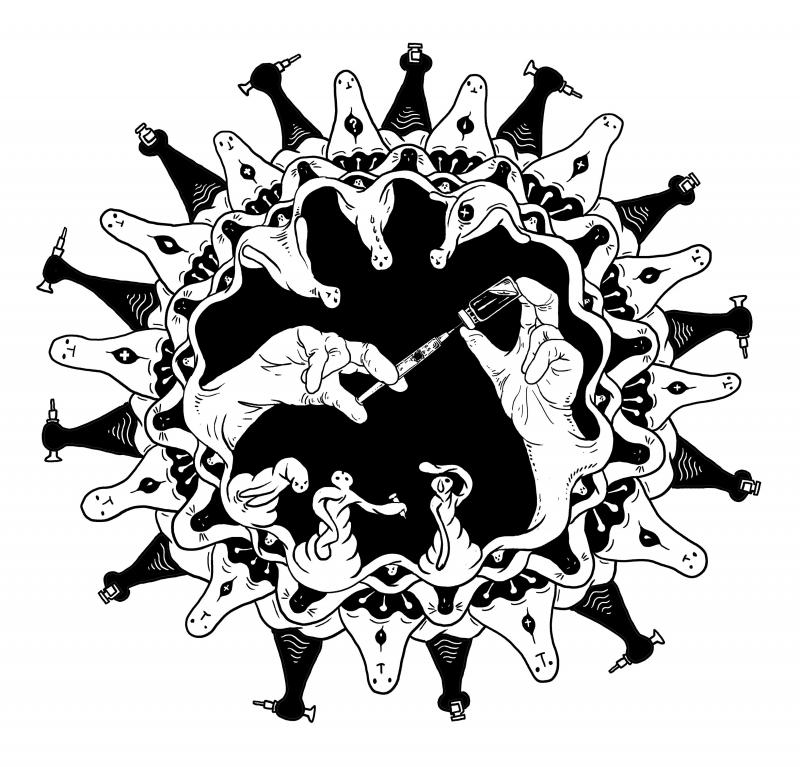
Illustration: Mountain People
That has not panned out, as the most optimistic time lines for US emergency use authorization go into late this month and next month, well behind China on this front.
There are potentially far-reaching implications for the way China goes about its vaccines.
The Asian country has the largest number of candidates in late-stage trials, and vaccines developed in China could be used by millions worldwide because Chinese President Xi Jinping (習近平) has pledged to share successful ones overseas.
The UK’s AstraZeneca, and US-based Johnson & Johnson (J&J) temporarily halted testing earlier this year after a single participant in each trial got sick.
In contrast, the Chinese Ministry of Science and Technology has said that about 60,000 volunteers have been inoculated in final-stage trials, but there have been no reports of serious adverse events.
One front-runner, China National Biotec Group Co, said it vaccinated hundreds of thousands of people under the emergency use program, a sign of how widely vaccines are being administered in the country without reports of serious adverse events.
Yet scientists say that the discovery of health problems are inevitable when tens of thousands of people across ages and with varying health conditions are included in the trials — even if the vaccine is not causing the illness.
“Biology is fundamentally messy, and you will always get heart attacks, neurological events and other toxicities by pure random chance,” said Michael Kinch, a vaccine specialist at Washington University in St. Louis, Missouri. “In a large enough population, you’re going to see that, and so it seems odd, maybe even suspicious, that nothing has been reported at all.”
The author of the 2018 book Between Hope and Fear: A History of Vaccines and Human Immunity, Kinch said that he would be concerned about data that are “really, really clean.”
He pointed to a study published in the journal BMC Medicine in 2015 that examined 202 late-stage vaccine trials, and found that only about 10 did not mention serious adverse effects.
Even this number likely under-represents the pervasiveness of major adverse effects in testing, Kinch said.
Globally, worries about the safety of COVID-19 vaccines are rising as researchers across nations work at an unprecedented pace, buffeted by political pressure and an urgency to end a pandemic that has killed more than 1.2 million people.
Chinese companies and officials say that their vaccines have so far been found safe in the research that is being conducted. The companies said that they have so far seen only mild effects, such as low fevers, pain at the injection sites, itchiness, fatigue and dizziness — symptoms consistent with a regular flu vaccine.
A spokesperson for China’s Sinovac Biotech said that the lack of reports of serious side effects does not mean that the company is not being transparent. He pointed to comments from the Instituto Butantan, Sinovac’s trial partner in Brazil, which said that fewer adverse reactions were seen in the Chinese company’s vaccine than in others tested in the country.
Different methods being used to develop vaccines are leading to the variations in adverse events, the spokesman said.
Based on its early-stage studies, inactivated vaccines — a traditional technology used by Sinovac that utilizes a dead version of the pathogen — have been shown to have a low incidence of adverse events, he said.
CanSino Biologics — a Chinese company developing a vaccine using a cold-causing adenovirus as a vector, a similar type of vaccine as AstraZeneca’s and J&J’s — declined to comment.
In a statement published on its official WeChat account late last month, CanSino said that its vaccine has good tolerability and safety, and there were no serious adverse reactions among participants in clinical trials.
China National Biotec did not respond to requests for comment.
However, some scientists are not convinced. They say that the transparency of Chinese trials does not appear to be at the same level of those in the West, making it hard to assess their rigor.
“Any statement that says when you vaccinated over 100,000 people and see no serious or severe effects cannot be true,” said William Haseltine, a former Harvard Medical School researcher who chairs the non-profit group Access Health International and has been a key player in understanding novel viruses such as HIV.
“If they want their vaccines to receive international credibility, they’ve got to be forthcoming,” Haseltine said. “If there is any country in the world that has the luxury of time to make sure a vaccine is safe and effective, it’s China”
Ezekiel Emanuel, vice provost for global initiatives and codirector of the Healthcare Transformation Institute at the University of Pennsylvania, said that there are questions about the way some of the Chinese studies are being run.
“There is appropriate skepticism and hesitancy about whether you ought to adopt them,” Emanuel said.
Vaccines typically take years to develop, and that process is now being whittled down to months globally, not just in China.
Yet Kinch said that it can sometimes take the immune system three or four months, and in rare cases years, to show the effects of toxicity and any damage caused by the vaccination.
China’s latest rules require that suspected and unexpected serious adverse events in clinical trials be reported to regulators. However, it is not mandatory for a Chinese company to communicate such problems or related trial pauses to the general public.
Neither is that a common practice in the US, although the US Food and Drug Administration would definitely be made aware, Haseltine said.
Pauses like those taken by AstraZeneca and J&J are drawing unusual attention because the scale of the COVID-19 pandemic and the speed of the trials are putting vaccine developers under the microscope.
The term “adverse event” can encompass everything from a fever, pain and itching to more serious problems like cancer, heart attacks and even death. They do not necessarily mean that a vaccine is doomed to fail as the benefits of each shot are weighed against its risk.
Severe side effects do occur, though rarely, after a vaccine is approved and distributed to the general public.
AstraZeneca and J&J have resumed the trials that had been halted. Regulators and teams of outside experts combed through the trial data and concluded that the unexplained illnesses were not triggered by the immunizations.
J&J chief scientific officer Paul Stoffels said that the company has found no evidence that the adverse event was linked to its vaccine or the technology that underscores it.
“When we have 60,000 people [in a clinical trial], it’s a small village, things happen,” Stoffels said.
AstraZeneca said that its trials had resumed globally, with regulators in several countries confirming that it was safe to do so.
China’s expanded emergency use program launched in July is also raising questions. Originally intended for front-line workers — such as medical staff treating COVID-19 patients or customs officers with exposure risk — the use of two shots from China National Biotec and one from Sinovac has since been expanded to employees of state-owned companies with missions overseas.
Discussions are underway to offer the vaccines to students headed abroad, and local media are reporting that ordinary people can sign up. That has researchers wondering how such large numbers are being tracked.
Ding Sheng (丁勝), director of Beijing-based Global Health Drug Discovery Institute, which has received funding from the Bill & Melinda Gates Foundation, said that the absence of severe adverse effects in the trials should not be seen as a bad thing.
Ding said that emergency use programs differ from controlled trials and the vaccines being given widely “does not necessarily mean bad things will happen.”
Yet he had questions about how people in the emergency program were being assessed.
“This is a huge number of people but they are not in clinical trials. How exactly these people are being followed up is unknown,” Ding said. “If they could be more transparent about how they do that, that would probably be a better assurance.”
Zheng Zhongwei (鄭忠偉), a director who oversees COVID-19 vaccine development at the Chinese National Health Commission, on Oct. 20 said that there had so far been no reports of serious adverse events in the emergency use program and that there is a tracking system for following up with those who receive the vaccines.
The Chinese National Medical Products Administration, the country’s drug regulatory agency, declined to comment beyond the Oct. 20 press conference.
That has not been the experience of one Beijing resident, who told Bloomberg that he received two shots of a COVID-19 vaccine earlier this year, and his family was vaccinated too. The man, who spoke on the condition of anonymity because he had signed a non-disclosure agreement, said that he experienced no adverse effects, but that there was no follow-up after the vaccination. There was a telephone number on the vaccination certificate, but no indication what it was for.
Others that Bloomberg spoke to, including an employee at a state-run company, said it was made clear that he should contact the developer if there was a serious adverse reaction to the vaccine he received under the emergency use program, but his case would not be actively tracked.
China National Biotec did not respond to queries on the emergency use program.
The Sinovac spokesman said that emergency use of its experimental vaccine is provided by China’s inoculation system, which has a monitoring mechanism in place, and that monitoring is not done by the company.
Moderna, Pfizer, AstraZeneca, and J&J — the major US and British firms in final stage testing — have all published detailed protocols with the methods and procedures being followed in those trials.
Only one of the three Chinese companies that are now in phase 2 testing — Sinovac — said it would make its protocol publicly available.
That means that independent academics have no way to assess how well designed some of the Chinese late-stage trials are.
CanSino declined to share its protocol when requested by Bloomberg, while China National Biotec did not respond to a query for its trial protocol.
China said it would make successful vaccines available internationally, through bilateral deals and the COVID-19 Vaccines Global Access Facility to distribute doses.
Yet Chinese vaccine developers face added scrutiny because of the industry’s mixed record at home. Chinese government bodies have in the past spotted issues such as the improper storage of some inoculations.
In 2018, consumers protested outside government offices after regulators said that two drugmakers, Changsheng Bio-technology Co and Wuhan Institute of Biological Products Co, had sold ineffective vaccines.
Sinopharm Group Co, the parent of China National Biotec, is also the parent of Wuhan Institute. At the time, it removed an executive from the subsidiary in charge of production and issued stern warnings and fines to others.
Changsheng said it halted production of problematic vaccines, and felt deep remorse and shame.
Chinese executives say that regulatory scrutiny has tightened and so have the vaccine industry’s standards.
The Chinese government said it would require no or extremely low incidence of serious adverse reactions to approve any COVID-19 vaccine.
The industry’s quality control and clinical studies are now fully in line with international standards, said Zhang Lan (張蘭), vice president of Hangzhou Tigermed Consulting Co, which is running a trial for one of the Chinese COVID-19 vaccines, although she did not specify which one due to disclosure rules.
“Does the situation arising out of the J&J trial have to happen to these Chinese vaccine candidates? I think it’s too early to make a call, and we have to wait for the results and data,” Zhang said.
From the Iran war and nuclear weapons to tariffs and artificial intelligence, the agenda for this week’s Beijing summit between US President Donald Trump and Chinese President Xi Jinping (習近平) is packed. Xi would almost certainly bring up Taiwan, if only to demonstrate his inflexibility on the matter. However, no one needs to meet with Xi face-to-face to understand his stance. A visit to the National Museum of China in Beijing — in particular, the “Road to Rejuvenation” exhibition, which chronicles the rise and rule of the Chinese Communist Party — might be even more revealing. Xi took the members
The Chinese Nationalist Party (KMT) and the Taiwan People’s Party (TPP) on Friday used their legislative majority to push their version of a special defense budget bill to fund the purchase of US military equipment, with the combined spending capped at NT$780 billion (US$24.78 billion). The bill, which fell short of the Executive Yuan’s NT$1.25 trillion request, was passed by a 59-0 margin with 48 abstentions in the 113-seat legislature. KMT Chairwoman Cheng Li-wun (鄭麗文), who reportedly met with TPP Chairman Huang Kuo-chang (黃國昌) for a private meeting before holding a joint post-vote news conference, was said to have mobilized her
Before the Chinese Communist Party (CCP) and its People’s Liberation Army (PLA) can blockade, invade, and destroy the democracy on Taiwan, the CCP seeks to make the world an accomplice to Taiwan’s subjugation by harassing any government that confers any degree of marginal recognition, or defies the CCP’s “One China Principle” diktat that there is no free nation of Taiwan. For United States President Donald Trump’s upcoming May 14, 2026 visit to China, the CCP’s top wish has nothing to do with Trump’s ongoing dismantling of the CCP’s Axis of Evil. The CCP’s first demand is for Trump to cease US
As artificial intelligence (AI) becomes increasingly widespread in workplaces, some people stand to benefit from the technology while others face lower wages and fewer job opportunities. However, from a longer-term perspective, as AI is applied more extensively to business operations, the personnel issue is not just about changes in job opportunities, but also about a structural mismatch between skills and demand. This is precisely the most pressing issue in the current labor market. Tai Wei-chun (戴偉峻), director-general of the Institute of Artificial Intelligence Innovation at the Institute for Information Industry, said in a recent interview with the Chinese-language Liberty Times


 RSS
RSS