


"God created, Linnaeus organized." Those are the words of Swedish botanist Carl Linnaeus, the scientist who developed the modern system of classification of nature and who was born 300 years ago.
To celebrate the tricentenary of Linnaeus' birth on May 23, 1707, festivities, exhibits, conferences and floral events will be organized in Sweden and around the world this week.
In his groundbreaking book Systema Naturae, published in 1735, Linnaeus, also called Carl von Linne, the name he was given after he was knighted by the Swedish king in 1757, classified the animal, plant and mineral worlds, defining each species by a double name in Latin.
Under this binomial nomenclature, the first name referred to the genus and the second a specific "shorthand" name. It was Linnaeus who coined the term Homo sapiens, a species that he classified among primates.
"He named 8,000 different flora and around 4,000 to 5,000 animals ... most of the vegetable kingdom around us," said Carl-Olof Jacobson, a retired zoology professor at Sweden's Uppsala University and the chairman of the Swedish Linnaeus Society.
Born in Raashult in southern Sweden as the son of a pastor, Carl Linnaeus was fascinated by plants and flowers from an early age. He went on to study medicine at Lund University and then Uppsala University, where he became a professor.
He received his medical degree in the Netherlands, where he lived for three years.
Jacobson said Linnaeus was a "revolutionary professor" who regularly took his students on excursions -- he called them "herbations" -- to study nature.
At Uppsala University, the classrooms "were always packed when Linnaeus was teaching a class, attended not only by medical students but anyone who was studying at the university and even people who weren't studying." he said.
Many of Linnaeus' students, which he called his "apostles," crossed the seven seas and braved terrible illnesses, which sometimes claimed their lives, to conduct research. They traveled to South Africa, China, Japan, Australia, Russia, Siberia and North and South America, among other destinations.
Linnaeus, a father of seven who became the physician to the Swedish royal family in 1757, was not only engrossed in medicine, botany, zoology and geology. He was also interested in the Swedish economy, and in 1739 he and a group of other scientists founded the Royal Swedish Academy of Sciences in order to promote research to help the country's industries.
Ethnography also interested him, and he observed and described Swedish customs and traditions with a particular emphasis on folk dances.
Linnaeus was also a man ahead of his time with his particular interest in ecology, Jacobson said.
"He believed that man had a responsibility to the world we live in, that man was part of it and not superior to it," he said.
While most of Linnaeus' research was conducted in Sweden, his work was spread throughout the world, in part thanks to his correspondence with hundreds of other international researchers.
In Sweden, the tricentenary celebrations of his birth have been going on since the start of 2007 and will culminate this week.
Japanese Emperor Akihito, a marine biologist who is a fan of Linnaeus, will attend special ceremonies today in Uppsala, with other events during the week attended by former UN secretary general Kofi Annan, British documentary filmmaker David Attenborough and primatologist Jane Goodall.
Festivities will be held to mark the anniversary in Japan, where flora and fauna were categorized by one of Linnaeus' students; in Britain, where most of Linnaeus' collection is now located; in the Netherlands where he lived; and in Russia, Italy and China, said Mats Bergquist, one of the organizers of the tricentenary.
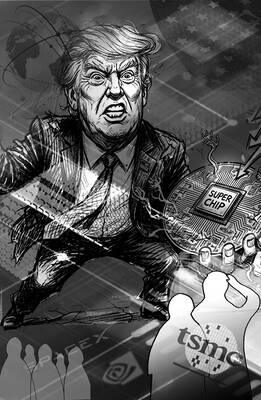
The White House’s decision to take a 9.9 percent stake in Intel Corp is looking like very shrewd business indeed. Since the government bought in at US$20.47 a share last August, the US chipmaker’s surging stock price has delivered the US a US$43 billion return. One of the reasons the investment has so far proved so sound is that the White House has made sure of it. According to The Wall Street Journal, Howard personally pushed deals on Intel’s behalf with some of the most lucrative clients imaginable. They include Nvidia Corp, the company at the heart of the AI
A single photograph can cut through a lot of noise, but it can also be used to misrepresent the truth. At the very least, it can concentrate the mind on something that requires further investigation. On Monday last week, Ma Ying-jeou Foundation CEO Tai Hsia-ling (戴遐齡) and former National Security Council secretary-general King Pu-tsung (金溥聰) held a news conference in which they showed a photograph of former foundation CEO Hsiao Hsu-tsen (蕭旭岑), now Chinese Nationalist Party (KMT) deputy chairman. In the image Hsiao is seated next to Xiamen Taiwan Businessmen Association chairman Han Ying-huan (韓螢煥). The two men were holding
I first met Professor Ray Jiing (井迎瑞) as a film and documentary student at Shih Hsin University’s (SHU) Department of Radio Television and Film in 1988. The following year, he went on to become the director of the Chinese Taipei Film Archive — forerunner of the Taiwan Film and Audiovisual Institute (TFAI). Over his eight-year tenure, Jiing rescued and restored over 200 classic Taiwanese films. In 1997, he established the Graduate Institute of Studies in Documentary and Film Archiving at Tainan National University of the Arts (TNNUA), and I joined the program in his third cohort of students. Beyond a
A recent report concerning a student who is suing his teacher posed the question in its headline: Does failing a student in two subjects constitute bullying? The college student in Chiayi County apparently sought NT$2 million (US$63,603) in state compensation, but a court dismissed the case. The first reaction of many might have been to ask: What has happened to students nowadays? Some say that teachers have lost their authority, while others say students are overindulged. Some even start reminiscing over the days when “whatever the teacher says goes.” However, the real issue might be overlooked if emotional reactions like that are the


 RSS
RSS