


CTBC Financial Holding Co (中信金控) yesterday reported record first-quarter profit and issued a positive outlook for earnings growth, thanks to strong overseas banking momentum, resilient core operations and potential interest-rate tailwinds.
The company posted net profit of NT$23.1 billion (US$729.9 million) for the first quarter, up 16 percent year-on-year and the highest on record for the period.
Earnings per share were NT$1.18, it said.
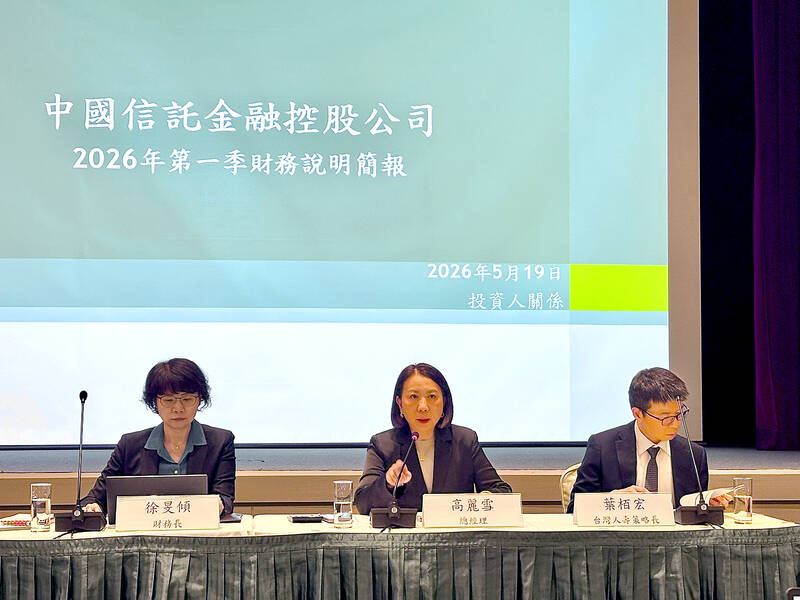
Photo: CNA
The company has proposed a cash dividend of NT$2.5 per share, implying a payout ratio of 61.3 percent.
Looking ahead, full-year profitability is expected to maintain a steady upward trajectory, underpinned by expanding overseas income and a favorable interest-rate environment in Taiwan, CTBC Financial president Rachael Kao (高麗雪) said at an earnings conference in Taipei.
Main subsidiary CTBC Bank Co (中信銀行) remained the key growth engine, posting net profit of NT$16.59 billion, up 23 percent year-on-year, also a quarterly record.
Kao attributed the results to rising cross-border financing demand as geopolitical realignment and global supply-chain diversification prompt technology and manufacturing firms to expand production bases outside China.
Overseas operations accounted for 35 percent of total profit at he bank, with Southeast Asia the strongest contributor, delivering 50 percent annual growth, the company said.
CTBC Bank’s international footprint is increasingly becoming a structural earnings driver, reinforcing its regional diversification strategy, with continued expansion planned in the US, Japan and Australia, CTBC Financial said.
The company said its banking unit would support financing mechanisms linked to Taiwanese firms’ US investment plans under the National Development Council’s initiative.
The company’s board is expected to discuss related capital allocation later this month, it said.
CTBC Financial said geopolitical tensions in the Middle East have added to global uncertainty and reinforced inflation stickiness in the US.
With US consumer inflation at 3.8 percent, the company sees a high likelihood the US Federal Reserve would keep interest rates unchanged for the rest of the year, given contained downside risks in the labor market.
In contrast, Taiwan’s economy continues to benefit from strong artificial intelligence-driven demand, with first-quarter GDP growing 13.69 percent year-on-year and exports surging more than 50 percent to US$195.7 billion. CTBC Financial expects Taiwan’s full-year GDP growth to exceed 8 percent, it said.
However, strong growth might prompt tighter monetary policy, as the company’s research team expects the central bank to raise its interest rates by 12.5 basis points at its quarterly meeting next month, with another possible increase later this year if overheating pressures persist.
A divergence between US and Taiwan rate paths would be supportive for the company’s earnings growth, CTBC Financial said.
The company estimates that each 12.5-basis-point rate hike in Taiwan could lift net interest margin by 1.7 basis points and add about NT$1.1 billion to net interest income, it said.
The New Taiwan dollar is expected to maintain a mild appreciation bias, supported by narrowing US-Taiwan rate differentials, fiscal concerns over the US dollar and strong equity inflows, with the local currency potentially strengthening toward NT$30.5 against the US dollar by the end of the year, CTBC Financial said.
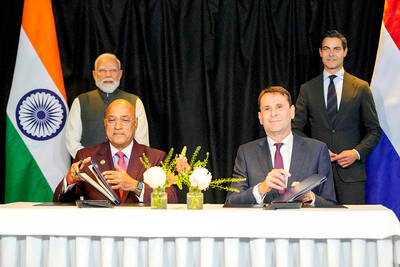
NEW MARKET: The partnership opens up India to the Dutch company, which already has a strong hold in the semiconductor market of South Korea, Taiwan and China ASML Holding NV entered into a partnership agreement with Tata Electronics Pvt Ltd aimed at ramping up India’s goal to develop domestic chip-manufacturing capabilities. The Dutch company’s technology would help power Tata Electronics’ planned 300 millimeter (mm) semiconductor foundry in Gujarat, according to a joint statement from the two companies on Saturday. The signing of a memorandum of understanding coincides with a visit by Indian Prime Minister Narendra Modi to the Netherlands, which is looking to deepen bilateral relations with New Delhi. ASML, whose top customers include Taiwan Semiconductor Manufacturing Co (台積電) and Samsung Electronics Co, makes lithography machines that can print
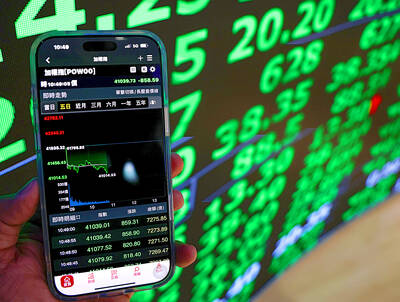
PORTFOLIO REBALANCING: The adjustments in three global equity indices reflect rising investor appetite for semiconductor and artificial intelligence-related stocks Taiwan’s weighting in major global equity indices compiled by MSCI Inc is to rise modestly following the latest quarterly review, underscoring the market’s expanding role in emerging-market portfolios, as global investors continue to favor the nation’s technology sector. Taiwan’s weighting in the MSCI Emerging Markets Index is to increase by 0.30 percentage points to 23.76 percent, after the changes take effect at the close of the May 29 session. Its weighting in the MSCI All-Country Asia ex-Japan Index is to rise 0.37 percentage points to 27.16 percent, while that in the MSCI All Country World Index is to edge up slightly to
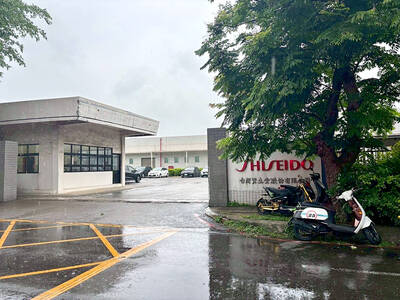
The Hsinchu County Government’s Labor Affairs Department yesterday said that it has received a plan from cosmetics brand Taiwan Shiseido Co (台灣資生堂) detailing mass layoffs at its plant in Hukou Township (湖口). While the labor authorities did not disclose the number of employees to be laid off, Japanese news media earlier in the day reported that the closure of the company’s factory in Hukou would result in 170 employees losing their jobs. Shiseido followed the law by reporting its layoff plan, the department said, adding that authorities would closely monitor negotiations between the management and affected employees and step in if any
Hon Hai Precision Industry Co (鴻海精密) on Tuesday confirmed a cyberattack targeting some of its North American facilities, but said the affected factories were gradually returning to normal. The company, known globally as Foxconn Technology Group (富士康科技集團), said that its cybersecurity team “activated the response mechanism and implemented operational measures to ensure the continuity of production and delivery.” “The affected factories are resuming normal production,” the company said in a statement. Hon Hai had previously described it as a “technical issue,” when news of the cyberattack first surfaced. The confirmation followed media reports of a large-scale information technology system incident that broke out at


 RSS
RSS