


After prevailing in its court fight with Elon Musk, OpenAI — the ChatGPT maker valued at US$852 billion — remains on track for what could be one of the largest initial public offerings in history.
Musk had been seeking the ouster of his fellow OpenAI co-founder, CEO Sam Altman, among other changes to the company. But with testimony from witnesses who called Altman dishonest, he’s hardly emerged unscathed.
At a time of growing concern about artificial intelligence's (AI) impacts, the landmark trial also shed new light on the flaws and outsize ambitions of the small number of billionaires steering the development of the breakthrough technology.
.jpg)
Photo: David Paul Morris, Bloomberg
The trial was a reminder “of how much the future of AI still depends on a remarkably small group of powerful tech figures and their personal rivalries,” Cornell University’s Tech Policy Institute director Sarah Kreps said.
“The trial highlighted not just a dispute between Musk and Altman, but a broader disconnect between the people building these systems and many of the people increasingly expected to live and work alongside them," Kreps said.
Musk had accused OpenAI, Altman and his top lieutenant Greg Brockman of betraying a shared vision for it to remain a nonprofit dedicated to guiding AI's development for the good of humanity. Altman, in turn, accused Musk of trying to hobble the ChatGPT maker for the benefit of his own AI company.
On Monday, the nine-person federal jury in Oakland, California, found that Musk waited too long to file his lawsuit and missed a statutory deadline. After a three-week trial that included hundreds of pieces of evidence and some of tech's biggest names on the stand, the jury deliberated less than two hours before returning a verdict essentially on a technicality.
Musk said he will appeal and called Judge Yvonne Gonzalez Rogers, who oversaw the trial, a “terrible activist Oakland judge, who simply used the jury as a fig leaf" to create a bad precedent. “She just handed out a free license to loot charities if you can keep the looting quiet for a few years!” Musk wrote on his social media platform X.
It was the second major courtroom loss for Musk in less than two months.
Gonzalez Rogers made it clear early on in the trial that she did not want it to become a debate over AI's dangers. But the unresolved questions about the risks AI poses for job losses, mental health issues and even humanity’s extinction served as a backdrop for the proceedings, with protesters decrying both Musk and Altman becoming a regular presence outside the federal courthouse.
Demonstrators' signs declared the real losers were regular people whose lives are being upended by an industry controlled by out-of-touch billionaires who can’t get along.
“This is a funny microcosm of this moment where we have this hugely important technology that’s being developed by for-profit corporations run by people like Musk and Altman and not as the part of some government-led initiative,” Columbia Law School professor Dorothy Lund said.
The trial laid bare some of Silicon Valley's messy inner workings, with emails, diary entries and sometimes embarrassing text message exchanges shown as evidence. Texts between Altman and a former OpenAI executive became meme fodder and the subject of parody songs.
The trial shed light on Altman’s removal from the OpenAI board in 2023, before he returned to his role a few days later. Several witnesses including two ex-board members, Helen Toner and Tasha McCauley, said there were concerns about Altman’s truthfulness.
Throughout the trial, OpenAI brushed off Musk’s allegations of betrayal as an unfounded case of sour grapes aimed at undercutting the company's rapid growth and bolstering Musk’s own AI company, xAI, which is now part of Space Exploration Technologies Corp (SpaceX).
Both Musk's SpaceX and OpenAI are planning massive initial public offerings, as is Anthropic, which was formed by a group of seven ex-OpenAI leaders.
“It’s a lot of dirty laundry that doesn’t look very appealing, I suppose, and so that may hurt their reputation and may have downstream effects on all kinds of things that you can’t even anticipate,” University of Richmond Law School professor Carl Tobias said. “But you know, AI is likely to come forward and continue even if it isn’t OpenAI.”
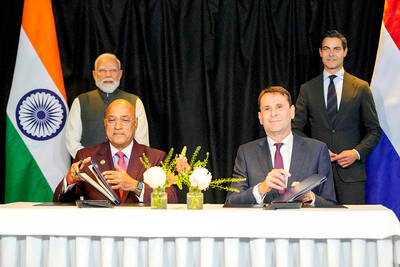
NEW MARKET: The partnership opens up India to the Dutch company, which already has a strong hold in the semiconductor market of South Korea, Taiwan and China ASML Holding NV entered into a partnership agreement with Tata Electronics Pvt Ltd aimed at ramping up India’s goal to develop domestic chip-manufacturing capabilities. The Dutch company’s technology would help power Tata Electronics’ planned 300 millimeter (mm) semiconductor foundry in Gujarat, according to a joint statement from the two companies on Saturday. The signing of a memorandum of understanding coincides with a visit by Indian Prime Minister Narendra Modi to the Netherlands, which is looking to deepen bilateral relations with New Delhi. ASML, whose top customers include Taiwan Semiconductor Manufacturing Co (台積電) and Samsung Electronics Co, makes lithography machines that can print
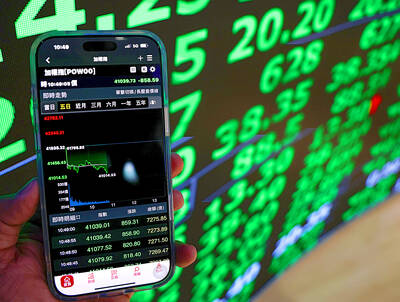
PORTFOLIO REBALANCING: The adjustments in three global equity indices reflect rising investor appetite for semiconductor and artificial intelligence-related stocks Taiwan’s weighting in major global equity indices compiled by MSCI Inc is to rise modestly following the latest quarterly review, underscoring the market’s expanding role in emerging-market portfolios, as global investors continue to favor the nation’s technology sector. Taiwan’s weighting in the MSCI Emerging Markets Index is to increase by 0.30 percentage points to 23.76 percent, after the changes take effect at the close of the May 29 session. Its weighting in the MSCI All-Country Asia ex-Japan Index is to rise 0.37 percentage points to 27.16 percent, while that in the MSCI All Country World Index is to edge up slightly to
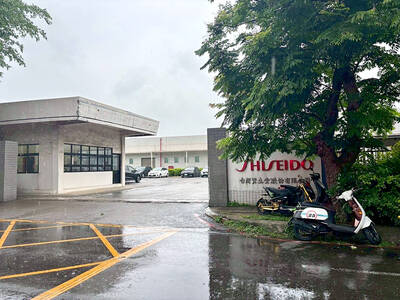
The Hsinchu County Government’s Labor Affairs Department yesterday said that it has received a plan from cosmetics brand Taiwan Shiseido Co (台灣資生堂) detailing mass layoffs at its plant in Hukou Township (湖口). While the labor authorities did not disclose the number of employees to be laid off, Japanese news media earlier in the day reported that the closure of the company’s factory in Hukou would result in 170 employees losing their jobs. Shiseido followed the law by reporting its layoff plan, the department said, adding that authorities would closely monitor negotiations between the management and affected employees and step in if any
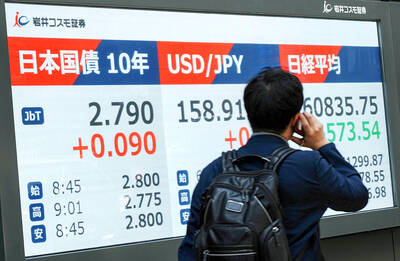
ROUGH RECORDS: Bonds in Japan, as well is in New Zealand, Australia and the US, are seeing the effects of a nervy market as stock exchanges across Asia edge down A deepening slump in Japanese government bonds added fuel to the selloff in global debt markets as rising oil prices stoked inflation fears and pushed yields to multi-decade highs. Japan’s 30-year yield yesterday surged as much as 20 basis points to the highest level since the tenor’s debut in 1999, before paring some of the move. Shorter-maturity Japanese debt was also under pressure, underscored by weak demand at a sale of five-year notes that offered a record-high coupon of 2 percent. Concerns over inflation and government spending rippling through markets including the US, Australia and New Zealand are being amplified in Japan,


 RSS
RSS