


Taiwan’s actively managed exchange-traded funds (ETFs) have become an investment frenzy, with several offerings more than doubling in value within a year as strong market gains and notable returns draw a surge of investor money into the fast-growing area.
The rapid ascent of active ETFs is the newest phase in Taiwan’s retail investing cycle, following earlier waves of enthusiasm for high-dividend strategies and market-cap weighted index funds.
Fund managers say the shift has become so pervasive that many retail investors are increasingly embracing “saving through ETFs” as a long-term strategy, rather than relying on traditional stock picking.
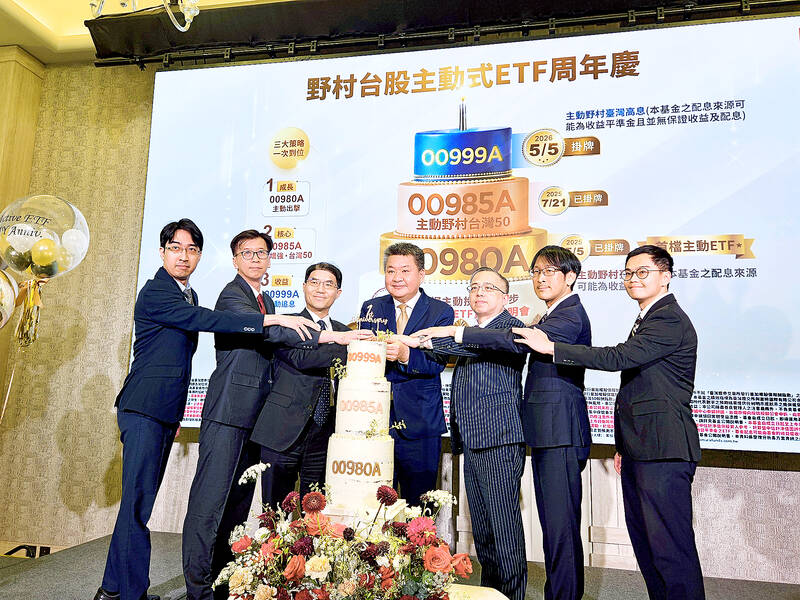
Photo: CNA
According to data from the Securities Investment Trust and Consulting Association (SITCA, 投信投顧公會), the number of investors holding Taiwan-listed active ETFs has climbed above 1.04 million, setting a record high for 23 consecutive weeks as new products continue to enter the market.
Asset managers say fundraising momentum has far exceeded expectations. Whereas new mutual funds typically raised between NT$1 billion (US$31.7 million) and NT$4 billion in the past, new active ETFs routinely attract more than NT$10 billion in subscriptions.
The surge has reshaped online retail-investor behavior. Social media forums that once focused heavily on individual stocks are dominated by discussions of ETFs — particularly actively managed products — as investors track portfolio changes and attempt to mirror fund managers’ winning trades.
Performance has fueled enthusiasm. Among active ETFs, the top performer since inception is the UPAMC Taiwan Growth Active ETF (00981A), which has delivered a return of 187.9 percent.
It is followed by the Nomura Taiwan Select Active ETF (00980A) with a gain of 127.22 percent, and then the Capital Taiwan Strong Growth Active ETF (00982A), which has returned 124.31 percent. All three have more than doubled investors’ capital since launch.
In just one year, Taiwan has launched 28 active ETFs spanning domestic and overseas strategies, with combined assets under management surpassing NT$500 billion, SITCA data showed.
Industry executives say the boom reflects a broader global shift. Worldwide issuance of active ETFs accelerated sharply last year, with new launches rising about 70 percent from 2024 levels and outpacing passive ETFs and traditional mutual funds.
Nomura Asset Management Taiwan Ltd (野村投信) said that active ETFs account for about 5 percent of Taiwan’s overall ETF market, with nearly 80 percent of assets concentrated in domestic equity products.
Compared with more mature overseas markets, Taiwan’s active ETF segment remains in its early stages and still has ample room to expand — particularly as issuers broaden offerings into overseas equities and fixed income products, Nomura said.
Looking ahead, analysts said the key question is whether the momentum can be sustained once market volatility returns. While strong performance has reinforced investor confidence, some warn that expectations anchored to triple-digit returns might be difficult to maintain, as competition among fund houses intensifies and stock market conditions normalize.
Even so, the rapid adoption of active ETFs suggests they are likely to remain a core feature of Taiwan’s retail investment landscape rather than a passing fad, analysts said.

Taiwan Semiconductor Manufacturing Co (TSMC, 台積電) has approved a capital budget of US$31.28 billion for production expansion to meet long-term development needs during the artificial intelligence (AI) boom. The company’s board meeting yesterday approved the capital appropriation plan for purposes such as the installation of advanced technology capacity and fab construction, the world’s largest contract chipmaker said in a statement. At an earnings conference last month, TSMC forecast that its capital expenditure for this year would be at the higher end of the US$52 billion to US$56 billion range it forecast in January in response to robust demand for 5G, AI and

NEW MARKET: The partnership opens up India to the Dutch company, which already has a strong hold in the semiconductor market of South Korea, Taiwan and China ASML Holding NV entered into a partnership agreement with Tata Electronics Pvt Ltd aimed at ramping up India’s goal to develop domestic chip-manufacturing capabilities. The Dutch company’s technology would help power Tata Electronics’ planned 300 millimeter (mm) semiconductor foundry in Gujarat, according to a joint statement from the two companies on Saturday. The signing of a memorandum of understanding coincides with a visit by Indian Prime Minister Narendra Modi to the Netherlands, which is looking to deepen bilateral relations with New Delhi. ASML, whose top customers include Taiwan Semiconductor Manufacturing Co (台積電) and Samsung Electronics Co, makes lithography machines that can print
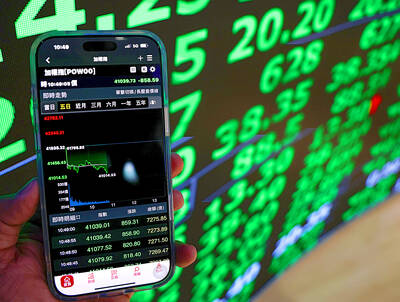
PORTFOLIO REBALANCING: The adjustments in three global equity indices reflect rising investor appetite for semiconductor and artificial intelligence-related stocks Taiwan’s weighting in major global equity indices compiled by MSCI Inc is to rise modestly following the latest quarterly review, underscoring the market’s expanding role in emerging-market portfolios, as global investors continue to favor the nation’s technology sector. Taiwan’s weighting in the MSCI Emerging Markets Index is to increase by 0.30 percentage points to 23.76 percent, after the changes take effect at the close of the May 29 session. Its weighting in the MSCI All-Country Asia ex-Japan Index is to rise 0.37 percentage points to 27.16 percent, while that in the MSCI All Country World Index is to edge up slightly to

The Hsinchu County Government’s Labor Affairs Department yesterday said that it has received a plan from cosmetics brand Taiwan Shiseido Co (台灣資生堂) detailing mass layoffs at its plant in Hukou Township (湖口). While the labor authorities did not disclose the number of employees to be laid off, Japanese news media earlier in the day reported that the closure of the company’s factory in Hukou would result in 170 employees losing their jobs. Shiseido followed the law by reporting its layoff plan, the department said, adding that authorities would closely monitor negotiations between the management and affected employees and step in if any


 RSS
RSS