


Taiwan’s “Goldilocks” economic environment could be approaching a tide change as rising energy costs threaten to stoke inflation and dampen private investment if tensions in the Middle East persist, DBS Bank Ltd warned yesterday.
While the bank maintained its forecast for Taiwan’s economic growth at 7 percent this year, it cautioned that imported inflation could cloud the outlook as geopolitical conflicts disrupt global energy supplies.
“The 2026 GDP growth forecast incorporates stronger-than-expected performance in the first quarter, followed by a gradual slowdown from this quarter onward,” Singapore-based DBS senior economist Ma Tieying (馬鐵英) said at a news conference in Taipei.
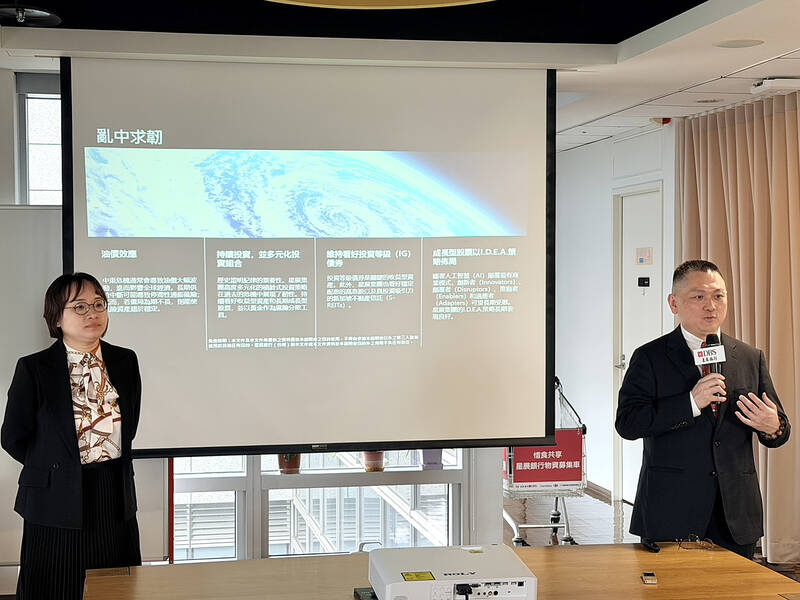
Photo: CNA
Taiwan’s economy likely expanded about 10 percent in the first quarter, before moderating to about 7 to 8 percent in the second and third quarters and slowing to 2 to 3 percent in the final quarter of the year, Ma said.
The deceleration would reflect weaker exports, investment and private consumption amid cooling global demand in non-artificial intelligence (AI) sectors, declining corporate profitability and softer household incomes as inflation and supply-chain constraints weigh on spending, she said.
DBS changed its inflation forecast for Taiwan this year to 1.9 percent from 1.5 percent, based on an assumption that Brent crude oil would average about US$80 per barrel.
The Middle East tensions are unlikely to ease soon after the US and Iran failed to reach a deal over the weekend, Ma said, adding that Taiwan remains vulnerable to energy shocks, as about 70 percent of its energy imports come from this region.
Economic data showed signs of potential headwinds ahead, with the indicators suggesting rising inflationary pressure and moderating export momentum for this quarter, while purchasing managers’ index data implied the highest input costs since the Russian invasion of Ukraine in 2022.
At the same time, consumer confidence is weakening amid growing concerns about the economic outlook, household finances and stock market prospects.
“Spillover effects on Taiwan could start to emerge from May onward,” Ma said.
Even if hostilities do not escalate, restoring shipping through the Strait of Hormuz could take several months as shipping confidence, insurance coverage and maritime security typically recover more slowly than political agreements, she said.
Energy infrastructure damage in the Gulf could prolong supply disruptions, as several refineries have been struck by Iran, she added.
Still, DBS said Taiwan’s technology sector, ranging from semiconductors to broader information technology hardware, is expected to remain resilient, supported by strong global demand tied to AI applications.
In particular, the rapid adoption of agentic AI — systems capable of planning and executing tasks autonomously — is driving global investment in advanced computing and cloud infrastructure, which Ma said is largely structural rather than cyclical, underpinned by long-term corporate strategies and government initiatives.
Taiwan’s foreign exchange reserves fell below the US$600 billion mark at the end of last month, with the central bank reporting a total of US$596.89 billion — a decline of US$8.6 billion from February — ending a three-month streak of increases. The central bank attributed the drop to a combination of factors such as outflows by foreign institutional investors, currency fluctuations and its own market interventions. “The large-scale outflows disrupted the balance of supply and demand in the foreign exchange market, prompting the central bank to intervene repeatedly by selling US dollars to stabilize the local currency,” Department of Foreign

ENERGY ISSUES: The TSIA urged the government to increase natural gas and helium reserves to reduce the impact of the Middle East war on semiconductor supply stability Chip testing and packaging service provider ASE Technology Holding Co (日月光投控) yesterday said it planned to invest more than NT$100 billion (US$3.15 billion) in building a new advanced chip testing facility in Kaohsiung to keep up with customer demand driven by the artificial intelligence (AI) boom. That would be included in the company’s capital expenditure budget next year, ASE said. There is also room to raise this year’s capital spending budget from a record-high US$7 billion estimated three months ago, it added. ASE would have six factories under construction this year, another record-breaking number, ASE chief operating officer Tien Wu

The EU and US are nearing an agreement to coordinate on producing and securing critical minerals, part of a push to break reliance on Chinese supplies. The potential deal would create incentives, such as minimum prices, that could advantage non-Chinese suppliers, according to a draft of an “action plan” seen by Bloomberg. The EU and US would also cooperate on standards, investments and joint projects, as well as coordinate on any supply disruptions by countries like China. The two sides are additionally seeking other “like-minded partners” to join a multicountry accord to help create these new critical mineral supply chains, which feed into

For weeks now, the global tech industry has been waiting for a major artificial intelligence (AI) launch from DeepSeek (深度求索), seen as a benchmark for China’s progress in the fast-moving field. More than a year has passed since the start-up put Chinese AI on the map in early last year with a low-cost chatbot that performed at a similar level to US rivals. However, despite reports and rumors about its imminent release, DeepSeek’s next-generation “V4” model is nowhere in sight. Speculation is also swirling over the geopolitical implications of which computer chips were chosen to train and power the new


 RSS
RSS