


Commercial property transactions surged in the first quarter, fueled largely by a major semiconductor factory acquisition, a report released by Colliers International Consultants Ltd’s Taiwan branch on Wednesday last week showed.
Total transactions reached NT$99.3 billion (US$3.1 billion) in the first quarter, more than doubling from a year earlier and marking the highest quarterly level since Colliers began tracking the local market.
The jump was driven primarily by Micron Technology Inc’s purchase of a semiconductor facility in Miaoli County from Powerchip Semiconductor Manufacturing Corp (力積電) for nearly NT$53 billion.
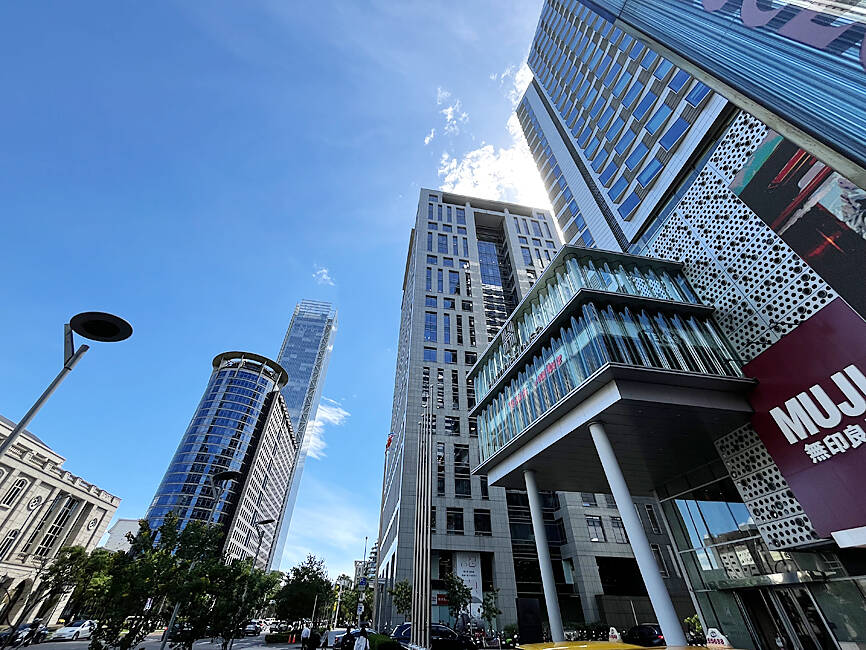
Photo: Hsu Yi-ping, Taipei Times
Owner-occupiers continued to dominate the market, with technology companies remaining the main drivers, Colliers Taiwan senior research director Eilleen Liang (梁儀盈) said.
Technology firms invested about NT$79.3 billion in commercial real estate during the quarter, accounting for about 79 percent of transactions.
By asset type, factory deals overwhelmingly led the market. Transactions involving owner-occupied factories totaled about NT$83.6 billion, representing 84 percent of the overall volume.
Demand from companies upgrading office space also remained steady, boosting transactions in newly completed and presale industrial and office projects in Taipei’s Neihu District (內湖) and Shilin District (士林), as well as New Taipei City’s Tucheng District (土城) and Sinjhuang District (新莊).
Investment capital was also active, although concentrated in a handful of deals. KGI Life Insurance Co (凱基人壽) acquired a logistics facility in Taoyuan for NT$6.3 billion, while an affiliate of Highwealth Construction Corp (興富發) bought an office building from Global Life Insurance Co (全球人壽) for NT$6 billion.
The land market remained relatively subdued, with transactions totaling about NT$52.1 billion in the first quarter, Colliers Taiwan said. However, three deals exceeded NT$10 billion, highlighting continued interest in strategically located sites.
Among them was US chipmaker Nvidia Corp’s NT$12.2 billion acquisition of surface rights at the Beitou-Shilin Technology Park, as well as the purchase of an industrial site in Taoyuan by Century Iron & Steel Industrial Co (世紀鋼構).
Looking ahead, Colliers Taiwan managing director Andrew Liu (劉學龍) said the property market would continue to be shaped by the expansion of artificial intelligence across industries.
Industrial properties including factories, office-factory complexes and logistics facilities that can be put into operation quickly are expected to remain the most sought-after assets, supported by strong owner-occupier demand and relatively stable returns.
The minimum yield requirement for life insurers’ property investments has been raised to 2.72 percent this year, which could encourage insurers to allocate more capital to higher-yielding industrial assets outside the greater Taipei area.
At the same time, rising geopolitical tensions and heightened global market volatility could prompt companies to diversify operations overseas, although it remains unclear whether such moves would dent domestic property investment, Liu said.
Taiwan Semiconductor Manufacturing Co (TSMC, 台積電) has approved a capital budget of US$31.28 billion for production expansion to meet long-term development needs during the artificial intelligence (AI) boom. The company’s board meeting yesterday approved the capital appropriation plan for purposes such as the installation of advanced technology capacity and fab construction, the world’s largest contract chipmaker said in a statement. At an earnings conference last month, TSMC forecast that its capital expenditure for this year would be at the higher end of the US$52 billion to US$56 billion range it forecast in January in response to robust demand for 5G, AI and
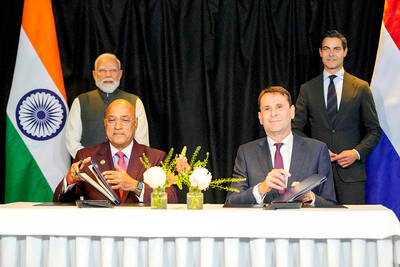
NEW MARKET: The partnership opens up India to the Dutch company, which already has a strong hold in the semiconductor market of South Korea, Taiwan and China ASML Holding NV entered into a partnership agreement with Tata Electronics Pvt Ltd aimed at ramping up India’s goal to develop domestic chip-manufacturing capabilities. The Dutch company’s technology would help power Tata Electronics’ planned 300 millimeter (mm) semiconductor foundry in Gujarat, according to a joint statement from the two companies on Saturday. The signing of a memorandum of understanding coincides with a visit by Indian Prime Minister Narendra Modi to the Netherlands, which is looking to deepen bilateral relations with New Delhi. ASML, whose top customers include Taiwan Semiconductor Manufacturing Co (台積電) and Samsung Electronics Co, makes lithography machines that can print
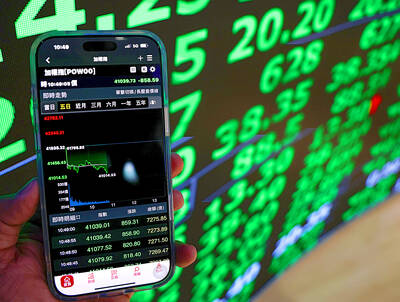
PORTFOLIO REBALANCING: The adjustments in three global equity indices reflect rising investor appetite for semiconductor and artificial intelligence-related stocks Taiwan’s weighting in major global equity indices compiled by MSCI Inc is to rise modestly following the latest quarterly review, underscoring the market’s expanding role in emerging-market portfolios, as global investors continue to favor the nation’s technology sector. Taiwan’s weighting in the MSCI Emerging Markets Index is to increase by 0.30 percentage points to 23.76 percent, after the changes take effect at the close of the May 29 session. Its weighting in the MSCI All-Country Asia ex-Japan Index is to rise 0.37 percentage points to 27.16 percent, while that in the MSCI All Country World Index is to edge up slightly to
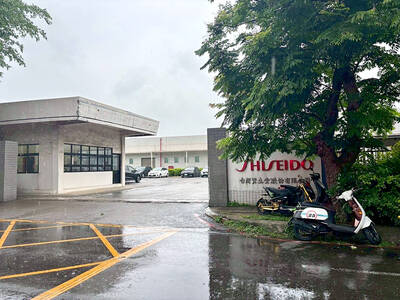
The Hsinchu County Government’s Labor Affairs Department yesterday said that it has received a plan from cosmetics brand Taiwan Shiseido Co (台灣資生堂) detailing mass layoffs at its plant in Hukou Township (湖口). While the labor authorities did not disclose the number of employees to be laid off, Japanese news media earlier in the day reported that the closure of the company’s factory in Hukou would result in 170 employees losing their jobs. Shiseido followed the law by reporting its layoff plan, the department said, adding that authorities would closely monitor negotiations between the management and affected employees and step in if any


 RSS
RSS