


Five EU countries are calling for a windfall tax on energy companies’ profits in reaction to rising fuel prices due to the Iran war, according to a letter from finance ministers to the EU Commission seen by Reuters on Saturday.
The finance ministers of Germany, Italy, Spain, Portugal and Austria made the joint call for an EU-wide tax in a letter dated on Friday.
Such a measure could help fund relief for consumers in the face of high energy prices and be a signal that “we stand united and are able to take action,” they said.
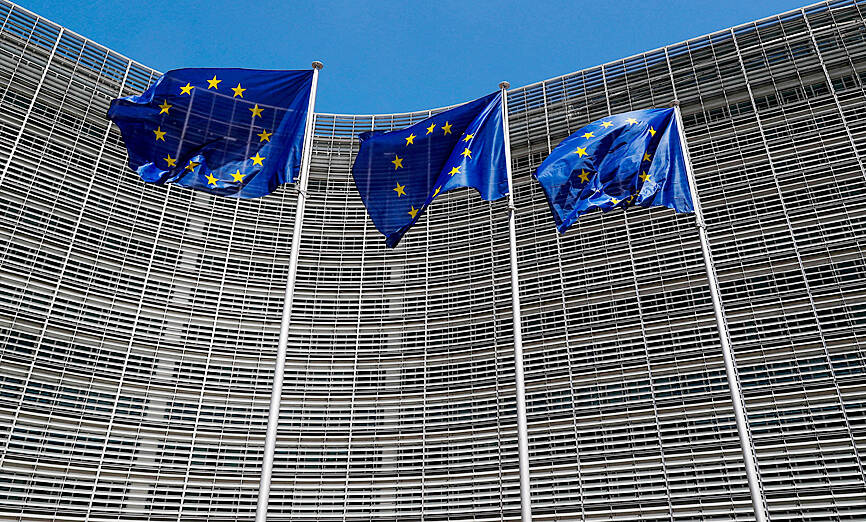
Photo: Reuters
“It would make it possible to finance temporary relief, especially for consumers, and curb rising inflation, without placing additional burdens on public budgets,” the ministers wrote.
“It would also send a clear message that those who profit from the consequences of the war must do their part to ease the burden on the general public,” they said.
Oil and gas prices have spiked since the US-Israeli strikes on Iran began on Feb. 28, creating a price shock similar to the energy crisis Europe went through after Russia invaded Ukraine in 2022 — even though EU countries are now getting more energy from renewable sources.
In the letter, addressed to European Commissioner for Climate, Net Zero and Clean Growth Wopke Hoekstra, the ministers pointed to a similar emergency tax in 2022 to address high energy prices.
“Given the current market distortions and fiscal constraints, the European Commission should swiftly develop a similar EU-wide contribution instrument grounded on a solid legal basis,” they wrote.
A spokesperson for the EU Commission confirmed it had received the letter and that it was assessing it.
“More generally, the Commission is working closely with member states on possible targeted policy measures in response to the current energy crisis facing Europe,” the spokesperson said.
The letter gave no details of what level of windfall tax the ministers were proposing, or on which companies it should fall.
The bloc’s energy chief said on Tuesday it was considering reviving energy crisis measures used in 2022, including proposals to curb grid tariffs and taxes on electricity.
The EU introduced a suite of emergency policies in 2022, after Russia cut gas deliveries. They included an EU-wide cap on gas prices, a tax on energy companies’ windfall profits, and targets to curb gas demand.
Europe’s heavy reliance on imported fuel leaves it exposed to the Middle East conflict’s impact on global energy prices. European gas prices have risen more than 70 percent since Feb. 28.
EU European Commissioner for Energy and Housing Dan Jorgensen said Brussels was particularly concerned in the short term about Europe’s supply of refined petroleum products such as jet fuel and diesel.
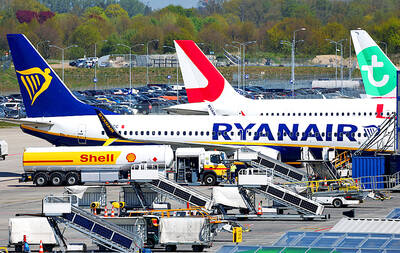
Ryanair, Transavia, Volotea and other low-cost airlines are feeling the financial pain from high jet fuel prices as a result of the Middle East war and are cutting flights. The closure of the Strait of Hormuz has taken a huge chunk of oil supplies off the market, sending the price of jet fuel soaring and triggering fears of shortages that could force airlines to cancel flights. Airlines are not waiting for a lack of supplies to react. “Travel alert: Airlines are cutting thousands of flights right now,” Travel Therapy host Karen Schaler said in an Instagram reel this past weekend.

MANAGING RISKS: Taiwan has secured LNG sufficient to cover 95 percent of electricity demand for next month, UBS said, describing the government’s approach as proactive UBS Group AG has raised its forecast for Taiwan’s economic growth this year to 8 percent, up from 6.9 percent previously, and said expansion could reach as high as 8.6 percent if external energy shocks are avoided. The upgrade reflects a stronger-than-expected first-quarter performance and sustained momentum in artificial intelligence (AI)-driven exports, which UBS said are providing a firm foundation for growth despite geopolitical and energy risks. Taiwan’s GDP expanded 13.69 percent year-on-year in the first quarter, the fastest growth since the second quarter of 1987, the Directorate-General of Budget, Accounting and Statistics (DGBAS) reported on Thursday. On a seasonally
The Fair Trade Commission’s (FTC) ongoing review of Grab Holdings Ltd’s US$600 million acquisition of Foodpanda Taiwan’s operations, announced on March 23, has taken on fresh urgency as industry experts warn that the transaction could embed significant Chinese cybersecurity vulnerabilities into Taiwan’s digital infrastructure through Grab’s deep ties to autonomous-driving firm WeRide (文遠知行). Less than 16 months after the FTC blocked Uber Eats’ direct attempt to acquire Foodpanda Taiwan — citing potential combined market shares of 80 to 90 percent — the emergence of Grab as the buyer has prompted questions about whether the same competitive harm is simply being rerouted

The list of Asian stocks that benefit from business partnership with Nvidia Corp is getting longer, as the region further integrates into the artificial intelligence (AI) chip giant’s business ecosystem. Just in the past week, South Korea’s LG Electronics Inc, Taiwan’s Nanya Technology Corp (南亞科技), as well as China’s Huizhou Desay SV Automotive Co (德賽西威) and Pateo Connect Technology Shanghai Corp (博泰車聯) have become the latest to rally on news of tie-ups, supply-chain participation or product collaboration with the US chip designer. Asian suppliers account for about 90 percent of Nvidia’s production costs, up from about 65 percent last year, data compiled


 RSS
RSS