


Taiwan’s economic growth is still expected to be higher than 7 percent this year if the Middle East war ends soon, National Development Council (NDC) Minister Yeh Chun-hsien (葉俊顯) said yesterday, citing the latest GDP growth forecasts by seven institutions.
Four forecast GDP growth above 8 percent, one predicted 7.28 percent, and two projected 6.92 percent and 6.22 percent, Yeh said at a news conference following an Executive Yuan meeting in Taipei.
“Economic growth this year should not differ significantly from the Directorate-General of Budget, Accounting and Statistics’ [DGBAS] forecast of 7.71 percent,” he said.
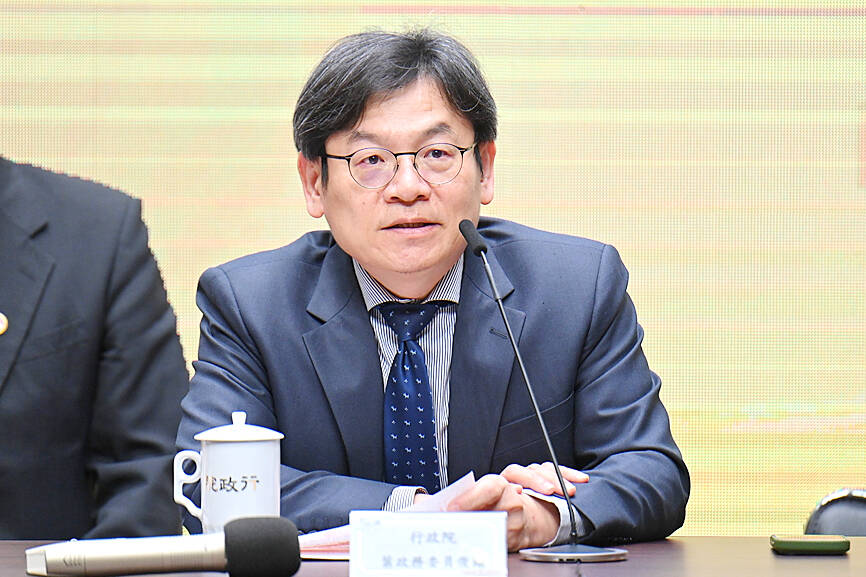
Photo courtesy of the Executive Yuan
The seven institutions include the central bank and Goldman Sachs Group Inc, Yeh added.
They remain relatively optimistic about the economy, mainly because the nation’s export structure has shifted toward the artificial intelligence (AI) industry, and the Middle East war has a relatively limited impact on AI development, he said, adding that it was “unlike the oil wars of the 1980s, when Taiwan’s exports focused more on petrochemical products.”
Regarding inflation outlook, the seven institutions forecast the consumer price index (CPI) could rise between 1.5 percent and 1.91 percent this year, Yeh said.
The central bank predicted CPI would rise 1.8 percent this year.
Headline inflation rose 1.33 percent in the first two months after seasonal adjustments, the DGBAS said last month.
The agency is scheduled to update its CPI data on Wednesday next week.
Based on information collected from the DGBAS and the central bank, inflation is expected to be below 1.5 percent in the first quarter and remain below the 2 percent alert level for the whole year, if the government’s price stabilization mechanism works smoothly, Vice Premier Cheng Li-chiun (鄭麗君) said at the news conference.
The conflict in the Middle East is impacting global energy supplies and market confidence, and exacerbating volatility in financial markets.
From March 2 to Wednesday, Taiwanese stocks fell by about 6.3 percent, lower than the 8.68 percent drop in Japanese stocks and the 12.26 percent decline in South Korean equities, indicating that the nation’s financial markets are relatively stable, Cheng said.
The government would continue to closely monitor the development of the war in the Middle East, and its impact on the domestic economy and inflation, and take subsequent policy adjustments when necessary, Cheng added.
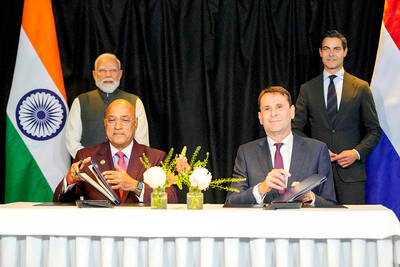
NEW MARKET: The partnership opens up India to the Dutch company, which already has a strong hold in the semiconductor market of South Korea, Taiwan and China ASML Holding NV entered into a partnership agreement with Tata Electronics Pvt Ltd aimed at ramping up India’s goal to develop domestic chip-manufacturing capabilities. The Dutch company’s technology would help power Tata Electronics’ planned 300 millimeter (mm) semiconductor foundry in Gujarat, according to a joint statement from the two companies on Saturday. The signing of a memorandum of understanding coincides with a visit by Indian Prime Minister Narendra Modi to the Netherlands, which is looking to deepen bilateral relations with New Delhi. ASML, whose top customers include Taiwan Semiconductor Manufacturing Co (台積電) and Samsung Electronics Co, makes lithography machines that can print
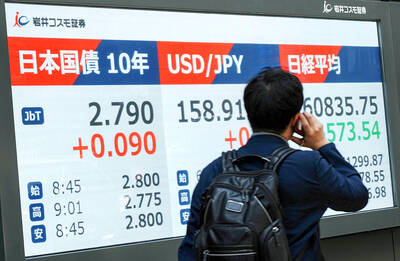
ROUGH RECORDS: Bonds in Japan, as well is in New Zealand, Australia and the US, are seeing the effects of a nervy market as stock exchanges across Asia edge down A deepening slump in Japanese government bonds added fuel to the selloff in global debt markets as rising oil prices stoked inflation fears and pushed yields to multi-decade highs. Japan’s 30-year yield yesterday surged as much as 20 basis points to the highest level since the tenor’s debut in 1999, before paring some of the move. Shorter-maturity Japanese debt was also under pressure, underscored by weak demand at a sale of five-year notes that offered a record-high coupon of 2 percent. Concerns over inflation and government spending rippling through markets including the US, Australia and New Zealand are being amplified in Japan,

Tokyo Electron's Taiwan unit today said in a written response that it respects the judicial process, takes the court ruling seriously and would not appeal in the Taiwan Semiconductor Manufacturing Co (TSMC, 台積電) trade secrets case. Last month, a court fined the Taiwan unit of Japan's Tokyo Electron NT$150 million (US$4.74 million) in a case involving trade secrets related to TSMC's sensitive chip technology.
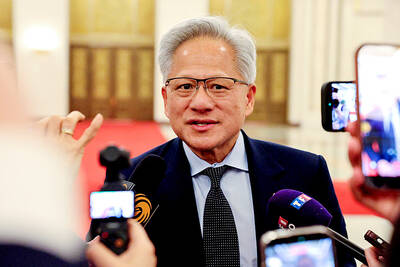
The US has cleared about 10 Chinese firms to buy Nvidia Corp’s second-most powerful artificial intelligence (AI) chip, the H200, but not a single delivery has been made so far, three people familiar with the matter said, leaving a major technology deal in limbo as chief executive officer Jensen Huang (黃仁勳) seeks a breakthrough in China this week. Huang, who was not initially listed in a White House delegation to Beijing, joined the trip after an invitation from US President Donald Trump, a source said. Trump picked him up in Alaska en route to a summit with Chinese President Xi Jinping


 RSS
RSS