


O-Bank Co (王道商業銀行) yesterday said its exposure to the Middle East remains limited and manageable despite escalating regional tensions, adding that it maintains a cautious but optimistic outlook for this year.
The Web-only lender’s holdings related to the Middle East account for only 0.76 percent of its total bond portfolio, O-Bank president Elton Lee (李芳遠) said, adding that the bank has no lending exposure to the region.
The bank’s bond investments in the region are mainly issued by large corporations or government-backed financial institutions with high credit ratings, Lee said at an earnings conference in Taipei.
Photo: Lee Chin-hui, Taipei Times
The bank has conducted a comprehensive review of its positions amid the ongoing Middle East conflict, he said.
“We are closely monitoring clients that could potentially be affected by the conflict, but their operations remain normal and the bank’s financial planning and profit outlook have not been materially affected,” Lee said.
At the conference, the bank also addressed investors’ concerns over rising non-performing loans (NPLs) at its Hong Kong branch.
O-Bank’s NPL ratio rose to 0.54 percent at the end of last year, mainly due to specific lending cases in Hong Kong, where some borrowers faced financial pressure amid a prolonged high-interest-rate environment and failed to make interest payments on schedule, Lee said.
All of the problematic loans are backed by sufficient real-estate collateral, and the bank has already begun disposal procedures to recover funds, he said.
The NPL ratio could drop sharply to about 0.07 percent once the collateral is successfully liquidated, Lee said, indicating that overall asset quality remains under control.
Looking ahead, O-Bank plans to issue subordinated bonds this year to strengthen its capital adequacy and support future operations, as it navigates shifting interest-rate cycles and evolving regional risks.
The board of O-Bank recently approved a proposal to distribute a cash dividend of NT$0.52 per common share, marking the highest payout since the bank’s listing on the Taiwan Stock Exchange in May 2017.
Taiwan Semiconductor Manufacturing Co (TSMC, 台積電) has approved a capital budget of US$31.28 billion for production expansion to meet long-term development needs during the artificial intelligence (AI) boom. The company’s board meeting yesterday approved the capital appropriation plan for purposes such as the installation of advanced technology capacity and fab construction, the world’s largest contract chipmaker said in a statement. At an earnings conference last month, TSMC forecast that its capital expenditure for this year would be at the higher end of the US$52 billion to US$56 billion range it forecast in January in response to robust demand for 5G, AI and
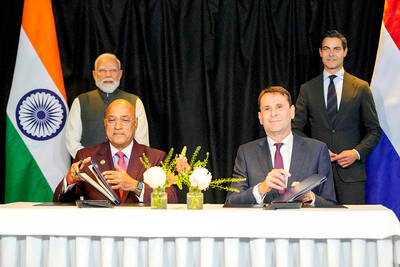
NEW MARKET: The partnership opens up India to the Dutch company, which already has a strong hold in the semiconductor market of South Korea, Taiwan and China ASML Holding NV entered into a partnership agreement with Tata Electronics Pvt Ltd aimed at ramping up India’s goal to develop domestic chip-manufacturing capabilities. The Dutch company’s technology would help power Tata Electronics’ planned 300 millimeter (mm) semiconductor foundry in Gujarat, according to a joint statement from the two companies on Saturday. The signing of a memorandum of understanding coincides with a visit by Indian Prime Minister Narendra Modi to the Netherlands, which is looking to deepen bilateral relations with New Delhi. ASML, whose top customers include Taiwan Semiconductor Manufacturing Co (台積電) and Samsung Electronics Co, makes lithography machines that can print
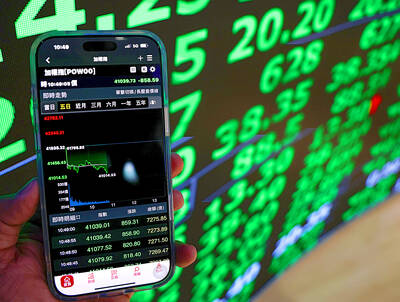
PORTFOLIO REBALANCING: The adjustments in three global equity indices reflect rising investor appetite for semiconductor and artificial intelligence-related stocks Taiwan’s weighting in major global equity indices compiled by MSCI Inc is to rise modestly following the latest quarterly review, underscoring the market’s expanding role in emerging-market portfolios, as global investors continue to favor the nation’s technology sector. Taiwan’s weighting in the MSCI Emerging Markets Index is to increase by 0.30 percentage points to 23.76 percent, after the changes take effect at the close of the May 29 session. Its weighting in the MSCI All-Country Asia ex-Japan Index is to rise 0.37 percentage points to 27.16 percent, while that in the MSCI All Country World Index is to edge up slightly to
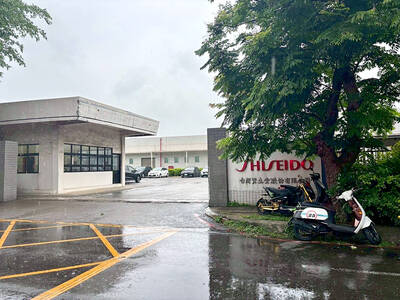
The Hsinchu County Government’s Labor Affairs Department yesterday said that it has received a plan from cosmetics brand Taiwan Shiseido Co (台灣資生堂) detailing mass layoffs at its plant in Hukou Township (湖口). While the labor authorities did not disclose the number of employees to be laid off, Japanese news media earlier in the day reported that the closure of the company’s factory in Hukou would result in 170 employees losing their jobs. Shiseido followed the law by reporting its layoff plan, the department said, adding that authorities would closely monitor negotiations between the management and affected employees and step in if any


 RSS
RSS