


Cable and connector maker Wonderful Hi-Tech Co (萬泰科技) yesterday said revenue is expected to grow sequentially each quarter this year, with full-year revenue likely to surpass the company’s target of NT$10 billion (NT$312.7 million).
The company reported revenue last year grew 6.1 percent year-on-year to NT$8.63 billion. Net profit gained 4.8 percent to NT$375 million, or earnings per share of NT$2.19.
The optimism underscores the company’s confidence in securing orders for high-speed cables for artificial intelligence (AI) servers, low Earth orbit (LEO) satellite-related products, and other higher-margin, customized cables, Wonderful Hi-Tech chairman Ringo Chang (張銘烈) told an earnings conference in Taipei.
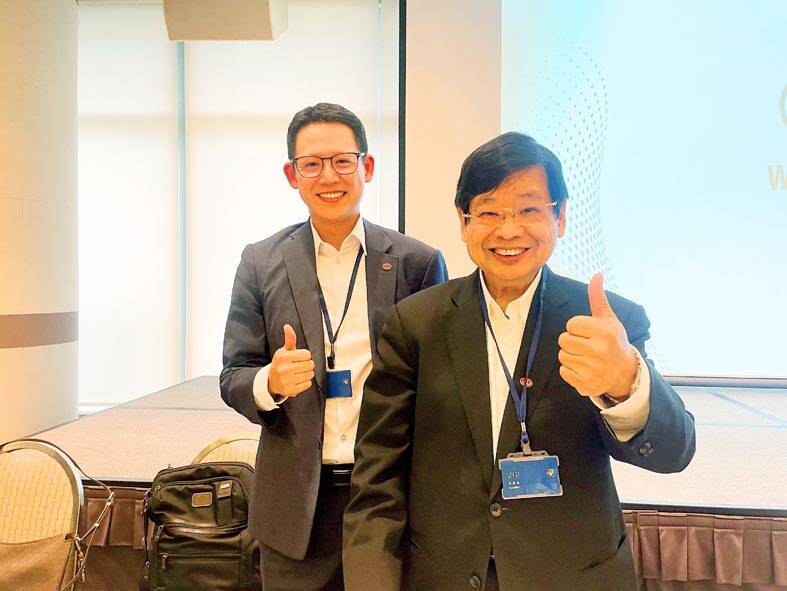
Photo: Meryl Kao, Taipei Times
The company’s core business focuses on copper-based wire and cable manufacturing, with applications spanning network transmission, power, control and sensing, as well as specialized environments.
As demand rises from AI data centers, edge computing, LEO satellites and advanced building cabling, the company has been shifting its product mix toward higher value-added offerings, it said.
Demand for satellite-related cables remains robust, given steady shipment growth among its US-based satellite customers, Wonderful Hi-Tech president Steve Chang (張程雅) said.
The company supplies AC power cables and network cables used in the ground equipment for LEO satellites, with shipments expected to ramp up as new customers enter mass production, he said.
Revenue contribution from satellite cables this year is expected to double from last year, he said.
To support growth, the company has budgeted capital expenditure of about NT$400 million for this year, with about NT$250 million for the third-phase expansion of high-speed cable production at its plant in Thailand, Steve Chang said.
Its plant in Vietnam has also expanded capacity for electron beam irradiated cables, with trial production beginning in January and mass production slated for the end of the second quarter, he said.
The company aims to expand its presence in AI server applications and further tap into the global satellite communications market as part of its mid-term growth strategy, he added.
Wonderful Hi-Tech targets a compound annual growth rate of 20 percent to 25 percent in revenue over the next five years, while aiming to increase the share of higher-margin, customized products, especially those supplied to AI data centers, from about 18 percent to 30 percent by 2030, he said.
That strategy is expected to drive growth in profit by lifting gross margin from about 18 percent now toward 20 percent by then, he said.
The company has expanded its global manufacturing footprint across Taiwan, the US, China, Thailand and Vietnam, and would continue to expand capacity in Southeast Asia to address rising geopolitical and supply chain risks, Steve Chang said.
It aims to increase North America’s revenue contribution to 40 percent, from 36 percent last year, in the coming years, he said.
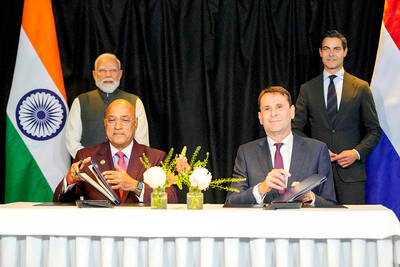
NEW MARKET: The partnership opens up India to the Dutch company, which already has a strong hold in the semiconductor market of South Korea, Taiwan and China ASML Holding NV entered into a partnership agreement with Tata Electronics Pvt Ltd aimed at ramping up India’s goal to develop domestic chip-manufacturing capabilities. The Dutch company’s technology would help power Tata Electronics’ planned 300 millimeter (mm) semiconductor foundry in Gujarat, according to a joint statement from the two companies on Saturday. The signing of a memorandum of understanding coincides with a visit by Indian Prime Minister Narendra Modi to the Netherlands, which is looking to deepen bilateral relations with New Delhi. ASML, whose top customers include Taiwan Semiconductor Manufacturing Co (台積電) and Samsung Electronics Co, makes lithography machines that can print
PORTFOLIO REBALANCING: The adjustments in three global equity indices reflect rising investor appetite for semiconductor and artificial intelligence-related stocks Taiwan’s weighting in major global equity indices compiled by MSCI Inc is to rise modestly following the latest quarterly review, underscoring the market’s expanding role in emerging-market portfolios, as global investors continue to favor the nation’s technology sector. Taiwan’s weighting in the MSCI Emerging Markets Index is to increase by 0.30 percentage points to 23.76 percent, after the changes take effect at the close of the May 29 session. Its weighting in the MSCI All-Country Asia ex-Japan Index is to rise 0.37 percentage points to 27.16 percent, while that in the MSCI All Country World Index is to edge up slightly to
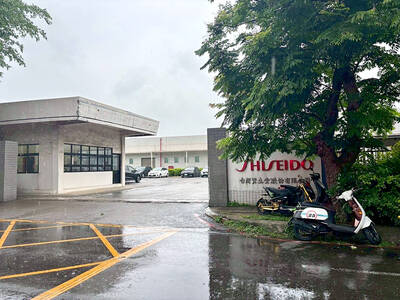
The Hsinchu County Government’s Labor Affairs Department yesterday said that it has received a plan from cosmetics brand Taiwan Shiseido Co (台灣資生堂) detailing mass layoffs at its plant in Hukou Township (湖口). While the labor authorities did not disclose the number of employees to be laid off, Japanese news media earlier in the day reported that the closure of the company’s factory in Hukou would result in 170 employees losing their jobs. Shiseido followed the law by reporting its layoff plan, the department said, adding that authorities would closely monitor negotiations between the management and affected employees and step in if any
Hon Hai Precision Industry Co (鴻海精密) on Tuesday confirmed a cyberattack targeting some of its North American facilities, but said the affected factories were gradually returning to normal. The company, known globally as Foxconn Technology Group (富士康科技集團), said that its cybersecurity team “activated the response mechanism and implemented operational measures to ensure the continuity of production and delivery.” “The affected factories are resuming normal production,” the company said in a statement. Hon Hai had previously described it as a “technical issue,” when news of the cyberattack first surfaced. The confirmation followed media reports of a large-scale information technology system incident that broke out at


 RSS
RSS