


Trade ministers are close to agreeing a reform plan for the WTO, as wrangling continues over extending a moratorium on customs duties for electronic transmissions such as digital downloads, two diplomats said.
The talks at a WTO meeting in Cameroon include efforts to bridge differences between the US and India over extending the e-commerce moratorium, which is due to expire this month.
Extending the moratorium — first adopted in 1998 as part of a declaration to encourage early digital trade growth — is seen as a test for the WTO’s relevance, following a year of tariff-fueled trade turmoil and major disruptions due to the Iran war.
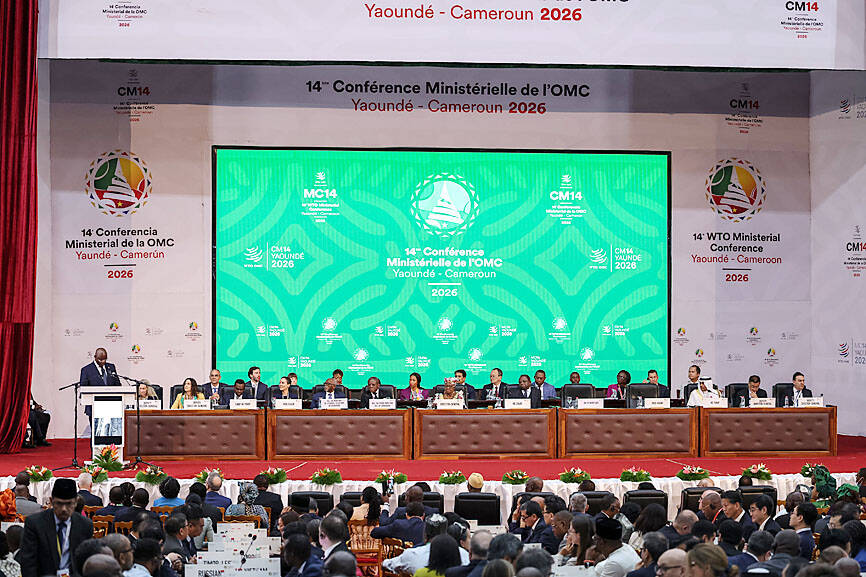
Photo: AFP
After initial resistance from some WTO members, a new draft of the reform road map provides a timeline for progress and sets out the key issues to address, according to a copy of the draft seen by Reuters.
Those issues include improving decisionmaking in a consensus-based system that has long been stymied by a few countries, and the trade benefits extended to developing countries.
The reform debate comes amid efforts to rework WTO rules to render subsidy use more transparent and make decision-taking easier. The US and the EU say China in particular has taken advantage of current rules to their detriment.
Bringing into WTO rules an agreement reached by a subset of members aimed at boosting investment in developing countries also remains blocked by India, which said plurilateral accords risk eroding the body’s founding principles.
Alongside the reform discussions, a senior diplomatic source — speaking on condition of anonymity — said there was a possibility of a four-year extension to the e-commerce moratorium.
India on Friday indicated that it would accept a two-year extension, diplomats said, while there were suggestions the US could accept a 10-year extension, another diplomat said.
US Trade Representative Jamieson Greer last week said that Washington wanted a permanent extension.
A new draft document on e-commerce seen by Reuters proposed support for developing country members concerned about losing out on tax revenues, as well as a review clause.
Business leaders said an extension is vital to guarantee predictability, fearing duties could otherwise be introduced. It is also seen as key to securing US support for the global trade body.
“If the moratorium does not get extended, the US will use it as an excuse to beat the WTO on the head,” a senior diplomat said.

Elon Musk’s lieutenants have reached out to chip industry suppliers, including Applied Materials Inc, Tokyo Electron Ltd and Lam Research Corp, for his envisioned Terafab, early steps in an audacious and likely arduous attempt to break into the production of cutting-edge chips. Staff working for the joint venture between Tesla Inc and Space Exploration Technologies Corp (SpaceX) have sought price quotes and delivery times for an array of chipmaking gear, people familiar with the matter said. In past weeks, they’ve contacted makers of photomasks, substrates, etchers, depositors, cleaning devices, testers and other tools, according to the people, who asked not to

Taiwan is attracting a growing number of foreign jobseekers as companies increasingly recruit overseas talent to ease labor shortages and expand global reach, recruitment platform 104 Job Bank (104人力銀行) said yesterday. More than 40,000 foreign nationals searched for jobs in Taiwan through the platform last year, a 28 percent increase from a year earlier, the company said. Malaysians accounted for the largest share of overseas jobseekers at 12.2 percent, followed by Indonesians at 11.9 percent and Vietnamese at 10.8 percent. Indonesian applicants surged more than 50 percent year-on-year, while Vietnamese jobseekers rose by more than 30 percent. Applicants from the
NO SHORTCUTS: Asked about Elon Musk’s Terafab initiative, TSMC CEO C.C. Wei said it takes two to three years to build a fab and another one to two to ramp it up Taiwan Semiconductor Manufacturing Co (TSMC, 台積電) yesterday raised its revenue growth forecast for this year to above 30 percent, up from the 25 percent it estimated three months earlier, citing extremely robust artificial intelligence (AI)-related chip demand. “Our customers and customers’ customers, who are mainly cloud service providers, continue to send us very positive signals and outlook,” TSMC chairman and CEO C.C. Wei (魏哲家) said at an earnings conference. The company also hiked its capital expenditure for this year toward the higher end of its forecast, or US$56 billion, as it aims to step up advanced chip capacity expansions, such as

The founder of Chinese property giant Evergrande Group (恆大集團) has pleaded guilty to charges of fraud and bribery, a court said yesterday, the latest blow for what was once the country’s leading developer. Evergrande’s rise was propelled by decades of rapid urbanization and rising living standards, but in 2020, its access to credit dramatically narrowed when the government introduced curbs on excessive borrowing and speculation. The company defaulted in 2021 after struggling to repay creditors. Founder Xu Jiayin (許家印), 67, known as Hui Ka Yan in Cantonese, was reportedly held by police in 2023, with Evergrande saying he had been subjected to


 RSS
RSS