


The return of the world’s biggest boy band, BTS, after their almost four-year hiatus looks set to be a major money-spinner — potentially beating Taylor Swift.
The K-pop giants were to hold a massive comeback concert in Seoul yesterday ahead of a world tour starting next month, one way that the mega-group earns money for itself — and others.
Some projections suggest that the 82-date, 23-country tour could even surpass US megastar Swift, whose 21-month Eras Tour reportedly generated about US$2 billion in ticket sales alone.
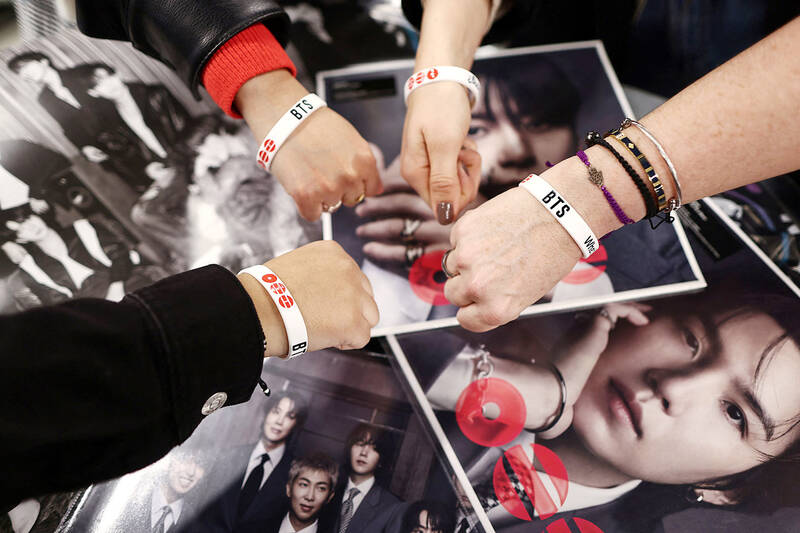
Photo: Reuters
Even more than Swift, money comes not just from ticket sales, but fans traveling from abroad and spending several days in the cities where BTS play — a phenomenon dubbed “BTSnomics.”
Starting in Goyang, South Korea, on April 9 and ending in the Philippines 11 months later, BTS’ tour encompasses 82 shows in 34 cities in 23 countries, including about 30 shows in North America.
“I expect these economic ripple effects to be distributed across all the countries and cities where the performances take place,” said Jang Soo-cheong, a professor of tourism at Purdue University in West Lafayette, Indiana.
“Given the number of scheduled performances, the massive global fandom — including ARMY — and the explosive release of pent-up longing for the group, I judge that this impact will indeed surpass that of ‘Taylornomics,’” Jang told reporters.
Analyst Kim Yu-hyuk of IBK Investment & Securities in Seoul said that a “highly conservative” estimate for ticket sales and merchandise from BTS’ tour is at least 2.9 trillion won (US$2 billion).
Six million people could go the shows, Kim said.
BTS might announce more dates next year.
On top of the 260,000 people expected to fill central Seoul yesterday, Netflix was to livestream the concert around the world.
“This is the biggest live musical performance Netflix has ever staged globally,” Netflix executive Brandon Riegg said in Seoul on Friday.
The buzz could further increase the global hunger for almost anything with a South Korean flavour, from movies and TV series to books, food and cosmetics.
KPop Demon Hunters — Netflix’s most-watched original film — this month won two Oscars and has already significantly helped boost tourism to South Korea.
Merchandise — ranging from tuna cans and beauty devices to glow sticks, blankets, clothing and dolls — is also a major generator of cash.
Shinsegae Duty Free said that its Myeongdong “K-Wave Zone,” which opened in central Seoul in January and sells K-pop-themed goods of multiple artists, is running out of BTS-related products.
Sales of BTS merchandise alone rose about 430 percent in the seven-day period ended on Thursday from a week earlier, it said in statement.
“Key rings sold out the fastest, while toothbrush-and-toothpaste sets — popular with travelers — and disposable bandages also went out of stock,” said Kim Ji-min, a spokesperson for Shinsegae.
“BTS has developed a new economic model for cultural IP [intellectual property], not one particular, but several, such as copyright, trademarks and design,” said Jin Dal-yong, a professor of culture and digital technology at Simon Fraser University in Vancouver.
“Their copyright extends to games, comics, music videos,” Jin said. “In terms of trademarks, the sale of merchandise, including dolls, has been significant.”
South Korea’s Yonhap news agency reported the number of foreign visitors to the country between March 1 and Wednesday rose by more than 30 percent compared with the same period last year.
BTS’ agency, HYBE, cited Hotels.com data showing overseas searches for Seoul jumped 160 percent within 48 hours of the announcement for the upcoming tour, while Busan, South Korea — another tour stop — saw a 2,400 percent surge.
Economically, the group’s impact is indeed “measurable in increased tourism to South Korea, the global expansion of K-pop, and spillover effects into industries like K-drama, beauty, cuisine and fashion,” said Shin Gi-wook, a professor of sociology at Stanford University in California. “In many ways, BTS helped catalyze the broader ‘K-everything’ wave, creating both cultural and economic multiplier effects.”
Reuters yesterday reported that Big Hit Music, the music label run by HYBE, said that the boy band’s new album Arirang sold 3.98 million copies on its first day of release.
The band went on hiatus in 2022 to allow members to complete their compulsory military service in South Korea.
Additional reporting by Reuters

Elon Musk’s lieutenants have reached out to chip industry suppliers, including Applied Materials Inc, Tokyo Electron Ltd and Lam Research Corp, for his envisioned Terafab, early steps in an audacious and likely arduous attempt to break into the production of cutting-edge chips. Staff working for the joint venture between Tesla Inc and Space Exploration Technologies Corp (SpaceX) have sought price quotes and delivery times for an array of chipmaking gear, people familiar with the matter said. In past weeks, they’ve contacted makers of photomasks, substrates, etchers, depositors, cleaning devices, testers and other tools, according to the people, who asked not to

Taiwan is attracting a growing number of foreign jobseekers as companies increasingly recruit overseas talent to ease labor shortages and expand global reach, recruitment platform 104 Job Bank (104人力銀行) said yesterday. More than 40,000 foreign nationals searched for jobs in Taiwan through the platform last year, a 28 percent increase from a year earlier, the company said. Malaysians accounted for the largest share of overseas jobseekers at 12.2 percent, followed by Indonesians at 11.9 percent and Vietnamese at 10.8 percent. Indonesian applicants surged more than 50 percent year-on-year, while Vietnamese jobseekers rose by more than 30 percent. Applicants from the
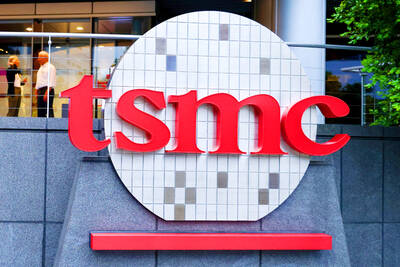
NO SHORTCUTS: Asked about Elon Musk’s Terafab initiative, TSMC CEO C.C. Wei said it takes two to three years to build a fab and another one to two to ramp it up Taiwan Semiconductor Manufacturing Co (TSMC, 台積電) yesterday raised its revenue growth forecast for this year to above 30 percent, up from the 25 percent it estimated three months earlier, citing extremely robust artificial intelligence (AI)-related chip demand. “Our customers and customers’ customers, who are mainly cloud service providers, continue to send us very positive signals and outlook,” TSMC chairman and CEO C.C. Wei (魏哲家) said at an earnings conference. The company also hiked its capital expenditure for this year toward the higher end of its forecast, or US$56 billion, as it aims to step up advanced chip capacity expansions, such as

The founder of Chinese property giant Evergrande Group (恆大集團) has pleaded guilty to charges of fraud and bribery, a court said yesterday, the latest blow for what was once the country’s leading developer. Evergrande’s rise was propelled by decades of rapid urbanization and rising living standards, but in 2020, its access to credit dramatically narrowed when the government introduced curbs on excessive borrowing and speculation. The company defaulted in 2021 after struggling to repay creditors. Founder Xu Jiayin (許家印), 67, known as Hui Ka Yan in Cantonese, was reportedly held by police in 2023, with Evergrande saying he had been subjected to


 RSS
RSS