


The EU on Wednesday unveiled new “made in Europe” rules to bolster the bloc’s industries against fierce competition from China, in a push held up for months by wrangling over measures some see as overly protectionist.
Concerning strategic sectors including cars, green tech and steel, the proposal is a key part of an EU drive to regain its competitive edge, reduce its dependencies and stave off job losses.
“It is a change in doctrine — one that was unthinkable just a few months ago,” European Commission Executive Vice President for Prosperity and Industrial Strategy Stephane Sejourne told a news conference.
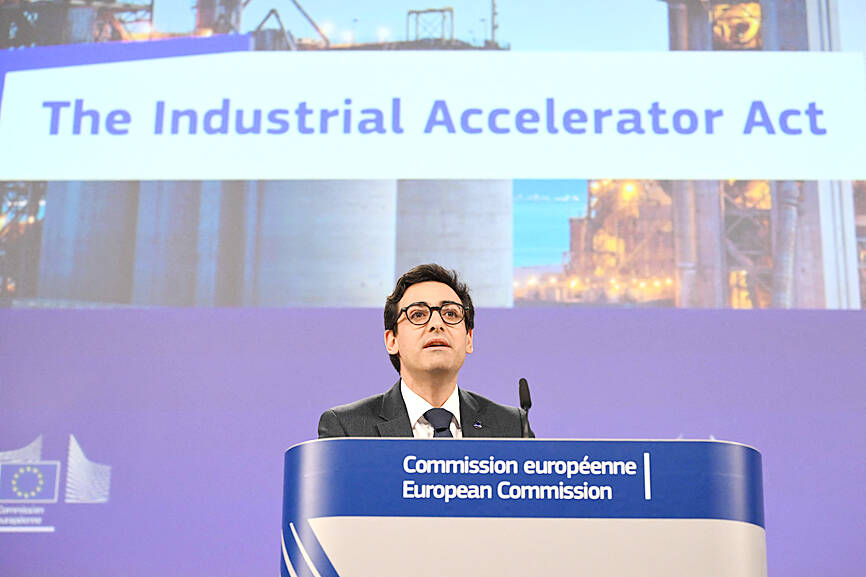
Photo: AFP
Broadly, the rules aim to ensure that public and foreign investments support manufacturing inside the 27-nation bloc, an EU official said.
To that end, companies that want public money must meet minimum thresholds for EU-made parts and subject large investments from dominant foreign firms to conditions including employing EU workers, they said.
The European Commission said the package aims to bring manufacturing’s share of EU GDP to 20 percent by 2035, up from about 14 percent in 2024.
At stake are about 600,000 jobs Brussels predicts could be lost over a decade unless the bloc reverses its industrial decline.
Initially expected last year, the measures strongly backed by France were pushed back several times due to disagreements, with some arguing they run counter to the EU’s pro-free-trade spirit.
Much of the discord revolved around the geographical scope of “made in Europe.”
Skeptics, including the EU’s largest economy Germany, said trade partners should be included in the definition under a “made with Europe” approach.
Brussels settled for a compromise based around the principle of reciprocity.
Countries that have deals with the EU allowing for European companies to access public money on a par with local firms in the sectors concerned would be brought into the fold.
Others — such as Canada — that give preference to local producers would be left out unless they change tack, the official said, adding that the rules would be used as a trade tool to negotiate better access for EU companies.
“We will exclude those who do not play by the rules or who pose a risk to our economic security,” Sejourne said.
Ahead of publication, the plans had raised concerns among foreign partners including the UK, Japan and Turkey.
A full list of who was in and who was out was not yet available.
The French government called the package “a first step” in the right direction, but said it was “not yet sufficiently protective of our interests.”
The “made in Europe” requirements, which also seek to boost industrial decarbonization, would apply to “strategic sectors,” namely: steel, cement, aluminum, cars, and net zero technologies.
Governments putting money behind infrastructure projects would have to ensure they include a minimum share of European low-carbon steel, cement and aluminum, among other provisions. Electric-vehicle (EV) manufacturers would have to make sure at least 70 percent of their cars’ components are made in the EU to access public money.
Similar rules would apply to batteries, solar, wind and nuclear.
The proposal, formally known as the “industrial accelerator act,” also aims to ensure foreign companies partner with European firms to set up shop in the bloc.
To do so, it imposes conditions on foreign investments of more than 100 million euros (US$116.2 million) in “emerging strategic sectors” such as batteries and EVs.
These kick in for investors from countries that hold more than 40 percent of the related global manufacturing capacity — an implicit reference to Chinese dominance.
They require foreign investors to meet four of six conditions including employing at least 50 percent EU workers, holding no more than 49 percent of the related EU company, and passing on technological know-how.
For many, the plans are necessary to boost the development of EU green tech and shield manufacturers from unfair competition from heavily subsidized Chinese rivals.
“The EU is embracing long-overdue economic realism and adapting itself to the new brutal global trade reality,” said Neil Makaroff of the Strategic Perspectives climate think tank.
However, others warn about bogging down companies with extra red tape and costs.
“Nobody needs another ‘industrial bureaucracy act,’” lamented Dirk Jandura of German foreign trade association BGA. “If companies are forced to use more expensive European components instead of relying on competitive imports from the global market, their competitiveness suffers.”
European steel industry group Eurofer said the act was a “welcome start,” but more was needed to ensure support for steel “melted and poured” in Europe, not in third countries.
The proposal is subject to approval by EU states and parliament.
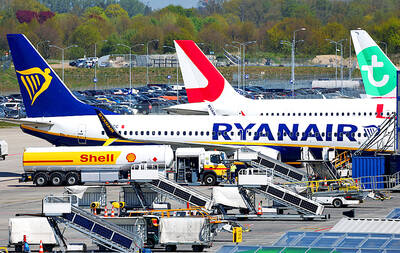
Ryanair, Transavia, Volotea and other low-cost airlines are feeling the financial pain from high jet fuel prices as a result of the Middle East war and are cutting flights. The closure of the Strait of Hormuz has taken a huge chunk of oil supplies off the market, sending the price of jet fuel soaring and triggering fears of shortages that could force airlines to cancel flights. Airlines are not waiting for a lack of supplies to react. “Travel alert: Airlines are cutting thousands of flights right now,” Travel Therapy host Karen Schaler said in an Instagram reel this past weekend.
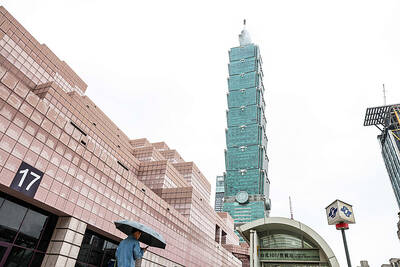
MANAGING RISKS: Taiwan has secured LNG sufficient to cover 95 percent of electricity demand for next month, UBS said, describing the government’s approach as proactive UBS Group AG has raised its forecast for Taiwan’s economic growth this year to 8 percent, up from 6.9 percent previously, and said expansion could reach as high as 8.6 percent if external energy shocks are avoided. The upgrade reflects a stronger-than-expected first-quarter performance and sustained momentum in artificial intelligence (AI)-driven exports, which UBS said are providing a firm foundation for growth despite geopolitical and energy risks. Taiwan’s GDP expanded 13.69 percent year-on-year in the first quarter, the fastest growth since the second quarter of 1987, the Directorate-General of Budget, Accounting and Statistics (DGBAS) reported on Thursday. On a seasonally
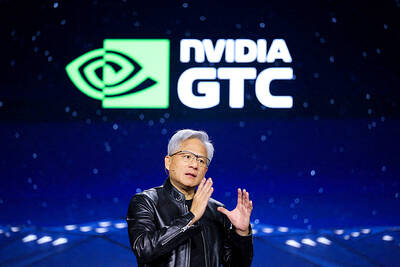
The list of Asian stocks that benefit from business partnership with Nvidia Corp is getting longer, as the region further integrates into the artificial intelligence (AI) chip giant’s business ecosystem. Just in the past week, South Korea’s LG Electronics Inc, Taiwan’s Nanya Technology Corp (南亞科技), as well as China’s Huizhou Desay SV Automotive Co (德賽西威) and Pateo Connect Technology Shanghai Corp (博泰車聯) have become the latest to rally on news of tie-ups, supply-chain participation or product collaboration with the US chip designer. Asian suppliers account for about 90 percent of Nvidia’s production costs, up from about 65 percent last year, data compiled
The Fair Trade Commission’s (FTC) ongoing review of Grab Holdings Ltd’s US$600 million acquisition of Foodpanda Taiwan’s operations, announced on March 23, has taken on fresh urgency as industry experts warn that the transaction could embed significant Chinese cybersecurity vulnerabilities into Taiwan’s digital infrastructure through Grab’s deep ties to autonomous-driving firm WeRide (文遠知行). Less than 16 months after the FTC blocked Uber Eats’ direct attempt to acquire Foodpanda Taiwan — citing potential combined market shares of 80 to 90 percent — the emergence of Grab as the buyer has prompted questions about whether the same competitive harm is simply being rerouted


 RSS
RSS