


Intel Corp named Craig H. Barratt as its next chairman, putting a tech veteran in the role at a time when the company is trying to reassert its chipmaking prowess.
Barratt, who already serves on the board, will replace Frank Yeary in the chairman job after the annual meeting on May 13, Intel said in a statement on Tuesday. Yeary, who joined the board in 2009 and led it since 2023, is a former investment banker.
Barratt previously ran Atheros Communications Inc, which was acquired by Qualcomm Inc, and held key roles at Alphabet Inc’s Google. He also served as chief executive officer of start-up Barefoot Networks Inc, which was bought by Intel in 2019. The executive, who has a strikingly similar name to former Intel CEO and chairman Craig Barrett, joined the board last year.
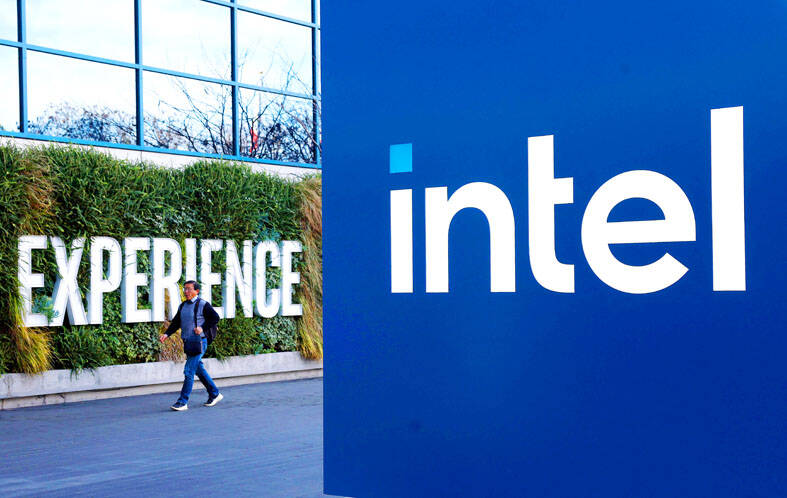
Photo: Getty Images via AFP
Barratt, a Stanford University-educated Australian, takes over the board at a precarious moment. The company has suffered years of sluggish sales and shrinking market share, but chief executive officer Lip-Bu Tan (陳立武) is trying to restore the company to its former glory.
Tan, an Intel board veteran himself, is a year into his turnaround bid as CEO. Though he’s had success attracting investments from the US government, Nvidia Corp and others, he still needs to show that Intel can field a competitive product line and attract outside customers to its factory network.
“Craig brings deep semiconductor expertise and a strong record of technology and operational leadership in complex, engineering-driven businesses,” Tan said in the statement. “As we enter our next phase — focused on disciplined execution, product leadership and foundry progress — his experience will be instrumental in supporting management and driving sustainable long-term value for stockholders.”
Tan has already made a series of changes to Intel’s leadership, bringing in outside executives to crucial roles. Yeary and the board said Tan’s contacts in the industry were part of the reason for choosing him to replace his ousted predecessor, Pat Gelsinger.
Yeary’s time on the board coincided with the Santa Clara, California-based company’s decline from the peak of its powers — just over a decade ago — to its current underdog status. He has presided over four CEO transitions and has dealt with the decline of Intel’s manufacturing and the rise of Taiwan Semiconductor Manufacturing Co (台積電).
“I think his departure was long overdue,” Seaport Securities Corp analyst Jay Goldberg said. “Intel has made a lot of bad decisions” while Yeary has been on the board, he said.
“Lip-Bu’s biggest challenge is changing Intel’s culture and professionalizing the board will help that a lot,” Goldberg said, referring to Barratt’s appointment as chair.
Since his appointment as CEO, Tan has made big changes to Intel. Last year, Intel cut roughly 20 percent of its workforce as Tan reshaped the company’s strategy to tackle artificial intelligence. Tan has also vowed to continue to operate Intel’s factories and pursue new customers for its next-generation manufacturing tech called 14A.
The company’s struggles have even spurred speculation that it might be split up, an idea Tan has pushed back on.
In the statement, Tan credited Yeary with giving him the mandate to make needed changes at the company.
“His leadership helped guide Intel through a period of transformation and onto firmer footing for the next phase,” Tan said.
Additional reporting by Reuters

ENERGY ISSUES: The TSIA urged the government to increase natural gas and helium reserves to reduce the impact of the Middle East war on semiconductor supply stability Chip testing and packaging service provider ASE Technology Holding Co (日月光投控) yesterday said it planned to invest more than NT$100 billion (US$3.15 billion) in building a new advanced chip testing facility in Kaohsiung to keep up with customer demand driven by the artificial intelligence (AI) boom. That would be included in the company’s capital expenditure budget next year, ASE said. There is also room to raise this year’s capital spending budget from a record-high US$7 billion estimated three months ago, it added. ASE would have six factories under construction this year, another record-breaking number, ASE chief operating officer Tien Wu

The EU and US are nearing an agreement to coordinate on producing and securing critical minerals, part of a push to break reliance on Chinese supplies. The potential deal would create incentives, such as minimum prices, that could advantage non-Chinese suppliers, according to a draft of an “action plan” seen by Bloomberg. The EU and US would also cooperate on standards, investments and joint projects, as well as coordinate on any supply disruptions by countries like China. The two sides are additionally seeking other “like-minded partners” to join a multicountry accord to help create these new critical mineral supply chains, which feed into

For weeks now, the global tech industry has been waiting for a major artificial intelligence (AI) launch from DeepSeek (深度求索), seen as a benchmark for China’s progress in the fast-moving field. More than a year has passed since the start-up put Chinese AI on the map in early last year with a low-cost chatbot that performed at a similar level to US rivals. However, despite reports and rumors about its imminent release, DeepSeek’s next-generation “V4” model is nowhere in sight. Speculation is also swirling over the geopolitical implications of which computer chips were chosen to train and power the new
TECH WINNERS: Taiwan and South Korea reported robust trade, which suggests that they have critical advantages in the rapidly expanding AI supply chain, an official said Exports last month surged to a new high, as booming demand tied to artificial intelligence (AI) infrastructure fueled shipments of advanced technology components, underscoring the nation’s pivotal role in the global semiconductor supply chain. Outbound shipments climbed to US$80.18 billion, the highest ever for a single month, rising 61.8 percent from a year earlier and marking the 29th consecutive month of growth, the Ministry of Finance said yesterday. “The surge was driven primarily by global investment in AI infrastructure,” Department of Statistics Director-General Beatrice Tsai (蔡美娜) said. The mass production of next-generation AI computing systems has accelerated procurement across the semiconductor supply


 RSS
RSS