


Oil and gas traders have spent days scrambling for alternative sources of supply to Asia outside of the Middle East on concerns a prolonged conflict could choke off flows from the energy-rich region.
Some liquefied natural gas (LNG) traders spent all night on Monday speaking to contacts about available supply after Iranian attacks closed the world’s biggest export plant in Qatar, people familiar with the matter said.
Importers in China, India and Japan have inquired about other sources of oil and LNG, they said.
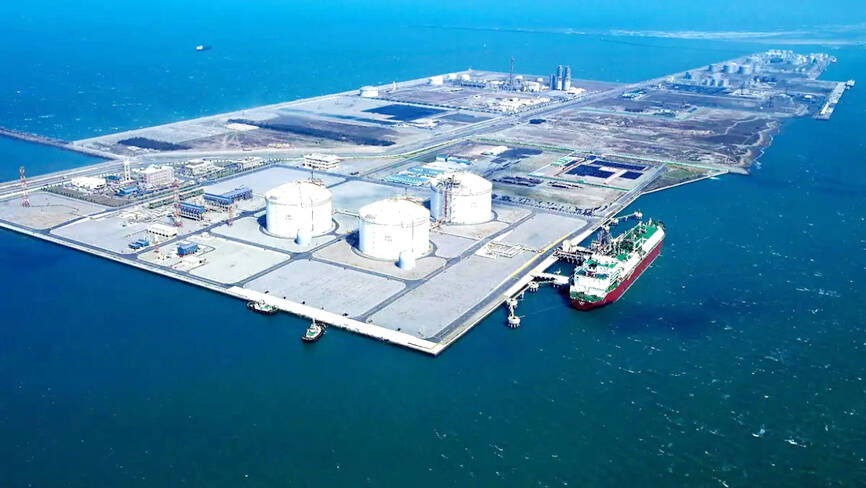
Photo courtesy of CPC Corp, Taiwan
The QatarEnergy facility, which accounts for about one-fifth of global supply, on Monday halted after an Iranian drone attack. Even before it stopped, the widening war in the Middle East had effectively closed the Strait of Hormuz, a key export route for Qatar, while attacks also forced Saudi Arabia’s largest oil refinery to close.
Some buyers of LNG, including Taiwan, requested suppliers deliver cargoes next month, a month early, the people said, asking not to be identified because they are not authorized to speak to the media.
Taiwan, along with South Korea, is seeking to secure fuel from other regions.
At the same time, Chinese gas buyers say the country is pushing Tehran to keep Hormuz open.
Asian nations have stockpiles of crude and LNG that would help buffer any short-term disruptions, but a sustained conflict threatens to quickly drain those supplies. Alternatives outside of the Middle East are likely to be more expensive, with bloated freight rates adding to spiraling costs for importers.
For LNG, alternatives include a small array of product flowing from the US — the world’s biggest producer — to Europe, which can easily be rerouted toward Asia mid-journey. There is also supply from Australia, which recently sent a rare shipment all the way to Canada because of subdued Asian demand.
For buyers of oil, there are stockpiles of Middle Eastern crude in locations such as Japan’s Kiire and Okinawa, which regional refiners can draw from. Kiire has capacity to store more than 46 million barrels, while Okinawa can hold more than 8 million barrels. Saudi Arabian Oil Co leases space at both storage sites.
Nearby countries such as Malaysia, Vietnam and Australia also produce crude, although significantly less than producers in the Persian Gulf. That leaves buyers with options much further afield, including the US and Africa.
The effective closure of the Strait of Hormuz — the narrow waterway separating Iran and the Arabian Peninsula — has halted crude and LNG shipments from the Persian Gulf. At least five LNG tankers, laden with cargoes from Qatar’s now-shut Ras Laffan facility, were seen inside the Persian Gulf, according to ship-tracking data compiled by Bloomberg. It remains to be seen when they would transit out.
Trading houses with take-or-pay contracts for LNG, particularly those tied to Qatar, are looking to source cargoes elsewhere to cover their deliveries to customers, the traders said.
Along with Taiwan, utilities and other buyers in Japan have asked for next month’s shipments to be brought forward, they added.
Taiwan, a global chipmaking hub, has enough LNG to meet its needs through the end of this month after emergency coordination and adjustments, Premier Cho Jung-tai (卓榮泰) told lawmakers yesterday.
The country might approach Japan and South Korea for supplies, Minister of Economic Affairs Kung Ming-hsin (龔明鑫) said.
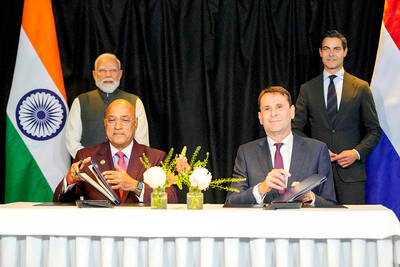
NEW MARKET: The partnership opens up India to the Dutch company, which already has a strong hold in the semiconductor market of South Korea, Taiwan and China ASML Holding NV entered into a partnership agreement with Tata Electronics Pvt Ltd aimed at ramping up India’s goal to develop domestic chip-manufacturing capabilities. The Dutch company’s technology would help power Tata Electronics’ planned 300 millimeter (mm) semiconductor foundry in Gujarat, according to a joint statement from the two companies on Saturday. The signing of a memorandum of understanding coincides with a visit by Indian Prime Minister Narendra Modi to the Netherlands, which is looking to deepen bilateral relations with New Delhi. ASML, whose top customers include Taiwan Semiconductor Manufacturing Co (台積電) and Samsung Electronics Co, makes lithography machines that can print
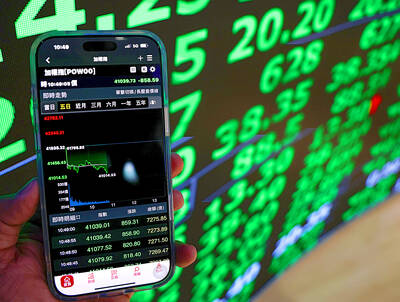
PORTFOLIO REBALANCING: The adjustments in three global equity indices reflect rising investor appetite for semiconductor and artificial intelligence-related stocks Taiwan’s weighting in major global equity indices compiled by MSCI Inc is to rise modestly following the latest quarterly review, underscoring the market’s expanding role in emerging-market portfolios, as global investors continue to favor the nation’s technology sector. Taiwan’s weighting in the MSCI Emerging Markets Index is to increase by 0.30 percentage points to 23.76 percent, after the changes take effect at the close of the May 29 session. Its weighting in the MSCI All-Country Asia ex-Japan Index is to rise 0.37 percentage points to 27.16 percent, while that in the MSCI All Country World Index is to edge up slightly to
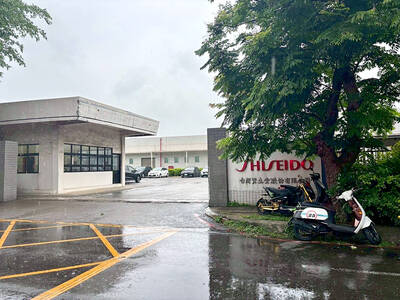
The Hsinchu County Government’s Labor Affairs Department yesterday said that it has received a plan from cosmetics brand Taiwan Shiseido Co (台灣資生堂) detailing mass layoffs at its plant in Hukou Township (湖口). While the labor authorities did not disclose the number of employees to be laid off, Japanese news media earlier in the day reported that the closure of the company’s factory in Hukou would result in 170 employees losing their jobs. Shiseido followed the law by reporting its layoff plan, the department said, adding that authorities would closely monitor negotiations between the management and affected employees and step in if any
Hon Hai Precision Industry Co (鴻海精密) on Tuesday confirmed a cyberattack targeting some of its North American facilities, but said the affected factories were gradually returning to normal. The company, known globally as Foxconn Technology Group (富士康科技集團), said that its cybersecurity team “activated the response mechanism and implemented operational measures to ensure the continuity of production and delivery.” “The affected factories are resuming normal production,” the company said in a statement. Hon Hai had previously described it as a “technical issue,” when news of the cyberattack first surfaced. The confirmation followed media reports of a large-scale information technology system incident that broke out at


 RSS
RSS