


The US and Israeli attacks on Iran rattled world markets today, with US futures falling more than 1 percent and oil prices soaring, though gains for defense contractors and oil companies helped limit losses in Asian trading.
The future for the S&P 500 sank 1.4 percent while the contract for the Dow Jones Industrial Average was down 1.2 percent.
Shares did fall in most Asian markets but they rose in Shanghai, where higher oil prices lifted some oil company stocks such as CNOOC Ltd (中國海洋石油), China Petroleum & Chemical Corp (中國石油化工) and PetroChina Co (中石油) to the 10 percent limit.
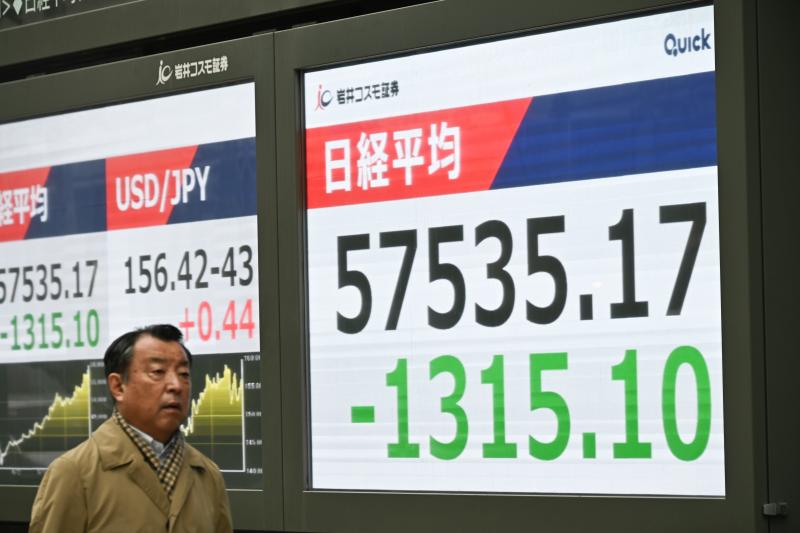
Photo: EPA
The Shanghai Composite index climbed 0.5 percent to 4,185.29, while in Hong Kong, the Hang Seng Index lost 2 percent to 26,102.53.
Japan’s Nikkei 225 index initially fell more than 2 percent. It closed 1.4 percent lower at 58,057.24. Offsetting other losses, shares in defense-related stocks including Mitsubishi Heavy Industries Inc and IHI Corp advanced.
In India, which could face disruptions to its access to oil due to the hostilities, the Sensex fell 1.8 percent.
Taiwan's benchmark TAIEX lost 0.9 percent and Singapore's Straits Times Index dropped 1.9 percent. In Bangkok, the SET fell 1.9 percent, while Australia’s S&P/ASX 200 ended flat, at 9,200.90.
Markets were closed in South Korea for a holiday.
The price of gold, which usually is viewed as a safe haven for investment in times of uncertainty, rose 2.7 percent to about US$5,392 per ounce.
The US dollar also gained, rising to 156.99 Japanese yen from 156.27 yen on Friday last week. The euro slipped to US$1.1732 from US$1.1762.
Traders are betting the supply of oil from Iran and elsewhere in the Middle East will slow or grind to a halt. Attacks throughout the region, including on two vessels traveling through the Strait of Hormuz, the narrow mouth of the Persian Gulf, have constrained oil exports to the rest of the world.
“Roughly one-fifth of global oil and LNG (liquefied natural gas) flows squeeze through the Strait of Hormuz. This is not an obscure canal. It is the aorta of the global energy system,” SPI Asset Management managing partner Stephen Innes said in a commentary.
The price of a barrel of US benchmark crude oil initially surged about 8 percent. By mid-afternoon Tokyo time it was up 7.5 percent at US$72.06 per barrel. Brent crude jumped 8 percent to US$78.69 per barrel.
A prolonged war would likely result in higher prices for other fuels and gasoline and could cascade throughout the global economy, adding to production costs overall.
Prolonged interruptions to oil flows through the Middle East would have “huge implications for oil and LNG and every market everywhere if it occurs. Energy is an input to ALL production,” RaboResearch Global Economics & Markets said in a report.
Iran exports roughly 1.6 million barrels of oil a day, mostly to China. It may need to look elsewhere for supply if Iran’s exports are disrupted, another factor that could increase energy prices.
The size of China's strategic oil reserves is a state secret. But a recent report by John Kemp of Base Research estimated them at 1.1 billion to 1.2 billion barrels — equivalent to around 100 days or just over three months of imports.
The war's impact on markets was muted somewhat because the attacks were anticipated, with a massive buildup of US forces in the Middle East. So traders had adjusted their positions to take that risk into account.
The conflict has shifted attention, for now, away from issues surrounding artificial intelligence that have dominated markets in recent months.
On Friday, the S&P 500 fell 0.4 percent to finish just its second losing month in the last 10. The Dow industrials dropped 1.1 percent, and the NASDAQ composite fell 0.9 percent.
Treasury yields fell in the bond market as investors sought safer places for their money.
“When markets are fragile, they do not need a knockout blow. They just need another weight on the bar,” Innes said.
Also hurting the broad market was a report on Friday showing that inflation at the US wholesale level was at 2.9 percent last month, much higher than the 1.6 percent that economists expected.
That could pressure the US Federal Reserve to hold off longer on its cuts to interest rates. Lower rates would give the economy and prices for investments a boost, but they risk worsening inflation.
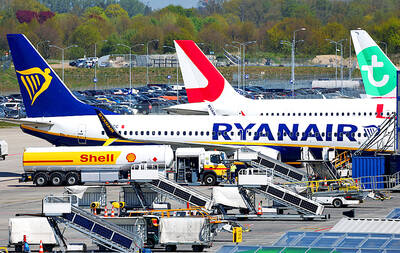
Ryanair, Transavia, Volotea and other low-cost airlines are feeling the financial pain from high jet fuel prices as a result of the Middle East war and are cutting flights. The closure of the Strait of Hormuz has taken a huge chunk of oil supplies off the market, sending the price of jet fuel soaring and triggering fears of shortages that could force airlines to cancel flights. Airlines are not waiting for a lack of supplies to react. “Travel alert: Airlines are cutting thousands of flights right now,” Travel Therapy host Karen Schaler said in an Instagram reel this past weekend.
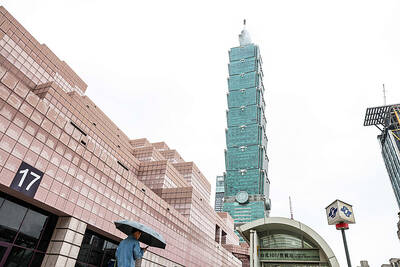
MANAGING RISKS: Taiwan has secured LNG sufficient to cover 95 percent of electricity demand for next month, UBS said, describing the government’s approach as proactive UBS Group AG has raised its forecast for Taiwan’s economic growth this year to 8 percent, up from 6.9 percent previously, and said expansion could reach as high as 8.6 percent if external energy shocks are avoided. The upgrade reflects a stronger-than-expected first-quarter performance and sustained momentum in artificial intelligence (AI)-driven exports, which UBS said are providing a firm foundation for growth despite geopolitical and energy risks. Taiwan’s GDP expanded 13.69 percent year-on-year in the first quarter, the fastest growth since the second quarter of 1987, the Directorate-General of Budget, Accounting and Statistics (DGBAS) reported on Thursday. On a seasonally
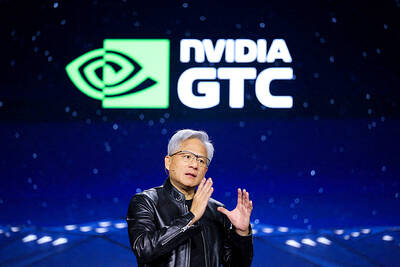
The list of Asian stocks that benefit from business partnership with Nvidia Corp is getting longer, as the region further integrates into the artificial intelligence (AI) chip giant’s business ecosystem. Just in the past week, South Korea’s LG Electronics Inc, Taiwan’s Nanya Technology Corp (南亞科技), as well as China’s Huizhou Desay SV Automotive Co (德賽西威) and Pateo Connect Technology Shanghai Corp (博泰車聯) have become the latest to rally on news of tie-ups, supply-chain participation or product collaboration with the US chip designer. Asian suppliers account for about 90 percent of Nvidia’s production costs, up from about 65 percent last year, data compiled
The Fair Trade Commission’s (FTC) ongoing review of Grab Holdings Ltd’s US$600 million acquisition of Foodpanda Taiwan’s operations, announced on March 23, has taken on fresh urgency as industry experts warn that the transaction could embed significant Chinese cybersecurity vulnerabilities into Taiwan’s digital infrastructure through Grab’s deep ties to autonomous-driving firm WeRide (文遠知行). Less than 16 months after the FTC blocked Uber Eats’ direct attempt to acquire Foodpanda Taiwan — citing potential combined market shares of 80 to 90 percent — the emergence of Grab as the buyer has prompted questions about whether the same competitive harm is simply being rerouted


 RSS
RSS