


Suppliers to US aerospace and semiconductor firms face worsening rare earth shortages, with two turning away some clients, industry insiders said, weeks before US President Donald Trump is expected to meet his Chinese counterpart Xi Jinping (習近平) for a summit in Beijing.
The shortages center on rare earths such as yttrium and scandium, niche members of the family of 17 elements, which play tiny but vital roles in defense technology, aerospace and semiconductors and are almost entirely produced in China.
While Beijing has allowed many rare earth exports to resume since it imposed restrictions in April last year, shipments of these materials still rarely make it to the US despite the October detente with Washington, Chinese customs data show.
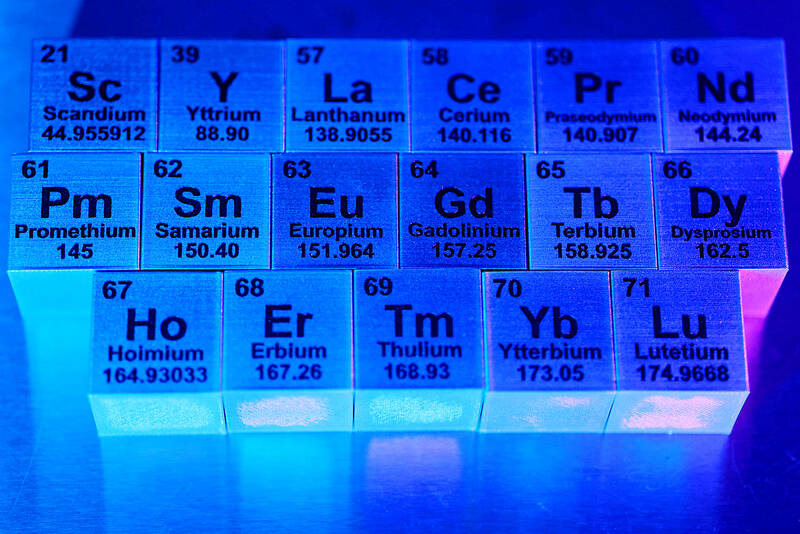
Photo: Reuters
That easing of trade tensions, premised in part on China pausing its critical mineral export restrictions, will be on the table when Trump and Xi meet in Beijing next month.
A key pain point is yttrium, used in coatings that keep engines and turbines from melting at high temperatures. Without regular application of these coatings, engines cannot be used.
Since Reuters first reported about yttrium shortages in November last year, prices have jumped 60 percent and are now about 69 times as high as a year ago. Some coatings manufacturers are also now starting to ration material, according to company executives and traders.
Executives at two North American firms that buy yttrium to make coatings told Reuters they have needed to temporarily pause production due to shortages. One is also now turning away smaller and offshore customers in order to conserve supply for larger clients, which include certain engine makers.
Another firm in the coating supply chain recently ran out of material and stopped selling products containing yttrium oxide, according to a source with direct knowledge of the matter.
While shortages of yttrium and scandium have not weighed on production of jet engines or chips yet, a US government official told Reuters some US manufacturers now face “shortages” of certain rare earths from China.
China exported 17 tonnes of yttrium products to the US in the eight months after controls were introduced in April last year versus 333 tonnes in the eight months before the measures.
A White House official said the Trump administration is committed to ensuring access to critical minerals for all US businesses.
“This includes negotiating with China and monitoring compliance with President Trump’s agreement with President Xi, as well as developing alternative supply chains as warranted.”
While low yttrium supplies have not hurt engine production, manufacturers remain concerned, aerospace supply chain specialist Kevin Michaels said.
“This is a watch item and a tangible example of how China is flexing its rare earth muscle,” said Michaels, managing director at US consultant AeroDynamic Advisory.
Enginemakers are already struggling to meet demand for spare parts from airlines and higher production by planemakers Boeing Co and Airbus SE.
In addition to yttrium, US semiconductor makers are running low on scandium, putting production of next-generation 5G chips at risk, SemiAnalysis founder and CEO Dylan Patel said.
With global production of only several tens of tonnes a year, scandium plays small but important parts in fuel cells, specialty aluminium aerospace alloys and advanced chip processing and packaging.
Major US semiconductor manufacturers all rely on scandium for making chip components that “go into essentially every 5G smartphone and base station,” Patel said.
US chipmakers have experienced delays in receiving new scandium export licenses from China in recent months and have reached out to Washington for help, two industry sources said.
Many of these firms had obtained scandium from third-country suppliers, another US official said, but China requires license applicants to declare their end-users.
“Our thesis is that it is precisely the semi industry being targeted,” the US official said.
“The US currently has zero domestic scandium production and no operational alternative sources outside China,” Patel said, adding that stockpiles are likely in months rather than years.
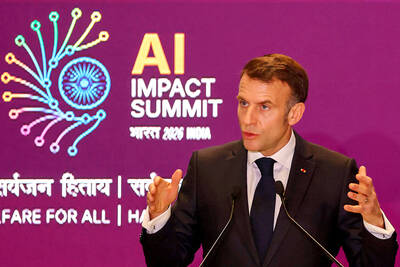
French President Emmanuel Macron told a global artificial intelligence (AI) summit in India yesterday he was determined to ensure safe oversight of the fast-evolving technology. The EU has led the way for global regulation with its Artificial Intelligence Act, which was adopted in 2024 and is coming into force in phases. “We are determined to continue to shape the rules of the game... with our allies such as India,” Macron said in New Delhi. “Europe is not blindly focused on regulation — Europe is a space for innovation and investment, but it is a safe space.” The AI Impact Summit is the fourth
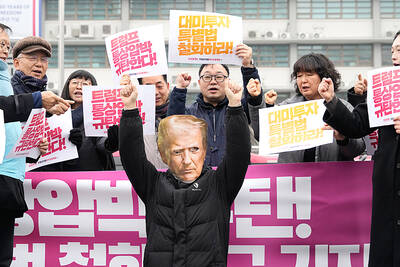
CONFUSION: Taiwan, Japan and other big exporters are cautiously monitoring the situation, while analysts said more Trump responses ate likely after his loss in court US trading partners in Asia started weighing fresh uncertainties yesterday after President Donald Trump vowed to impose a new tariff on imports, hours after the Supreme Court struck down many of the sweeping levies he used to launch a global trade war. The court’s ruling invalidated a number of tariffs that the Trump administration had imposed on Asian export powerhouses from China and South Korea to Japan and Taiwan, the world’s largest chip maker and a key player in tech supply chains. Within hours, Trump said he would impose a new 10 percent duty on US imports from all countries starting on
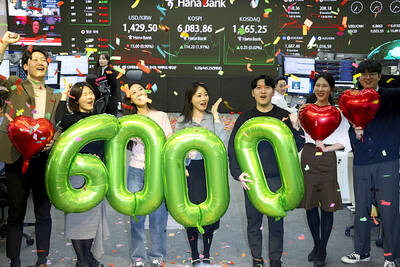
South Korea’s equity benchmark yesterday crossed a new milestone just a month after surpassing the once-unthinkable 5,000 mark as surging global memory demand powers the country’s biggest chipmakers. The KOSPI advanced as much as 2.6 percent to a record 6,123, with Samsung Electronics Co and SK Hynix Inc each gaining more than 2 percent. With the benchmark now up 45 percent this year, South Korea’s stock market capitalization has also moved past France’s, following last month’s overtaking of Germany’s. Long overlooked by foreign funds, despite being undervalued, South Korean stocks have now emerged as clear winners in the global market. The so-called “artificial intelligence
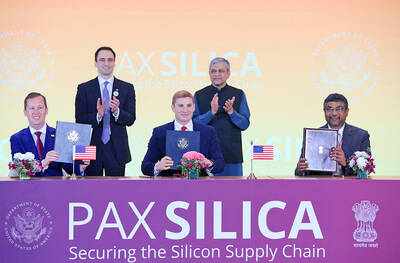
STRATEGIC ALLIANCE: The initiative is aimed at protecting semiconductor supply chain resilience to reduce dependence on China-dominated manufacturing hubs India yesterday joined a US-led initiative to strengthen technology cooperation among strategic allies in a move that underscores the nations’ warming ties after a brief strain over New Delhi’s unabated purchase of discounted Russian oil. The decision aligns India closely with Washington’s efforts to build secure supply chains for semiconductors, advanced manufacturing and critical technologies at a time when geopolitical competition with China is intensifying. It also signals a reset in relations following friction over energy trade and tariffs. Nations that have joined the Pax Silica framework include Japan, South Korea, the UK and Israel. “Pax Silica will be a group of nations


 RSS
RSS