


In a swift reversal of fortunes, countries that had been hardest hit by US President Donald Trump’s tariffs have emerged as the biggest winners from the US Supreme Court’s decision to strike down his emergency levies.
China, India and Brazil are among those now seeing lower tariff rates for shipments to the US after the court ruled Trump’s use of the International Emergency Economic Powers Act to impose duties was illegal.
While Trump subsequently announced plans for a 15 percent global rate, Bloomberg Economics said that would mean an average effective tariff rate of about 12 percent — the lowest since his “Liberation Day” tariffs were released in April last year.
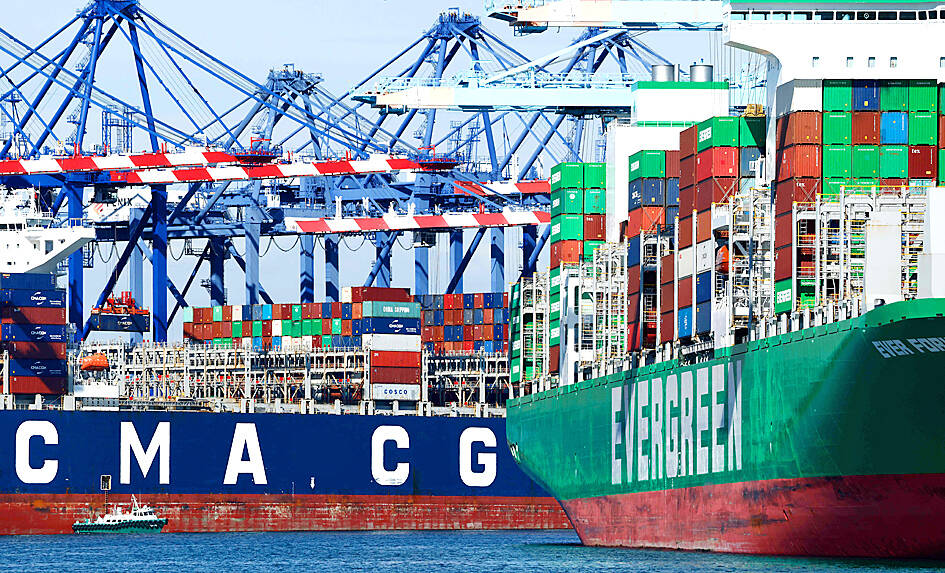
Photo: Getty Images North America / Getty Images via AFP
Morgan Stanley economists said the weighted average tariff rate for Asia will fall to 17 percent from 20 percent, with average levies on goods from China declining to 24 percent from 32 percent. Relief might be temporary as the Trump administration seeks to impose sectoral and economy-specific duties to rebuild its tariff regime.
Still, “the peak level of uncertainty on tariffs and trade tensions has passed,” Morgan Stanley economists led by Chetan Ahya wrote in a note.
The new across-the-board levy effectively resets the playing field for the US’ trade partners.
For the likes of China, which also saw a 10 percent fentanyl tariff scrapped by the courts, exports now face less punitive rates. Losers include economies including the UK and Australia that had negotiated lower levies of 10 percent under the old “reciprocal” framework.
Senior US officials are pressing partners including the EU and Japan to stick to commitments they made in earlier negotiations. They also sought continuity in the one-year truce with China, with Trump planning to soon visit Beijing for a meeting with Chinese President Xi Jinping (習近平).
“We want to make sure that China is complying with its part of the deal,” US Trade Representative Jamieson Greer said. “So that means they continue to buy the products they said they would buy.”
Canada and Mexico had also faced fentanyl-related levies, so they win out, as those no longer apply.
If exemptions under the US-Mexico-Canada trade agreement remain in place, they would emerge in a “very favorable position,” Bloomberg Economics analysts Nicole Gorton-Caratelli, Chris Kennedy and Maeva Cousin wrote in a note.
The new 15 percent levy leaves countries with the earlier 10 percent rate worse off, with Australia and the UK in that position. Meantime, those that previously had what was then a competitive 15 percent level applied on their exports — such as Japan — have now seen that advantage stripped away.
Even as the court ruling adds a fresh layer of uncertainty, analysts are pointing to the resilience of global commerce over the past year and the relatively minor shift in the overall average tariff rate to suggest the near-term effects might prove limited.
Goldman Sachs Group Inc economists, including David Mericle, estimated that the combination of the US Supreme Court ruling and the newly announced Section 122 tariff would reduce the increase in the effective tariff rate since the start of last year from just more than 10 percentage points to 9 percentage points.
“Imports from countries that will experience meaningful tariff reductions from the latest policy changes are likely to pick up in coming months,” Goldman economists wrote. “But the impact on GDP should be largely offset by increased inventory accumulation and consumption, reduced imports from other countries through which trade had been rerouted, and small reductions in imports from countries whose tariff rate has risen.”
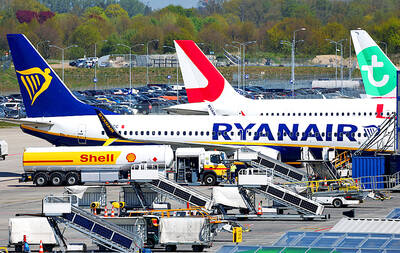
Ryanair, Transavia, Volotea and other low-cost airlines are feeling the financial pain from high jet fuel prices as a result of the Middle East war and are cutting flights. The closure of the Strait of Hormuz has taken a huge chunk of oil supplies off the market, sending the price of jet fuel soaring and triggering fears of shortages that could force airlines to cancel flights. Airlines are not waiting for a lack of supplies to react. “Travel alert: Airlines are cutting thousands of flights right now,” Travel Therapy host Karen Schaler said in an Instagram reel this past weekend.
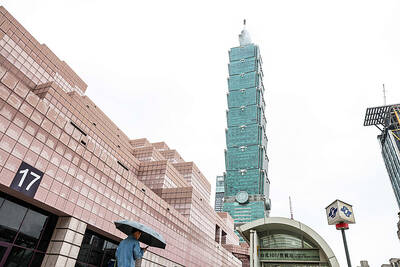
MANAGING RISKS: Taiwan has secured LNG sufficient to cover 95 percent of electricity demand for next month, UBS said, describing the government’s approach as proactive UBS Group AG has raised its forecast for Taiwan’s economic growth this year to 8 percent, up from 6.9 percent previously, and said expansion could reach as high as 8.6 percent if external energy shocks are avoided. The upgrade reflects a stronger-than-expected first-quarter performance and sustained momentum in artificial intelligence (AI)-driven exports, which UBS said are providing a firm foundation for growth despite geopolitical and energy risks. Taiwan’s GDP expanded 13.69 percent year-on-year in the first quarter, the fastest growth since the second quarter of 1987, the Directorate-General of Budget, Accounting and Statistics (DGBAS) reported on Thursday. On a seasonally

The list of Asian stocks that benefit from business partnership with Nvidia Corp is getting longer, as the region further integrates into the artificial intelligence (AI) chip giant’s business ecosystem. Just in the past week, South Korea’s LG Electronics Inc, Taiwan’s Nanya Technology Corp (南亞科技), as well as China’s Huizhou Desay SV Automotive Co (德賽西威) and Pateo Connect Technology Shanghai Corp (博泰車聯) have become the latest to rally on news of tie-ups, supply-chain participation or product collaboration with the US chip designer. Asian suppliers account for about 90 percent of Nvidia’s production costs, up from about 65 percent last year, data compiled

The Fair Trade Commission’s (FTC) ongoing review of Grab Holdings Ltd’s US$600 million acquisition of Foodpanda Taiwan’s operations, announced on March 23, has taken on fresh urgency as industry experts warn that the transaction could embed significant Chinese cybersecurity vulnerabilities into Taiwan’s digital infrastructure through Grab’s deep ties to autonomous-driving firm WeRide (文遠知行). Less than 16 months after the FTC blocked Uber Eats’ direct attempt to acquire Foodpanda Taiwan — citing potential combined market shares of 80 to 90 percent — the emergence of Grab as the buyer has prompted questions about whether the same competitive harm is simply being rerouted


 RSS
RSS