


India yesterday joined a US-led initiative to strengthen technology cooperation among strategic allies in a move that underscores the nations’ warming ties after a brief strain over New Delhi’s unabated purchase of discounted Russian oil.
The decision aligns India closely with Washington’s efforts to build secure supply chains for semiconductors, advanced manufacturing and critical technologies at a time when geopolitical competition with China is intensifying.
It also signals a reset in relations following friction over energy trade and tariffs.
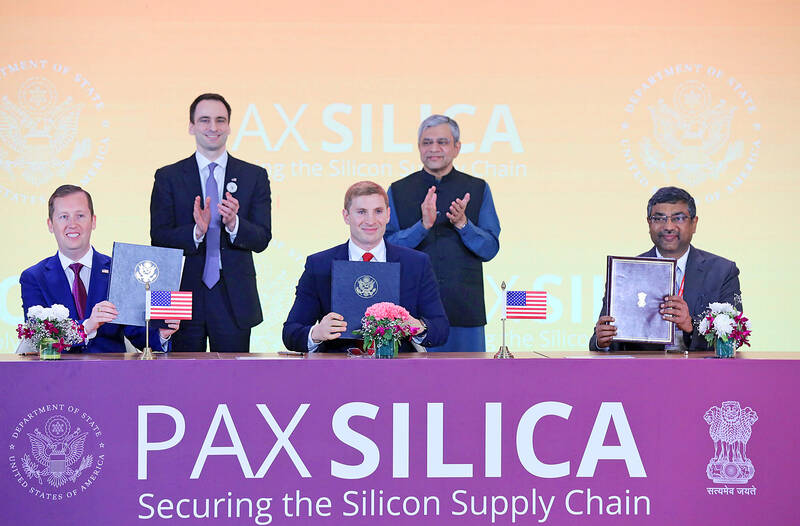
Photo: EPA
Nations that have joined the Pax Silica framework include Japan, South Korea, the UK and Israel.
“Pax Silica will be a group of nations that believe technology should empower free people and free markets. India’s entry into Pax Silica isn’t just symbolic. Its strategic, it’s essential,” US Ambassador to India Sergio Gor said in a speech preceding the agreement signing.
Pax Silica is aimed at strengthening cooperation among partner countries on semiconductor design, fabrication, research and supply chain resilience. The initiative seeks to reduce dependence on China-dominated manufacturing hubs while promoting trusted production networks across democracies and strategic allies.
The development at the artificial intelligence summit in New Delhi comes weeks after India and the US reached an interim trade framework to reduce tariffs and grant greater access to each other’s markets, easing tensions that had threatened to slow bilateral momentum.
US President Donald Trump earlier this month announced that the US would lower reciprocal import tariffs on India from 25 percent to 18 percent and also remove the additional 25 percent levy imposed earlier for buying Russian crude after Indian Prime Minister Narendra Modi agreed to stop imports.
India had ramped up Russian oil imports after Moscow’s invasion of Ukraine in 2022, drawing criticism from Western partners even as New Delhi defended the purchases as necessary to manage inflation and protect its consumers.
India’s entry into Pax Silica, combined with trade concessions, marks a strategic convergence that extends beyond commerce into long-term technology and security cooperation, reinforcing India’s role as a key US partner in the Indo-Pacific.
“From the trade deal to Pax Silica to defense cooperation, the potential for our two nations to work together is truly limitless,” Gor said.
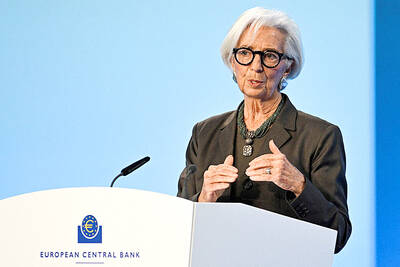
European Central Bank (ECB) President Christine Lagarde is expected to step down from her role before her eight-year term ends in October next year, the Financial Times reported. Lagarde wants to leave before the French presidential election in April next year, which would allow French President Emmanuel Macron and German Chancellor Friedrich Merz to find her replacement together, the report said, citing an unidentified person familiar with her thoughts on the matter. It is not clear yet when she might exit, the report said. “President Lagarde is totally focused on her mission and has not taken any decision regarding the end of

Australian singer Kylie Minogue says “nothing compares” to performing live, but becoming an international wine magnate in under six years has been quite a thrill for the Spinning Around star. Minogue launched her first own-label wine in 2020 in partnership with celebrity drinks expert Paul Schaafsma, starting with a basic rose but quickly expanding to include sparkling, no-alcohol and premium rose offerings. The actress and singer has since wracked up sales of around 25 million bottles, with her carefully branded products pitched at low-to mid-range prices in dozens of countries. Britain, Australia and the United States are the biggest markets. “Nothing compares to performing

AUSPICIOUS TIMING: Ostensibly looking to spike the guns of domestic rivals, ByteDance launched the upgrade to coincide with the Lunar New Year China’s ByteDance Ltd (字節跳動) has rolled out its Doubao 2.0 model, an upgrade of the country’s most widely used artificial-intelligence (AI) app, the company announced on Saturday. ByteDance is one of several Chinese firms hoping to generate overseas and domestic buzz around its new AI models during the Lunar New Year holiday, which began yesterday, when hundreds of millions of Chinese partake in family gatherings in their hometowns. The company, like rival Alibaba Group Holding Ltd (阿里巴巴), was caught off-guard by DeepSeek’s (深度求索) meteoric rise to global fame during last year’s Spring Festival, when Silicon Valley and investors worldwide were

It is not just people — in China, the robots are also getting ready to celebrate the Lunar New Year. Friday was dress rehearsal day for four cute humanoid robots, each about 95 centimeters tall, at a mall in western Beijing. Curious onlookers stopped to watch. Each robot got a colorful lion costume and within minutes the moves started: Bend the knees, up, to the left, to the right, shake the mask, and do it all again. Ahead of the Lunar New Year, and as part of different “fairs” and activities around Beijing, some venues have been busy setting up their stages and


 RSS
RSS