


Global semiconductor stocks advanced yesterday, as comments by Nvidia Corp chief executive officer Jensen Huang (黃仁勳) at Davos, Switzerland, helped reinforce investor enthusiasm for artificial intelligence (AI).
Samsung Electronics Co gained as much as 5 percent to an all-time high, helping drive South Korea’s benchmark KOSPI above 5,000 for the first time. That came after the Philadelphia Semiconductor Index rose more than 3 percent to a fresh record on Wednesday, with a boost from Nvidia.
The gains came amid broad risk-on trade after US President Donald Trump withdrew his threat of tariffs on some European nations over backing for Greenland.
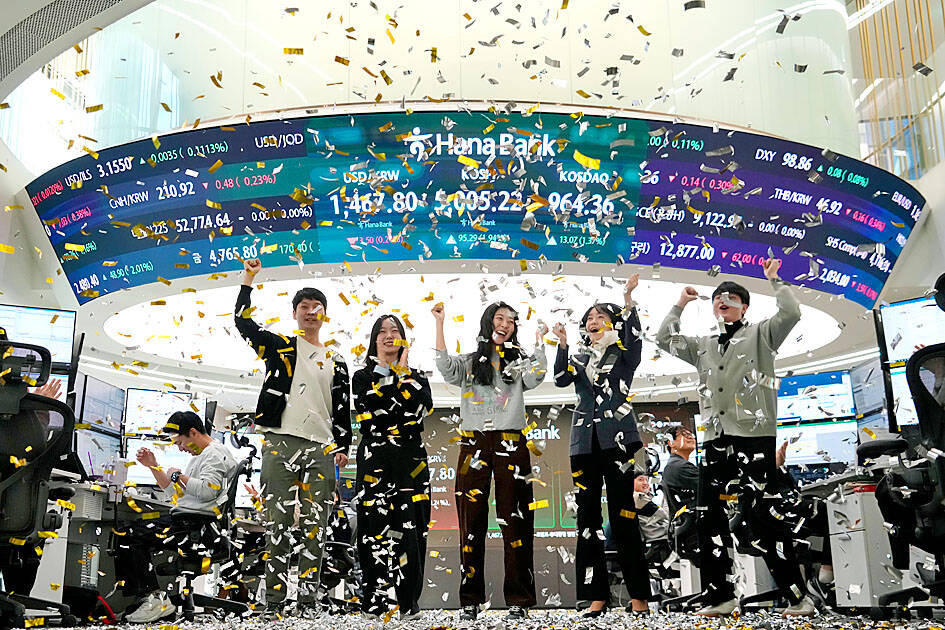
Photo: AP
Huang further fueled that rally with his comments on Wednesday to the World Economic Forum in Davos, saying that the global AI buildout would require trillions of dollars of investment.
He told delegates that today’s AI boom “has started the largest infrastructure buildout in human history.”
“We’re now a few hundred billion dollars into it... There are trillions of dollars of infrastructure that needs to be built out in fields including energy, cloud computing and electronics,” he said.
South Korea’s Samsung and SK Hynix Inc closed up about 2 percent in Seoul, while in Japan tech investment giant Softbank Group Corp jumped 11.61 percent, with chip firms Advantest Corp 4.96 percent higher and Tokyo Electron Ltd up 3.13 percent.
Taiwan Semiconductor Manufacturing Co (台積電), Asia’s largest stock, was up 1.15 percent in Taipei.
“Davos is all about AI Revolution,” Wedbush Securities Inc analyst Dan Ives wrote in a note. “While there are clearly geopolitical worries in a constantly changing global landscape, the one thing that is clear from Davos is that the US tech world is dominating the AI Revolution, with China a distant second.”
The AI boom is riding high into this year, defying concerns about lofty valuations, as well as tensions between various nations. Earnings due later yesterday from Intel Corp might shed further light on crucial industry capital expenditure plans, along with results next week from Apple Inc and Meta Platforms Inc.
“The expansion of AI infrastructure and a surge in data storage demand are further tightening overall supply,” Eugene Asset Management Co chief investment officer Ha Seok-keun said in Seoul. “The market is now increasingly pricing in these strengthened industry fundamentals.”
While AI’s funding needs are massive, there seems to be no shortage of investors willing to pile in through private deals as well as in the markets. OpenAI chief executive officer Sam Altman has been meeting with top investors in the Middle East to line up funding for an investment round of at least US$50 billion, at a valuation of about US$750 billion to US$830 billion.

KEEPING UP: The acquisition of a cleanroom in Taiwan would enable Micron to increase production in a market where demand continues to outpace supply, a Micron official said Micron Technology Inc has signed a letter of intent to buy a fabrication site in Taiwan from Powerchip Semiconductor Manufacturing Corp (力積電) for US$1.8 billion to expand its production of memory chips. Micron would take control of the P5 site in Miaoli County’s Tongluo Township (銅鑼) and plans to ramp up DRAM production in phases after the transaction closes in the second quarter, the company said in a statement on Saturday. The acquisition includes an existing 12 inch fab cleanroom of 27,871m2 and would further position Micron to address growing global demand for memory solutions, the company said. Micron expects the transaction to

Vincent Wei led fellow Singaporean farmers around an empty Malaysian plot, laying out plans for a greenhouse and rows of leafy vegetables. What he pitched was not just space for crops, but a lifeline for growers struggling to make ends meet in a city-state with high prices and little vacant land. The future agriculture hub is part of a joint special economic zone launched last year by the two neighbors, expected to cost US$123 million and produce 10,000 tonnes of fresh produce annually. It is attracting Singaporean farmers with promises of cheaper land, labor and energy just over the border.

US actor Matthew McConaughey has filed recordings of his image and voice with US patent authorities to protect them from unauthorized usage by artificial intelligence (AI) platforms, a representative said earlier this week. Several video clips and audio recordings were registered by the commercial arm of the Just Keep Livin’ Foundation, a non-profit created by the Oscar-winning actor and his wife, Camila, according to the US Patent and Trademark Office database. Many artists are increasingly concerned about the uncontrolled use of their image via generative AI since the rollout of ChatGPT and other AI-powered tools. Several US states have adopted

A proposed billionaires’ tax in California has ignited a political uproar in Silicon Valley, with tech titans threatening to leave the state while California Governor Gavin Newsom of the Democratic Party maneuvers to defeat a levy that he fears would lead to an exodus of wealth. A technology mecca, California has more billionaires than any other US state — a few hundred, by some estimates. About half its personal income tax revenue, a financial backbone in the nearly US$350 billion budget, comes from the top 1 percent of earners. A large healthcare union is attempting to place a proposal before


 RSS
RSS