


Deputy Minister of Finance Frank Juan (阮清華), who is also executive secretary of the National Stabilization Fund (NSF), yesterday denied speculation that the fund took advantage of soaring stock prices to sell shares for profit.
Asked about the rumors during a legislative meeting of the Finance Committee, Juan said the stabilization fund would not sell any of the holdings accumulated during its intervention until the committee decides to withdraw from the market.
“When the fund will retreat from the market will be decided by its committee,” Juan said. “Even if the committee decides to stop the intervention, it will adjust its positions based on market conditions and is unlikely to cut its holdings in one or two sessions.”
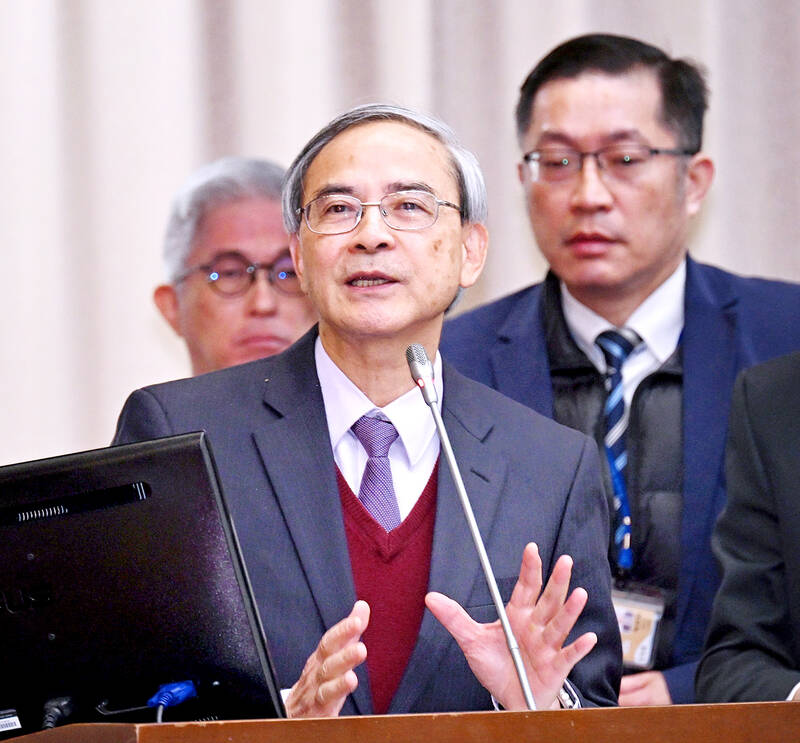
Photo: Fang Pin-chao, Taipei Times
The committee is scheduled to meet on Monday next week to discuss whether the fund will continue its market support program.
The NT$500 billion (US$15.85 billion) stabilization fund was established in 2000 to cushion the local equity market against unexpected external factors that might disrupt the local bourse.
The fund launched its latest intervention on April 9 last year, the ninth such move since its creation, as market volatility intensified after the White House on April 2 announced sweeping “reciprocal tariffs” on the US’ trading partners, including Taiwan.
The nation has since negotiated the tariff down from 32 percent to 20 percent and continues talks for further reductions.
Meanwhile, optimism over artificial intelligence (AI) development helped fuel a strong market rebound. From April 9 to the end of last year, the TAIEX surged 66.54 percent to close at 28,963.6 points. For the entire year, the index soared 25.73 percent.
The TAIEX rose a further 2.57 percent to close at 30,105.04 points yesterday, surpassing 30,000 points for the first time, led largely by contract chipmaker Taiwan Semiconductor Manufacturing Co (TSMC, 台積電), a major AI-related stock.
“It was hard in the past to imagine the TAIEX breaching 30,000 points, but now it has happened, as Taiwan’s industries move in the right direction,” Juan said, referring to domestic firms’ efforts in AI development.
He also attributed the TAIEX’s 755-point rise yesterday to TSMC’s strong gains, which contributed about 670 points of the index’s upturn.
Responding to lawmakers’ concerns about uneven growth between high-tech and traditional sectors, Juan said the government would assist old-economy industries in upgrading and narrowing the gap with their high-tech counterparts.
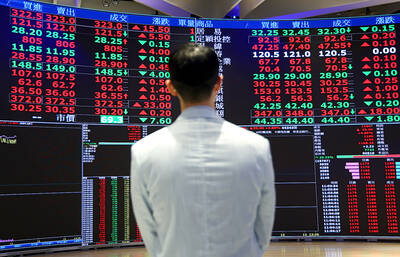
Shares in Taiwan closed at a new high yesterday, the first trading day of the new year, as contract chipmaker Taiwan Semiconductor Manufacturing Co (TSMC, 台積電) continued to break records amid an artificial intelligence (AI) boom, dealers said. The TAIEX closed up 386.21 points, or 1.33 percent, at 29,349.81, with turnover totaling NT$648.844 billion (US$20.65 billion). “Judging from a stronger Taiwan dollar against the US dollar, I think foreign institutional investors returned from the holidays and brought funds into the local market,” Concord Securities Co (康和證券) analyst Kerry Huang (黃志祺) said. “Foreign investors just rebuilt their positions with TSMC as their top target,
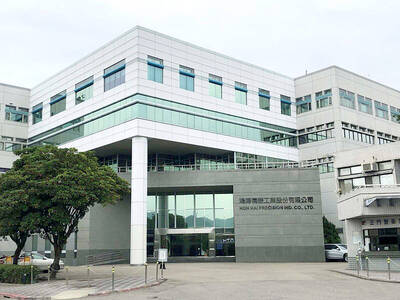
REVENUE PERFORMANCE: Cloud and network products, and electronic components saw strong increases, while smart consumer electronics and computing products fell Hon Hai Precision Industry Co (鴻海精密) yesterday posted 26.51 percent quarterly growth in revenue for last quarter to NT$2.6 trillion (US$82.44 billion), the strongest on record for the period and above expectations, but the company forecast a slight revenue dip this quarter due to seasonal factors. On an annual basis, revenue last quarter grew 22.07 percent, the company said. Analysts on average estimated about NT$2.4 trillion increase. Hon Hai, which assembles servers for Nvidia Corp and iPhones for Apple Inc, is expanding its capacity in the US, adding artificial intelligence (AI) server production in Wisconsin and Texas, where it operates established campuses. This
H200 CHIPS: A source said that Nvidia has asked the Taiwanese company to begin production of additional chips and work is expected to start in the second quarter Nvidia Corp is scrambling to meet demand for its H200 artificial intelligence (AI) chips from Chinese technology companies and has approached contract manufacturer Taiwan Semiconductor Manufacturing Co (TSMC, 台積電) to ramp up production, sources said. Chinese technology companies have placed orders for more than 2 million H200 chips for this year, while Nvidia holds just 700,000 units in stock, two of the people said. The exact additional volume Nvidia intends to order from TSMC remains unclear, they said. A third source said that Nvidia has asked TSMC to begin production of the additional chips and work is expected to start in the second
US President Donald Trump on Friday blocked US photonics firm HieFo Corp’s US$3 million acquisition of assets in New Jersey-based aerospace and defense specialist Emcore Corp, citing national security and China-related concerns. In an order released by the White House, Trump said HieFo was “controlled by a citizen of the People’s Republic of China” and that its 2024 acquisition of Emcore’s businesses led the US president to believe that it might “take action that threatens to impair the national security of the United States.” The order did not name the person or detail Trump’s concerns. “The Transaction is hereby prohibited,”


 RSS
RSS