


Nvidia Corp is scrambling to meet demand for its H200 artificial intelligence (AI) chips from Chinese technology companies and has approached contract manufacturer Taiwan Semiconductor Manufacturing Co (TSMC, 台積電) to ramp up production, sources said.
Chinese technology companies have placed orders for more than 2 million H200 chips for this year, while Nvidia holds just 700,000 units in stock, two of the people said.
The exact additional volume Nvidia intends to order from TSMC remains unclear, they said.
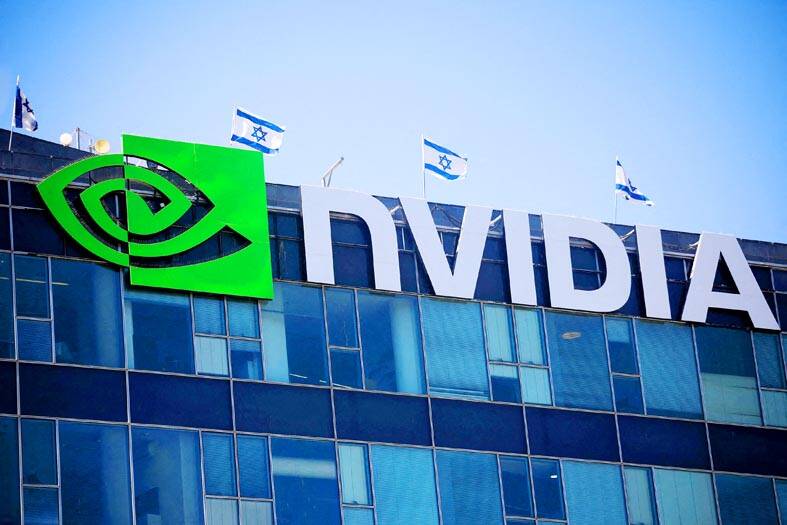
Photo: Reuters
A third source said that Nvidia has asked TSMC to begin production of the additional chips and work is expected to start in the second quarter of this year.
Nvidia has decided which H200 variants it would offer to Chinese customers and has priced them at about US$27,000 per chip, the sources said.
The moves raise concerns over whether there could be further tightening in global AI chip supplies, as Nvidia now has to strike the right balance between meeting robust Chinese demand and addressing constrained supplies elsewhere.
They could also intensify risks for Nvidia, as Beijing has yet to greenlight any shipments of H200 chips.
The administration of US President Donald Trump only recently allowed exports of the H200 to China.
Nvidia said in response to a request for comment that it continuously manages its supply chain.
“Licensed sales of the H200 to authorized customers in China will have no impact on our ability to supply customers in the United States,” a Nvidia spokesperson said.
The potential order would mark a significant expansion of H200 production at a time when Nvidia has been focused on ramping up its newer Blackwell and upcoming Rubin chip lines. The H200, part of Nvidia’s previous-generation Hopper architecture, uses TSMC’s 4-nanometer manufacturing process.
Nvidia plans to fulfill initial orders from existing stock, with the first batch of H200 chips expected to arrive before the Lunar New Year holiday in the middle of next month.
The bulk of the orders of more than 2 million chips has come from major Chinese Internet companies, which view the H200 as a significant upgrade over chips currently available to them, two of the people said.
Of Nvidia’s current 700,000-unit inventory, about 100,000 are GH200 superchips, which combine Nvidia’s Grace central processing unit with the Hopper graphics processing unit architecture, while the remainder are standalone H200 chips, one of the sources said.
Both variants would be offered to Chinese customers, the person said.
ByteDance Ltd (字節跳動) this year plans to spend about 100 billion yuan (US$14.29 billion) on Nvidia’s chips, up from about 85 billion yuan last year, if China allows H200 sales, the South China Morning Post reported yesterday, citing sources.


Taiwanese firms have increased investment in the Philippines in recent years as Manila’s ties with Washington deepen and global supply chains continue to shift away from China, an expert at the Chung-Hua Institution for Economic Research (CIER, 中華經濟研究院) said yesterday. The Philippines had not been among Taiwanese investors’ top choices in Southeast Asia, CIER Taiwan ASEAN Studies Center director Kristy Hsu (徐遵慈) said at a seminar in Taipei. However, Taiwan’s investment in the country has grown significantly since the COVID-19 pandemic, reaching US $257 million last year, a high in recent years, she said. Although Taiwan’s total investment in the Philippines still lags

Intel Corp regards Taiwan Semiconductor Manufacturing Co (TSMC, 台積電) as a longstanding partner, as the US chipmaker would continue outsourcing production of advanced chips to TSMC, Intel chief executive officer Lip-Bu Tan (陳立武) said yesterday. “I don’t look at people as competitors. I look at the collaboration... Nvidia is also, you know, a good friend,” Tan told a news conference following his keynote speech at the Computex trade show in Taipei. “It’s a very trusted partnership for us... We are a big, top customer for them, and we’re going to continue doing that,” he said, referring to TSMC, the world’s largest foundry

Hon Hai Precision Industry Co (鴻海精密) yesterday said it would work with US chipmaker Intel Corp to jointly develop and deploy next-generation artificial intelligence (AI) infrastructure and intelligent computing platforms in a move to capture booming demand for AI computing systems. Hon Hai, also known as Foxconn Technology Group (富士康), said in a statement that the partnership would combine its global manufacturing scale, system integration expertise and AI data center deployment capabilities with Intel’s strengths in processor architecture, silicon technologies and software ecosystem. The companies said they plan to work on equipment used in AI data centers, including server racks powered by

Artificial intelligence (AI) agents would supplant smartphones as the center of people’s digital lives, fundamentally reshaping personal devices and driving a major computing upgrade cycle, Qualcomm Inc CEO Cristiano Amon said yesterday. In his keynote speech for this year’s Computex trade show in Taipei, Amon said that the rise of "agentic AI" — AI systems capable of reasoning, planning and carrying out tasks autonomously — would transform how people interact with technology across phones, PCs, vehicles and wearable devices. Describing the technology as the next major evolution in computing, Amon said that "2026 is the year of agents.” For decades, smartphones have sat


 RSS
RSS