


Manufacturing giant Hon Hai Precision Industry Co (鴻海精密) yesterday said that clients have already booked 70 to 80 percent of the computing power at its artificial intelligence (AI) data center in Kaohsiung.
Hon Hai in May announced a partnership with Nvidia Corp to build the data center in the city’s Asia New Bay Area (亞洲新灣區).
Hon Hai said it would purchase 10,000 GB300 chips based on Nvidia’s Blackwell Ultra architecture to provide up to 27MW of computing power in the center’s first phase of development, positioning it as a local AI inference hub.

Photo: Fang Wei-chieh, Taipei Times
Four clients have booked computing power at the data center, Hon Hai spokesman James Wu (巫俊毅) said on the sidelines of a news conference in Taipei, without naming the clients.
The center is to begin operations in the first half of next year, with a second phase of development being planned, Hon Hai said.
The company has intensified its efforts in AI development in the past few years to diversify its product portfolio. Last month, the company’s board of directors approved a NT$42 billion (US$1.345 billion) investment plan to purchase AI equipment for the data center.
Hon Hai plans to grow its AI deployment vertically and horizontally, Wu said.
As the AI industry is focused not only on hardware, but also on ecosystems and strategic alliances, Hon Hai — which has a large share of the AI server market — can extend its supply chain upstream to provide key components or downstream to build data centers, forming a “vertically integrated hardware supply chain,” he said.
In addition, the company plans to “expand horizontally” in the AI market through its three major application platforms, the self-developed large language model FoxBrain and the data center, he added.
The company said it would hold its annual Hon Hai Technology Day on Friday — larger than previous years — for the sixth time.
More than 2,000 people are expected to attend Friday’s invitation-only event, while more than 7,000 are expected to show up on Saturday when it opens to the public, it said.
The themes of this year’s event range from AI applications in smart manufacturing, smart electric vehicles and smart cities to vertical integration techniques for AI server racks, Wu said.
The company plans to showcase smart manufacturing automation integrating robotics and precision machining, as well as a range of advanced technologies, including quantum technology, aerospace applications and humanoid robots, he said.
Hon Hai is also to announce details of its cooperation with OpenAI and unveil its new Model A electric car at the event, he added.
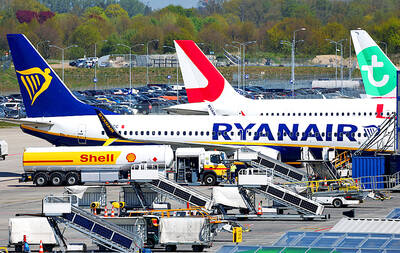
Ryanair, Transavia, Volotea and other low-cost airlines are feeling the financial pain from high jet fuel prices as a result of the Middle East war and are cutting flights. The closure of the Strait of Hormuz has taken a huge chunk of oil supplies off the market, sending the price of jet fuel soaring and triggering fears of shortages that could force airlines to cancel flights. Airlines are not waiting for a lack of supplies to react. “Travel alert: Airlines are cutting thousands of flights right now,” Travel Therapy host Karen Schaler said in an Instagram reel this past weekend.
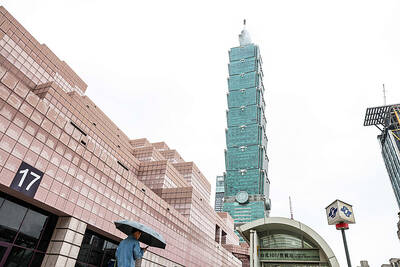
MANAGING RISKS: Taiwan has secured LNG sufficient to cover 95 percent of electricity demand for next month, UBS said, describing the government’s approach as proactive UBS Group AG has raised its forecast for Taiwan’s economic growth this year to 8 percent, up from 6.9 percent previously, and said expansion could reach as high as 8.6 percent if external energy shocks are avoided. The upgrade reflects a stronger-than-expected first-quarter performance and sustained momentum in artificial intelligence (AI)-driven exports, which UBS said are providing a firm foundation for growth despite geopolitical and energy risks. Taiwan’s GDP expanded 13.69 percent year-on-year in the first quarter, the fastest growth since the second quarter of 1987, the Directorate-General of Budget, Accounting and Statistics (DGBAS) reported on Thursday. On a seasonally
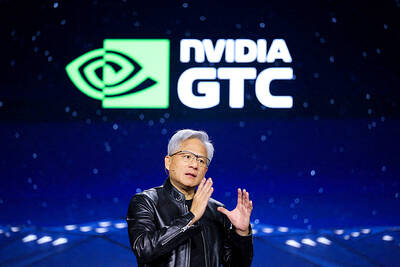
The list of Asian stocks that benefit from business partnership with Nvidia Corp is getting longer, as the region further integrates into the artificial intelligence (AI) chip giant’s business ecosystem. Just in the past week, South Korea’s LG Electronics Inc, Taiwan’s Nanya Technology Corp (南亞科技), as well as China’s Huizhou Desay SV Automotive Co (德賽西威) and Pateo Connect Technology Shanghai Corp (博泰車聯) have become the latest to rally on news of tie-ups, supply-chain participation or product collaboration with the US chip designer. Asian suppliers account for about 90 percent of Nvidia’s production costs, up from about 65 percent last year, data compiled

The Fair Trade Commission’s (FTC) ongoing review of Grab Holdings Ltd’s US$600 million acquisition of Foodpanda Taiwan’s operations, announced on March 23, has taken on fresh urgency as industry experts warn that the transaction could embed significant Chinese cybersecurity vulnerabilities into Taiwan’s digital infrastructure through Grab’s deep ties to autonomous-driving firm WeRide (文遠知行). Less than 16 months after the FTC blocked Uber Eats’ direct attempt to acquire Foodpanda Taiwan — citing potential combined market shares of 80 to 90 percent — the emergence of Grab as the buyer has prompted questions about whether the same competitive harm is simply being rerouted


 RSS
RSS