


At least US$50 million for the freedom of an Emirati sheikh: That is the king’s ransom paid two weeks ago to militants linked to al-Qaeda who are pushing to topple the Malian government and impose Islamic law.
Alongside a crippling fuel blockade, the Group for the Support of Islam and Muslims (JNIM) has made kidnapping wealthy foreigners for a ransom a pillar of its strategy of “economic jihad.”
Its goal: Oust the junta, which has struggled to contain Mali’s decade-long insurgency since taking power following back-to-back coups in 2020 and 2021, by scaring away investors and paralyzing the west African country’s economy. In June, the JNIM threatened to strike any foreign businesses and industries installed in Mali, as well as any enterprise doing business with the Malian government without its “authorization.”
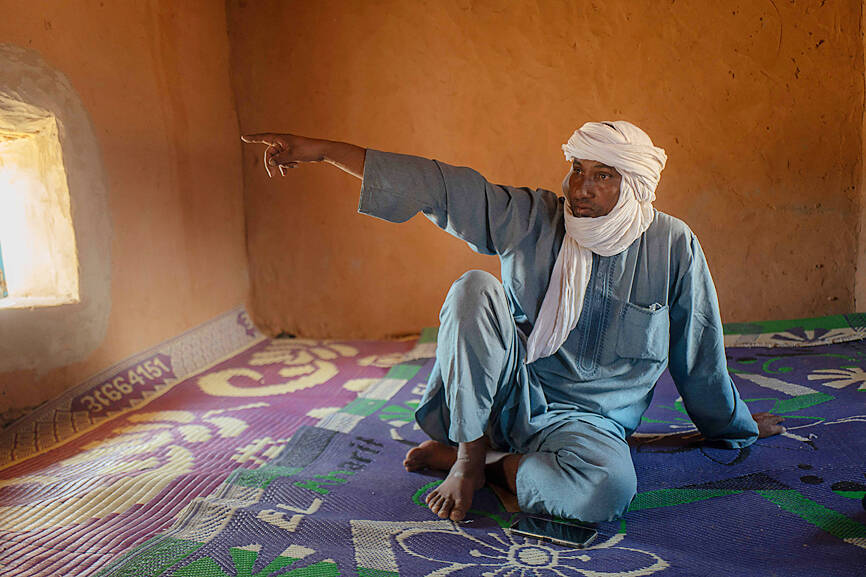
Photo: AFP
Since then the group — which hopes to cement its status as one of the most powerful of the militant factions to plague the region by expanding towards the Atlantic coast — has made good on its promise.
It has attacked and burnt tankers carrying vital fuel to landlocked Mali from the coasts of Senegal or Ivory Coast, launched assaults on factories and mines alike — and kidnapped more foreigners than ever before.
“Between May and October 2025, at least 22 foreign nationals have been abducted — roughly double the previous record of 13 in 2022,” said Heni Nsaibia, senior West Africa analyst for the ACLED conflict monitor.
Chinese, Indians, Egyptians, Emiratis and Iranians are all among the victims, together with a Serbian, a Croat and a Bosniak, Nsaibia added.
The JNIM demanded the US$50 million ransom after kidnapping a member of the United Arab Emirates royal family involved in the gold trade near the capital Bamako on Sept. 26, according to a source close to the negotiations and another Malian security source.
Two of his business partners, an Iranian and a Pakistani, were also abducted. A first sum of 400 million West African CFA Francs (US$702,400) was then sent to the militants in exchange for proof that the hostages were alive, the source close to the negotiations said.
The JNIM then freed the trio at the end of last month after a ransom of “US$50 million at least,” the source added.
That sum “represents the highest known ransom in the region and constitutes a major financial boost for [the JNIM],” Nsaibia said.
Who actually paid the ransom is unknown.
A Malian security source, who confirmed the exorbitant total, said JNIM also obtained “the release of around 30 of its prisoners” held by the Malian intelligence services.
“Malian soldiers were also released during the same exchange. It is an astounding deal in terms of its scale and the elements involved, especially in the current context,” the security source added.
For Rida Lyammouri, a researcher at the Policy Center for the New South, the ransom would allow the JNIM to “maintain its current level of military engagement, including the economic blockade on Bamako, for a prolonged period.”
“Such a haul will only serve to boost the JNIM’s ambitions to expand and establish a lasting presence in the Sahel and the coastal states of Africa,” Lyammouri added.
Liam Karr, an analyst at the Washington-based American Enterprise Institute (AEI), said that those “funds will help the group procure more weapons, such as commercial drones, explosives, and small arms, as well as pay salaries to fighters.”
The withdrawal of French troops in the wake of the coup has left a security vacuum exploited by the militants, which the junta’s new security partners — including Russia — have failed to fill, Lyammouri said.
The JNIM still holds several other hostages who, once ransomed, would swell its war chest even further. Most are abducted in the west of the country, where about 80 percent of Mali’s gold production is mined, according to the Soufan Centre consultancy.
At least 11 Chinese citizens have been abducted in western Mali in attacks on seven industrial sites, of which six were run by Chinese companies, according to the AEI think tank.
Just last week, five Indians working for an electricity company and an Egyptian were kidnapped in the same region.
“Targeting foreign nationals drives away foreign investment, undermining a key revenue stream for the Malian junta,” notably in the mining sector, Karr said.
With the JNIM’s grip tightening, the US and the UK announced two weeks ago that it was pulling out all non-essential personnel from Mali, while many embassies have urged their citizens to leave the country.
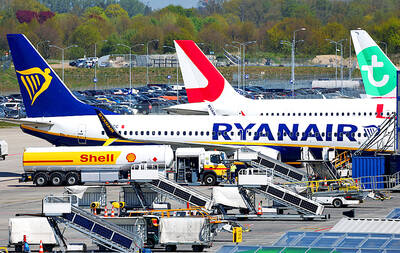
Ryanair, Transavia, Volotea and other low-cost airlines are feeling the financial pain from high jet fuel prices as a result of the Middle East war and are cutting flights. The closure of the Strait of Hormuz has taken a huge chunk of oil supplies off the market, sending the price of jet fuel soaring and triggering fears of shortages that could force airlines to cancel flights. Airlines are not waiting for a lack of supplies to react. “Travel alert: Airlines are cutting thousands of flights right now,” Travel Therapy host Karen Schaler said in an Instagram reel this past weekend.
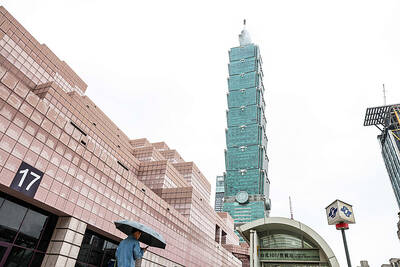
MANAGING RISKS: Taiwan has secured LNG sufficient to cover 95 percent of electricity demand for next month, UBS said, describing the government’s approach as proactive UBS Group AG has raised its forecast for Taiwan’s economic growth this year to 8 percent, up from 6.9 percent previously, and said expansion could reach as high as 8.6 percent if external energy shocks are avoided. The upgrade reflects a stronger-than-expected first-quarter performance and sustained momentum in artificial intelligence (AI)-driven exports, which UBS said are providing a firm foundation for growth despite geopolitical and energy risks. Taiwan’s GDP expanded 13.69 percent year-on-year in the first quarter, the fastest growth since the second quarter of 1987, the Directorate-General of Budget, Accounting and Statistics (DGBAS) reported on Thursday. On a seasonally

The list of Asian stocks that benefit from business partnership with Nvidia Corp is getting longer, as the region further integrates into the artificial intelligence (AI) chip giant’s business ecosystem. Just in the past week, South Korea’s LG Electronics Inc, Taiwan’s Nanya Technology Corp (南亞科技), as well as China’s Huizhou Desay SV Automotive Co (德賽西威) and Pateo Connect Technology Shanghai Corp (博泰車聯) have become the latest to rally on news of tie-ups, supply-chain participation or product collaboration with the US chip designer. Asian suppliers account for about 90 percent of Nvidia’s production costs, up from about 65 percent last year, data compiled
The Fair Trade Commission’s (FTC) ongoing review of Grab Holdings Ltd’s US$600 million acquisition of Foodpanda Taiwan’s operations, announced on March 23, has taken on fresh urgency as industry experts warn that the transaction could embed significant Chinese cybersecurity vulnerabilities into Taiwan’s digital infrastructure through Grab’s deep ties to autonomous-driving firm WeRide (文遠知行). Less than 16 months after the FTC blocked Uber Eats’ direct attempt to acquire Foodpanda Taiwan — citing potential combined market shares of 80 to 90 percent — the emergence of Grab as the buyer has prompted questions about whether the same competitive harm is simply being rerouted


 RSS
RSS