


The central bank yesterday cautioned that privately issued stablecoins could divert deposits from commercial banks and weaken monetary policy, even as it acknowledged the tokens’ potential role in broader payment and financial innovation.
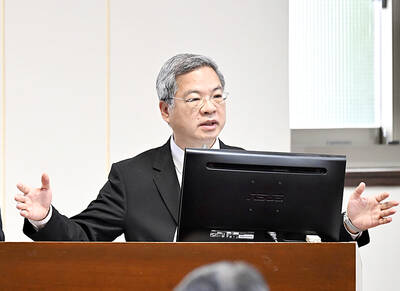
However, digital tokens are not expected to be widely used for day-to-day payments in Taiwan in the near term, central bank Deputy Governor Chu Mei-lie (朱美麗) told a meeting of the legislature’s Finance Committee.
Stablecoins are cryptocurrencies designed to maintain a stable value, usually by pegging their price to a fiat currency.
Photo: Chen Mei-ying, Taipei Times
If private stablecoins were legalized, issuers would be required to maintain reserves akin to electronic payment operators, including demand-deposit reserves and high-quality liquid assets, such as government bonds, at levels equal to or exceeding the value of tokens in circulation, Chu said.
Lawmakers raised concerns that allowing private entities to issue money-like instruments could pose risks to financial stability and erode the central bank’s control over money supply.
Chu said that funds could migrate from traditional bank deposits to stablecoin issuers, potentially weakening banks’ funding bases.
The broader monetary impact would depend on how the issuers deploy their funds — whether they remain within the banking system or are invested in bonds, securities or other financial assets, she added.
“Stablecoins could influence inflation, interest rates and the effectiveness of monetary policy,” Chu said.
The rise of private digital currency also raises concerns about monetary sovereignty, liquidity management and the central bank’s ability to steer the economy through conventional policy tools.
Taiwan is finalizing rules to regulate virtual-asset platforms and stablecoin issuers, reflecting a global push to tighten oversight of cryptocurrencies following high-profile token failures and instances of market volatility.
The US Congress enacted the Guiding and Establishing National Innovation for US Stablecoins Act, creating a federal framework for stablecoin regulation.
The Financial Supervisory Commission has indicated that existing banks should be the primary issuers of stablecoins, rather than leaving it to unregulated entities.
Cathay United Bank (國泰世華銀行), the lending arm of Cathay Financial Holding Co (國泰金控), said it is exploring the issuance of stablecoins, but emphasized that tokens must be interoperable across financial institutions to provide meaningful utility.
Major payment networks including Visa and Mastercard have already adopted stablecoin payments, bringing the digital tokens closer to being directly exchangeable with traditional currencies.
The developments highlight the rising significance of stablecoins in global finance, even as their domestic adoption in Taiwan is still being considered, the bank said.
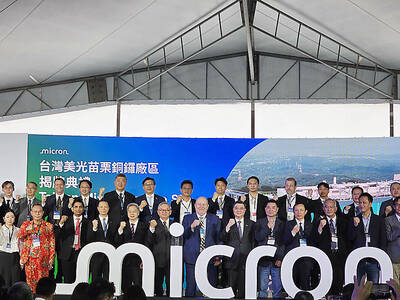
UNPRECEDENTED PACE: Micron Technology has announced plans to expand manufacturing capabilities with the acquisition of a new chip plant in Miaoli Micron Technology Inc unveiled a newly acquired chip plant in Miaoli County yesterday, as the company expands capacity to meet growing demand for advanced DRAM chips, including high-bandwidth memory chips amid the artificial intelligence boom. The plant in Miaoli County’s Tongluo Township (銅鑼), which Micron acquired from Powerchip Semiconductor Manufacturing Corp (力積電) for US$1.8 billion, is expected to make a sizeable capacity contribution to the company from fiscal 2028, the company said in a statement. It would be an extended production site of Micron’s large-scale manufacturing hub in Taichung, the company said. As the global semiconductor industry is racing to reach US$1 trillion
ABOVE LEGAL REQUIREMENT: The Ministry of Economic Affairs is prepared if LNG supply is disrupted, with more than the legal requirement of 11 days of inventory Taiwan has largely secured liquefied natural gas (LNG) supplies through May and arranged about half of June’s supply, Minister of Economic Affairs Kung Ming-hsin (龔明鑫) said yesterday. Since the Middle East conflict began on Feb. 28, Taiwan’s LNG inventories have remained more than 12 days, exceeding the legal requirement of 11 days, indicating no major supply concerns for domestic gas and electricity, Kung said at a meeting of the legislature’s Economics Committee in Taipei. The ministry aims to increase the figure to 14 days by the end of next year, he said. While one or two LNG or crude oil shipments for May

Singapore-based ride-hailing and delivery giant Grab Holdings Ltd has applied for regulatory approval to acquire the Taiwan operations of Germany-based Delivery Hero SE's Foodpanda in a deal valued at about US$600 million. Grab submitted the filing to the Fair Trade Commission on Friday last week, with the transaction subject to regulatory review and approval, the company said in a statement yesterday. Its independent governance structure would help foster a healthy and competitive market in Taiwan if the deal is approved, Grab said. Grab, which is listed on the NASDAQ, said in the filing that US-based Uber Technologies Inc holds about 13 percent of

Taiwan’s food delivery market could undergo a major shift if Singapore-based Grab Holdings Ltd completes its planned acquisition of Delivery Hero SE’s Foodpanda business in Taiwan, industry experts said. Grab on Monday last week announced it would acquire Foodpanda’s Taiwan operations for US$600 million. The deal is expected to be finalized in the second half of this year, with Grab aiming to complete user migration to its platform by the first half of next year. A duopoly between Uber Eats and Foodpanda dominates Taiwan’s delivery market, a structure that has remained intact since the Fair Trade Commission (FTC) blocked Uber Technologies Inc’s


 RSS
RSS