


Taiwan’s consumer price index (CPI) last month rose 1.25 percent from the same month last year, the slowest pace in four-and-a-half years and below the government’s 2 percent alert level for a fifth straight month, the Directorate-General of Budget, Accounting and Statistics (DGBAS) said yesterday.
DGBAS official Tsao Chih-hung (曹志弘) said that the moderation reflected favorable weather, tax cuts on new vehicle purchases and a high comparison base due to the timing of Mid-Autumn Festival last year.
“After the middle of August, stable weather conditions allowed for smooth vegetable replanting, easing food prices,” Tsao said. “Meanwhile, lower commodity taxes on newly purchased cars and aggressive discounting by automakers brought down costs.”
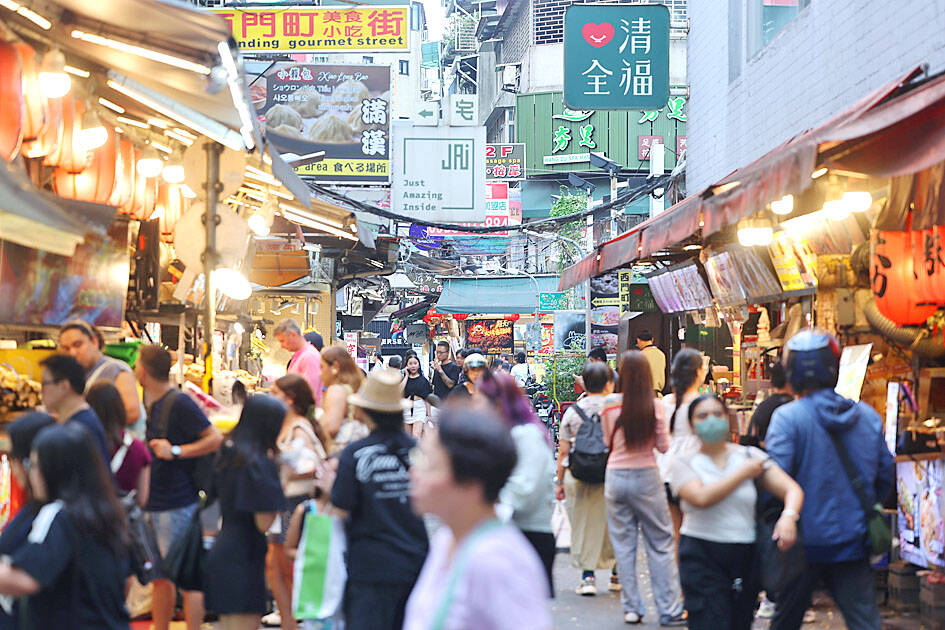
Photo: CNA
The timing of the Mid-Autumn Festival in September last year, which fell in October this year, also helped temper the annual increase, he said.
CPI this month is likely to remain at about the same level, as mild weather would offset upward pressure from higher electricity prices following a rate hike that took effect on Wednesday last week, he said.
The rate increase is expected to have only a minimal impact, adding about 0.01 percentage points to inflation and 0.04 percentage points next year, as the adjustments mainly target residential users and small businesses, Tsao said.
The latest power rate adjustments would likely add a negligible burden to small vendors of about NT$70 per month on average, he added.
Core CPI — the central bank’s preferred gauge that strips out energy, vegetables and other volatile items — rose 1.46 percent from a year earlier, the slowest growth in seven months, DGBAS data showed, suggesting subdued underlying price pressures.
Although Typhoon Ragasa struck last month, damage from the storm was largely confined to eastern Taiwan and caused limited agricultural losses, so prices were not affected much, Tsao said.
Still, prices of daily necessities continued their ascent. The CPI for key livelihood items climbed 2.47 percent, the sharpest increase in 18 months, driven by an 8.74 percent jump in pork prices and a 5.94 percent gain in egg prices.
Pork demand typically spikes ahead of the Ghost Festival, which this year was early last month, but has since eased, Tsao said.
Global conditions also point to continued price stability. Crude oil prices remain relatively low, while Taiwan’s import price index continues to fall, easing input costs for manufacturers, Tsao said.
The producer price index (PPI), a measure of the price movements of goods from a seller’s perspective, contracted 3.73 percent last month, dragged down by declines in chemical, petrochemical, metal and electronic components, the DGBAS said.
In the first nine months of this year, the CPI climbed 1.77 percent from a year earlier, while the PPI retreated 1.53 percent over the same period.

ENERGY ISSUES: The TSIA urged the government to increase natural gas and helium reserves to reduce the impact of the Middle East war on semiconductor supply stability Chip testing and packaging service provider ASE Technology Holding Co (日月光投控) yesterday said it planned to invest more than NT$100 billion (US$3.15 billion) in building a new advanced chip testing facility in Kaohsiung to keep up with customer demand driven by the artificial intelligence (AI) boom. That would be included in the company’s capital expenditure budget next year, ASE said. There is also room to raise this year’s capital spending budget from a record-high US$7 billion estimated three months ago, it added. ASE would have six factories under construction this year, another record-breaking number, ASE chief operating officer Tien Wu

The EU and US are nearing an agreement to coordinate on producing and securing critical minerals, part of a push to break reliance on Chinese supplies. The potential deal would create incentives, such as minimum prices, that could advantage non-Chinese suppliers, according to a draft of an “action plan” seen by Bloomberg. The EU and US would also cooperate on standards, investments and joint projects, as well as coordinate on any supply disruptions by countries like China. The two sides are additionally seeking other “like-minded partners” to join a multicountry accord to help create these new critical mineral supply chains, which feed into

For weeks now, the global tech industry has been waiting for a major artificial intelligence (AI) launch from DeepSeek (深度求索), seen as a benchmark for China’s progress in the fast-moving field. More than a year has passed since the start-up put Chinese AI on the map in early last year with a low-cost chatbot that performed at a similar level to US rivals. However, despite reports and rumors about its imminent release, DeepSeek’s next-generation “V4” model is nowhere in sight. Speculation is also swirling over the geopolitical implications of which computer chips were chosen to train and power the new
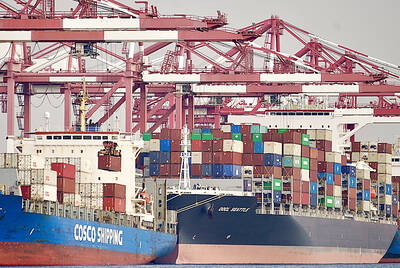
TECH WINNERS: Taiwan and South Korea reported robust trade, which suggests that they have critical advantages in the rapidly expanding AI supply chain, an official said Exports last month surged to a new high, as booming demand tied to artificial intelligence (AI) infrastructure fueled shipments of advanced technology components, underscoring the nation’s pivotal role in the global semiconductor supply chain. Outbound shipments climbed to US$80.18 billion, the highest ever for a single month, rising 61.8 percent from a year earlier and marking the 29th consecutive month of growth, the Ministry of Finance said yesterday. “The surge was driven primarily by global investment in AI infrastructure,” Department of Statistics Director-General Beatrice Tsai (蔡美娜) said. The mass production of next-generation AI computing systems has accelerated procurement across the semiconductor supply


 RSS
RSS