


A coalition of business groups on Friday warned US President Donald Trump that a newly announced US$100,000 fee for H-1B visa applications risks harming the US economy and urged the administration to avoid changes to the skilled worker program that impose added burdens on companies.
In a letter to Trump, about a dozen industry organizations representing chipmakers, software companies and retailers said the new fee threatens to crimp a crucial talent pipeline of foreign skilled workers and leave critical jobs unfilled.
“We ask the administration to work with industry on necessary reforms to the H-1B visa program without increasing the significant challenges US employers face recruiting, training, and retaining top talent,” the groups wrote.
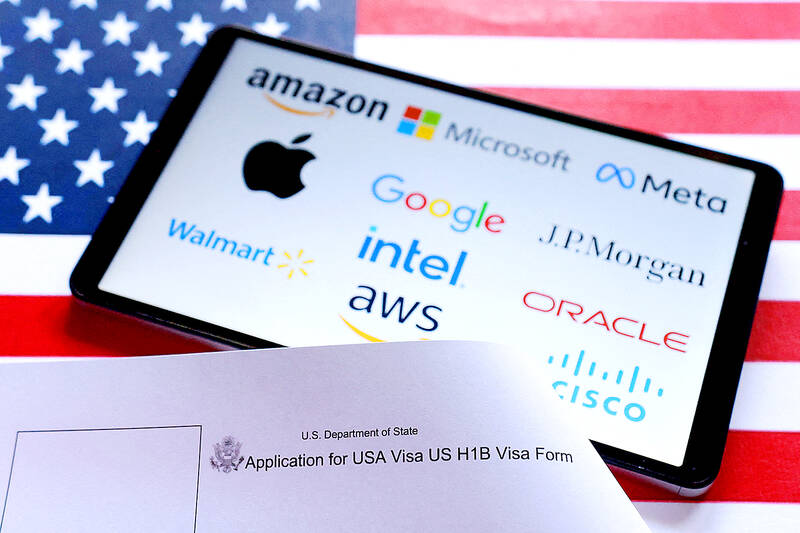
Photo: Reuters
Signers of the letter included the Business Software Alliance, the semiconductor industry association SEMI, the National Retail Federation, the Entertainment Software Association and the Information Technology Industry Council, according to a copy seen by Bloomberg News.
The industry groups’ objections marked a rare rebuke from the business community of US policy under the new administration. Trump last month announced the H-1B changes at the White House, heralding the US$100,000 fee as a way to rein in abuses in the skilled worker program while pushing US companies to turn more to domestic talent to fill jobs.
After Trump’s announcement, several major companies urged employees holding the visa not to leave the US.
White House spokesman Kush Desai defended the new H-1B policy, saying it would help US companies access top talent while reducing fallout from “fraudulent practices by bad-faith actors.”
“Widespread visa abuse not only undermines American workers, but undermines the companies” that need to recruit first-class talent, Desai said in a statement.
Higher costs from the new H-1B fees threaten to hammer a wide range of industries, from technology to healthcare to finance. Companies including Microsoft Corp, Amazon.com Inc and Walmart Inc have for years relied on the skilled worker program to bolster their ranks, and changes to the program put their talent pipelines at risk.
Cutting-edge sectors like artificial intelligence (AI) and biomedical engineering would need a high-skilled workforce to sustain their pace of growth in the US, the groups wrote.
The H-1B changes risk hurting progress in those key areas, the groups said.
“The new approach to H-1B visas, as it stands, will harm the administration’s goals to ensure the US remains a leader in AI, revitalizes manufacturing growth and propels US-developed energy,” they wrote.
Meanwhile, Trump’s H-1B visa changes on Friday faced their first major court challenge. A nurse-staffing agency and several unions sued the administration in federal court seeking to block the fee.
For hospitals, the H-1B program is crucial to recruiting doctors in rural areas hit by shortages of healthcare workers. The administration on Sept. 22 said that doctors could qualify for exemptions from the new fee.
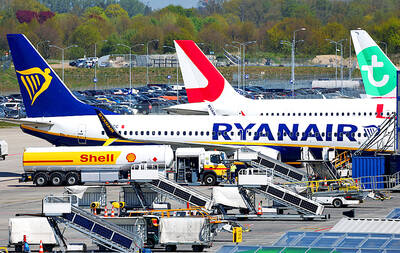
Ryanair, Transavia, Volotea and other low-cost airlines are feeling the financial pain from high jet fuel prices as a result of the Middle East war and are cutting flights. The closure of the Strait of Hormuz has taken a huge chunk of oil supplies off the market, sending the price of jet fuel soaring and triggering fears of shortages that could force airlines to cancel flights. Airlines are not waiting for a lack of supplies to react. “Travel alert: Airlines are cutting thousands of flights right now,” Travel Therapy host Karen Schaler said in an Instagram reel this past weekend.
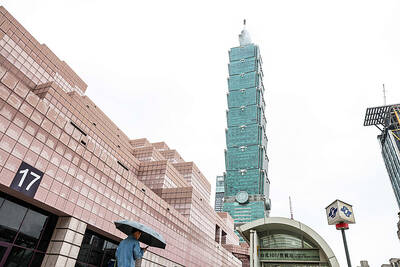
MANAGING RISKS: Taiwan has secured LNG sufficient to cover 95 percent of electricity demand for next month, UBS said, describing the government’s approach as proactive UBS Group AG has raised its forecast for Taiwan’s economic growth this year to 8 percent, up from 6.9 percent previously, and said expansion could reach as high as 8.6 percent if external energy shocks are avoided. The upgrade reflects a stronger-than-expected first-quarter performance and sustained momentum in artificial intelligence (AI)-driven exports, which UBS said are providing a firm foundation for growth despite geopolitical and energy risks. Taiwan’s GDP expanded 13.69 percent year-on-year in the first quarter, the fastest growth since the second quarter of 1987, the Directorate-General of Budget, Accounting and Statistics (DGBAS) reported on Thursday. On a seasonally

The Fair Trade Commission’s (FTC) ongoing review of Grab Holdings Ltd’s US$600 million acquisition of Foodpanda Taiwan’s operations, announced on March 23, has taken on fresh urgency as industry experts warn that the transaction could embed significant Chinese cybersecurity vulnerabilities into Taiwan’s digital infrastructure through Grab’s deep ties to autonomous-driving firm WeRide (文遠知行). Less than 16 months after the FTC blocked Uber Eats’ direct attempt to acquire Foodpanda Taiwan — citing potential combined market shares of 80 to 90 percent — the emergence of Grab as the buyer has prompted questions about whether the same competitive harm is simply being rerouted

The list of Asian stocks that benefit from business partnership with Nvidia Corp is getting longer, as the region further integrates into the artificial intelligence (AI) chip giant’s business ecosystem. Just in the past week, South Korea’s LG Electronics Inc, Taiwan’s Nanya Technology Corp (南亞科技), as well as China’s Huizhou Desay SV Automotive Co (德賽西威) and Pateo Connect Technology Shanghai Corp (博泰車聯) have become the latest to rally on news of tie-ups, supply-chain participation or product collaboration with the US chip designer. Asian suppliers account for about 90 percent of Nvidia’s production costs, up from about 65 percent last year, data compiled


 RSS
RSS